 格物
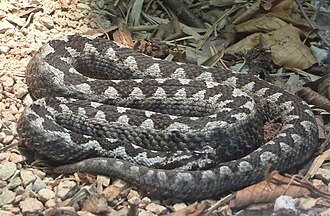
图:BS Thurner Hof · CC BY-SA 3.0 · Wikimedia Commons
- 学名
- Vipera ammodytes
- 分类等级
- 种
- 上级类群
- 蝰属
- 大类
- 爬行动物
- 命名
- 卡尔·林奈,1758 年
- 保护状况(IUCN)
- 无危物种
- 数据库
- NCBI 分类 · GBIF · IUCN 红色名录
百科正文
分类
它有五个亚种,此外一些文献还包含有亚种V. a. ruffoi(Bruno, 1968;分布于意大利阿尔卑斯山区),但大多数学者认为它和V. a. gregorwalineri是V. a. ammodytes的异名。V. a. transcaucasiana有时也被视为一个单独的种。
特征
全长可达95 cm(37.5英寸),但一般不超过85 cm(33.5英寸),而且其北方个体明显比南方个体要大。其平均长度在50—70 cm(19.5—27.5英寸)之间。
以上内容摘自维基百科「沙蝰」,按 CC BY-SA 4.0 使用,去掉了参考文献、外部链接等尾部小节,公式改写成了纯文本。全文、配图和出处见原文。
英文维基百科补充中文条目比较短,下面是英文条目「Vipera ammodytes」的原文
Vipera ammodytes, commonly known as horned viper, long-nosed viper, nose-horned viper, and sand viper, is a species of viper found in northern Italy, the Balkans, and parts of Asia Minor. Like all other vipers, it is venomous. It is reputed to be the most dangerous of the European vipers due to its large size, long fangs (up to 13 mm) and high venom toxicity. The specific name, ammodytes, is derived from the Greek words ammos, meaning "sand", and dutes, meaning "burrower" or "diver", despite its preference for rocky habitats. Five subspecies are currently recognized, including the nominate subspecies described here.
Common names
The common names that can be found for Vipera ammodytes in English are horned viper, long-nosed viper, nose-horned viper, sand viper, sand adder, common sand adder, common sand viper, and sand natter. In Bosnia and Herzegovina, Croatia, Montenegro, North Macedonia and Serbia, a common name used for this snake is poskok (поскок, lit. 'jumper'). In Greece, the common name used is ochia (οχιά).
Geographic range
North-eastern Italy, Slovenia, Croatia, Bosnia-Herzegovina, Serbia, Montenegro, Kosova, Albania, Macedonia, Greece (including Cyclades), southern Austria, Romania, Bulgaria, Turkey, Georgia and Syria.
The type locality is listed as "Oriente". Schwarz (1936) proposed that the type locality be restricted to "Zara" (Zadar, Croatia).
Reproduction
Before mating, the males of this species will engage in a combat dance, similar to adders. Mating takes place in the spring (April–May), and one to twenty live young are born in late summer or fall (August–October). At birth, juveniles are 14–24 cm (5.5–9.4 in) in total length. This species is ovoviviparous.
Conservation status
This species is listed as strictly protected (Appendix II) under the Berne Convention.
以上节选摘自英文维基百科「Vipera ammodytes」,按 CC BY-SA 4.0 使用,去掉了参考文献、外部链接等尾部小节,公式改写成了纯文本。篇幅所限,较长的小节只摘了开头一部分,有的小节没有收;全文、配图和出处见原文。