格物
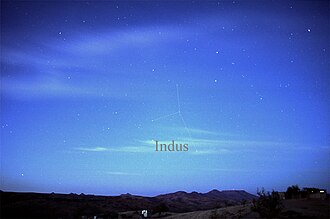
图:Till Credner · CC BY-SA 3.0 · Wikimedia Commons
- 类型
- 星座
- 发现 / 发明时间
- 1597 年
- 发现者 / 提出者
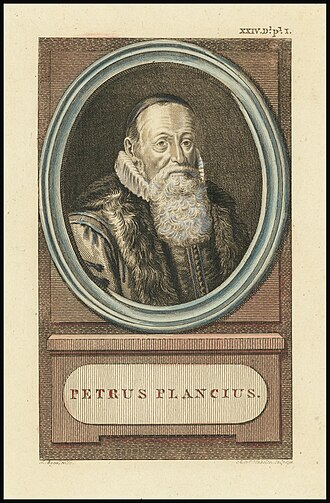
- 彼得勒斯·普朗修斯
- 命名来源
- 美洲原住民
- 属于
- 南天 (天球)
- 学科
- 天文学
相关科学家
百科正文
尽管该星座名为“印第安”,但并不一定意味着它是以印第安人命名的。它的确切起源尚不清楚,也可能代表马达加斯加或南非的土著居民。
特点
恒星
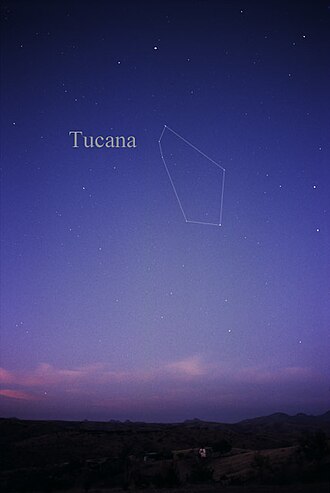
印第安座的亮星很少,没有亮于3等的恒星。印第安座α(波斯二,3.11等)是全星座最亮的恒星,距离地球101光年。印第安座ε(波斯七,4.69等)是距地球最近的天体之一,自行高,(11.82光年),有棕矮星伴星。这颗恒星是SETI计划的目标恒星之一。2640年,该恒星会移动到杜鹃座中。印第安座θ(波斯四)是印第安座的双星,主星亮度为4.5等,伴星亮度为6.9等。
星系
由于其赤纬极南,印第安座没有梅西耶天体。NGC 7038是位于印第安座的棒旋星系,是阿贝尔3742最亮的成员星系。NGC 7090是位于印第安座的棒旋星系,其星系盘正对着地球的视线。IC 5152是位于印第安座的不规则星系,位于本星系群的边缘。目前尚未确定它是否是本星系群的成员。从地球看去,IC 5152前方有一颗明亮的恒星,提升了观测该星系的难度。
超新星
2015年,超新星全天自动巡天(ASAS-SN)在发现了一颗名为ASAS-SN-15lh(又称SN 2015L)的超高光度超新星。它的亮度大约是以往发现的任何超新星的两倍。在亮度峰值时,其光度几乎是银河系的50倍。该超新星距离地球约38.2亿光年。
以上内容摘自维基百科「印第安座」,按 CC BY-SA 4.0 使用,去掉了参考文献、外部链接等尾部小节,公式改写成了纯文本。全文、配图和出处见原文。
英文维基百科补充中文条目比较短,下面是英文条目「Indus (constellation)」的原文
Indus is a constellation in the southern sky first professionally surveyed by Europeans in the 1590s and mapped on a globe by Petrus Plancius by early 1598. It was included on a plate illustrating southern constellations in Bayer's sky atlas Uranometria in 1603. It lies well south of the Tropic of Capricorn, but its triangular shape can be seen for most of the year from the Equator. It is elongated from north to south and has a complex boundary. The English translation of its name is given as the Indian, apparently representing an inhabitant of Madgascar or the East Indies.
Features
Indus lacks stars among the sky's brightest 100 stars in apparent magnitude. Its brightest stars are two of third magnitude and three of fourth magnitude.
Stars
Lacaille gave 18 stars Bayer designations Alpha through Rho in 1756, but omitted Xi, and labelled two stars as Kappa and Lambda. Lambda Indi (Lambda1 and Lambda2) were included in Pavo and the designations are no longer used. In 1879, Benjamin Gould renamed Nu Indi as Nu Microscopii as it turns out that it was situated into Microscopium and renamed as such, though today's Nu Indi now refers to HD 211988.
Alpha Indi, its brightest, is an orange giant of magnitude 3.1, 101 light-years away. Beta Indi is an orange giant of magnitude 3.7, 600 light-years distant. Delta Indi is a white star of magnitude 4.4, 185 light-years from Earth. The three form a near-perfect right-angled triangle, such that Beta marks the right angle and is in the south-east.
Epsilon Indi is one of the closest stars to Earth, approximately 11.8 light years away. It is an orange dwarf of magnitude 4.7, meaning that the yellow dwarf Sun is slightly hotter and larger. The system has been discovered to contain a pair of binary brown dwarfs, and has long been a prime candidate in SETI studies. This star has the third-highest proper motion of all visible to the unaided eye, as ranks behind Groombridge 1830 and 61 Cygni, and the ninth-highest overall. This will move the star into Tucana around 2640. It figures directly between Alpha and Beta.
Indus is home to one bright binary star. Theta Indi is a binary star divisible in small amateur telescopes, 97 light-years from Earth. Its primary is a white star of magnitude 4.5 and its secondary is a white star of magnitude 7.0. It figures close to the hypotenuse of the right-angled triangle of Alpha, Beta and Delta, the three brightest stars of Indus.
Variable stars
T Indi is the only bright variable star in Indus. It is a semi-regular, deeply coloured red giant with a period of 11 months, 1900 light-years away. Its minimum magnitude is 7 and its maximum: 5.
Galaxies
Galaxies include NGC 7038, NGC 7049, and NGC 7090. IC 5152 is a dwarf irregular galaxy lying at a distance of about 1.7 million parsec (5.5 million light years), at the edge of the Local Group, although it is not a certain member.
Supernovae
All Sky Automated Survey for SuperNovae (ASAS-SN) in 2015 detected a superluminous supernova, named ASASSN-15lh (also designated SN 2015L). Based on the study conducted by Subo Dong and team from the Kavli Institute for Astronomy and Astrophysics (KIAA) at Peking University, it was approximately doubly luminous to any supernova detected, and at peak was almost 50 times more intrinsically luminous than the Milky Way.
Its distance: approximately 3.82 gigalight-years, denoting an age approximately half that of the universe.
History
The constellation was first illustrated by Petrus Plancius, who made a fairly large celestial globe from the observations of Pieter Dirkszoon Keyser and Frederick de Houtman. The first depiction of this constellation in a celestial atlas followed in Johann Bayer's Uranometria of 1603. Plancius portrayed the figure as a nude male with three arrows in one hand and one in the other, as a native, lacking quiver and bow. It is among the twelve constellations introduced by Keyser and de Houtman, which first appeared on Plancius's celestial globe in 1598.
以上内容摘自英文维基百科「Indus (constellation)」,按 CC BY-SA 4.0 使用,去掉了参考文献、外部链接等尾部小节,公式改写成了纯文本。全文、配图和出处见原文。