格物
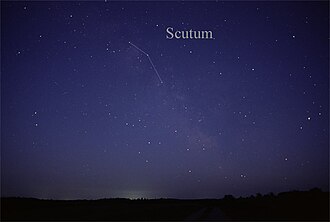
图:Till Credner · CC BY-SA 3.0 · Wikimedia Commons
- 类型
- 星座
- 发现 / 发明时间
- 1684 年
- 发现者 / 提出者
- 约翰·赫维留
- 命名来源
- 盾、约翰三世 (波兰)、维也纳之战
- 属于
- 南天 (天球)
- 学科
- 数学
相关科学家

百科正文
历史传说
盾牌座并无有关之神话故事,这星座代表了波兰国王约翰三世的"扬尼那纹章"。其名字和后发座一样和真实的历史人物有关。原来的名字Scutum Sobiescianum(苏比斯基之盾)是赫维留在1683年后期为了纪念维也纳之战中带领基督教军队的的波兰英雄和国王约翰三世而起的。
特点
盾牌座以天区面积计名列倒数第五,只占109平方度。它的亮星不多,其主星是盾牌座α, 视星等3.85. 银河穿越这个星座,盾牌座星云可于盾牌座的东北角边界找到。
深空天体
盾牌座包含几个疏散星团、一个球状星团及一个行星状星云。
当中两个疏散星团被收录于梅西尔天体列表,包括M11"野鸭星团"(NGC 6705)和M26星团(NGC 6694)。
盾牌座的东部可找到球状星团NGC 6712及行星状星云IC 1295,两者相距24弧秒
重要主星
资料来源:The Bright Star Catalogue, 5th Revised Ed., The Hipparcos Catalogue, ESA SP-1200
其他恒星
盾牌座UY - 一颗位于盾牌座的红特超巨星。 这颗恒星过去长期以来一直被人们认为是已知最大的恒星,但最新观测数据表明,这颗恒星的实际半径大约仅为太阳的755倍。
史蒂文森2-18 - 一颗位于盾牌座的红特超巨星。 它取代盾牌座UY成为目前已知最大的恒星,其测量的半径是太阳半径的2158倍。
外在链接
The Deep Photographic Guide to the Constellations: Scutum (页面存档备份,存于互联网档案馆)
以上内容摘自维基百科「盾牌座」,按 CC BY-SA 4.0 使用,去掉了参考文献、外部链接等尾部小节,公式改写成了纯文本。全文、配图和出处见原文。
英文维基百科补充中文条目比较短,下面是英文条目「Scutum (constellation)」的原文
Scutum is a small constellation. Its name is Latin for shield, and it was originally named Scutum Sobiescianum by Johannes Hevelius in 1684. Located just south of the celestial equator, its four brightest stars form a narrow diamond shape. It is one of the 88 IAU designated constellations defined in 1922.
History
Scutum was named in 1684 by Polish astronomer Johannes Hevelius (Jan Heweliusz), who originally named it Scutum Sobiescianum (Shield of Sobieski) to commemorate the victory of the Christian forces led by Polish King John III Sobieski (Jan III Sobieski) in the Battle of Vienna in 1683. Later, the name was shortened to Scutum.
Five bright stars of Scutum (α Sct, β Sct, δ Sct, ε Sct and η Sct) were previously known as 1, 6, 2, 3, and 9 Aquilae respectively.
The constellation of Scutum was adopted by the International Astronomical Union in 1922 as one of the 88 constellations covering the entire sky, with the official abbreviation of "Sct". The constellation boundaries are defined by a quadrilateral. In the equatorial coordinate system, the right ascension coordinates of these borders lie between 18h 21.6m and 18h 59.3m, while the declination coordinates are between −3.83° and −15.94°.
Coincidentally, the Chinese also associated these stars with battle armor, incorporating them into the larger asterism known as Tien Pien, i.e., the Heavenly Casque (or Helmet).
Features
Stars
Scutum is not a bright constellation, with the brightest star, Alpha Scuti, being a K-type giant star at magnitude 3.85. However, some stars are notable in the constellation. Beta Scuti is the second brightest at magnitude 4.22, followed by Delta Scuti at magnitude 4.72. It is also known as 6 Aquilae. Beta Scuti is a binary system, with the primary with a spectral type similar to the Sun, although it is 1,270 times brighter. Delta Scuti is a bluish white giant star, which is now coming at the direction of the Solar System. Within 1.3 million years it will come as close to 10 light years from Earth, and will be much brighter than Sirius by that time.
UY Scuti is a red supergiant and is also one of the largest stars currently known with a radius over 900 times that of the Sun. RSGC1-F01 is another red supergiant whose radius is over 1,450 times that of the Sun. Scutum contains several clusters of supergiant stars, including RSGC1, Stephenson 2 and RSGC3.
Deep-sky objects
Although not a large constellation, Scutum contains several open clusters, as well as a globular cluster and a planetary nebula. The two best known deep sky objects in Scutum are M11 (the Wild Duck Cluster) and the open cluster M26 (NGC 6694). The globular cluster NGC 6712 and the planetary nebula IC 1295 can be found in the eastern part of the constellation, only 24 arcminutes apart.
The most prominent open cluster in Scutum is the Wild Duck Cluster, M11. It was named by William Henry Smyth in 1844 for its resemblance in the eyepiece to a flock of ducks in flight. The cluster, 6200 light-years from Earth and 20 light-years in diameter, contains approximately 3000 stars, making it a particularly rich cluster. It is around 220 million years old, although some studies give older estimates. Estimates for the mass of the star cluster range from 3,700 M☉ to 11,000 M☉.
Space exploration
The space probe Pioneer 11 is moving in the direction of this constellation. It will not be near the closest star in this constellation for over a million years at its present speed, by which time its batteries will be long dead.
以上内容摘自英文维基百科「Scutum (constellation)」,按 CC BY-SA 4.0 使用,去掉了参考文献、外部链接等尾部小节,公式改写成了纯文本。全文、配图和出处见原文。