格物
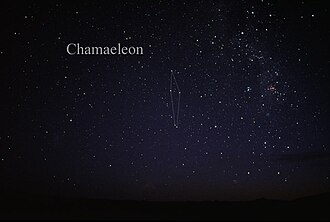
图:Till Credner · CC BY-SA 3.0 · Wikimedia Commons
- 类型
- 星座
- 发现 / 发明时间
- 1597 年
- 发现者 / 提出者
- 彼得勒斯·普朗修斯
- 命名来源
- 避役科
- 属于
- 南天 (天球)
- 学科
- 天文学
相关科学家

百科正文
星座神话
荷兰探险家彼得·德克斯宗·凯泽和弗雷德里克·德·豪特曼所创,代表变色龙。
深空天体
蝘蜓座δ星:这是一个两子星相距很宽的微弱双星,用裸眼可以看见,通过双筒望远镜可以看的更为清楚。双星中比较明亮的子星叫δ1,它本身又是一颗双星,它的两子星相距很近。
NGC 3195:这是一个行星状星云,从地球看上去是一个蓝色的圆盘。中央星星等的+15.3,用小型望远镜是看不见它的。
重要主星
小斗Little Dipper(极9)
以上内容摘自维基百科「蝘蜓座」,按 CC BY-SA 4.0 使用,去掉了参考文献、外部链接等尾部小节,公式改写成了纯文本。全文、配图和出处见原文。
英文维基百科补充中文条目比较短,下面是英文条目「Chamaeleon」的原文
Chamaeleon ( kə-MEE-lee-ən) is a small constellation in the deep southern sky. It is named after the chameleon, a kind of lizard. It was first defined in the end of the 16th century.
History
Chamaeleon was one of twelve constellations created by Petrus Plancius from the observations of Pieter Dirkszoon Keyser and Frederick de Houtman. It first appeared on a 35-cm diameter celestial globe published in 1597 (or 1598) in Amsterdam by Plancius and Jodocus Hondius. Johann Bayer was the first uranographer to put Chamaeleon in a celestial atlas. It was one of many constellations created by European explorers in the 15th and 16th centuries out of unfamiliar Southern Hemisphere stars.
Features
Stars
Lacaille gave 17 stars Bayer designations Alpha through Pi in 1756, but omitted Omicron and Xi, and labelled two stars as Delta, Mu and Pi. In 1879, Benjamin Gould included Lambda Chamaeleontis and Pi2 Chamaeleontis as part of Musca and the designations were no longer used.
There are four bright stars in Chamaeleon that form a compact diamond-shape approximately 10 degrees from the south celestial pole and about 15 degrees south of Acrux, along the axis formed by Acrux and Gamma Crucis. Alpha Chamaeleontis is a white-hued star of magnitude 4.1, 63 light-years from Earth. Beta Chamaeleontis is a blue-white hued star of magnitude 4.2, 271 light-years from Earth. Gamma Chamaeleontis is a red-hued giant star of magnitude 4.1, 413 light-years from Earth. The other bright star in Chamaeleon is Delta Chamaeleontis, a wide double star. The brighter star is Delta2 Chamaeleontis, a blue-hued star of magnitude 4.4. Delta1 Chamaeleontis, the dimmer component, is an orange-hued giant star of magnitude 5.5. They both lie about 350 light years away.
Chamaeleon is also the location of Cha 110913, a sub-brown dwarf or rogue planet with planets or moons (depending on classification).
Deep-sky objects
In 1999, a nearby open cluster was discovered centered on the star η Chamaeleontis. The cluster, known as either
the Eta Chamaeleontis cluster or Mamajek 1, is 8 million years old, and lies 316 light years from Earth.
The constellation contains a number of molecular clouds (the Chamaeleon dark clouds) that are forming low-mass T Tauri stars. The cloud complex lies some 400 to 600 light years from Earth, and contains tens of thousands of solar masses of gas and dust. The most prominent cluster of T Tauri stars and young B-type stars are in the Chamaeleon I cloud, and are associated with the reflection nebula IC 2631.
In wide-field optical images, the dark clouds of the Chamaeleon complex are visible as prominent obscuring structures spanning much of the constellation's area.
Chamaeleon contains one planetary nebula, NGC 3195, which is fairly faint. It appears in a telescope at about the same apparent size as Jupiter.
Equivalents
In Chinese astronomy, the stars that form Chamaeleon were classified as the Little Dipper (小斗; Xiǎodǒu) among the Southern Asterisms (近南極星區; Jìnnánjíxīngōu) by Xu Guangqi. Chamaeleon is sometimes also called the Frying Pan in Australia.
以上内容摘自英文维基百科「Chamaeleon」,按 CC BY-SA 4.0 使用,去掉了参考文献、外部链接等尾部小节,公式改写成了纯文本。全文、配图和出处见原文。