格物
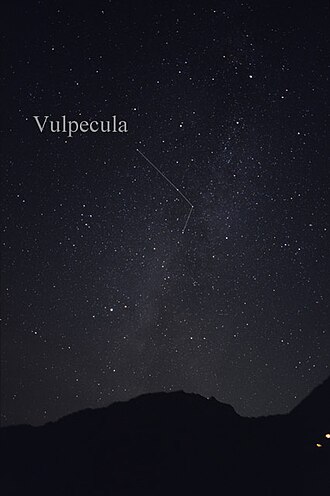
图:Till Credner · CC BY-SA 3.0 · Wikimedia Commons
- 类型
- 星座
- 发现 / 发明时间
- 1683 年
- 发现者 / 提出者
- 约翰·赫维留
- 属于
- 北天
- 学科
- 数学
相关科学家

百科正文
历史
这个微弱的星座位于银河一个明亮的区域,因此更加难以观测。1660年,波兰天文学家赫维留斯感觉这里应该设立一个星座。尽管这个区域看起来很不显眼,但使用双筒望远镜或小型望远镜可以发现这是一个有趣的天区。这里有一个梅西耶天体M27。
1967年10月,位于狐狸座的脉冲星PSR B1919+21由剑桥大学卡文迪许实验室的安东尼·休伊什教授的研究生——24岁的乔丝琳·贝尔检测射电望远镜收到的信号时无意中发现。这是人类有史以来发现的第一颗脉冲星。
深空天体
M27:对于使用小型望远镜的人,这可能是最好的行星状星云。因为它大而明亮,结构清楚。它的另外一个名称是哑铃星云,那是因为它的外表长而两端宽圆。使用3英寸(8厘米)望远镜可以看见它,尽管它全部的星云面貌只要使用14英寸(36厘米)或更大的望远镜才可见,它的星等是+8.1。
NGC 6830:这是一个由星等+11或更暗的星构成的小星团,越向中心越紧密。
NGC 6940:这个疏散星团的突出特征是6颗星等+9的恒星分布在一个细致的星团上,用6英寸(15厘米)或更大的望远镜能看到60-100颗恒星。
其他天体
Collinder 339:它也称为Brocchi星团或衣架星团,从地球看它与日常使用的衣架外形惊人的相似。Collinder 399是一个明亮的星协,使用双筒望远镜可见。如果使用6英寸(15厘米)或更大的望远镜就可以看见在衣架星团的东部狐狸座7的旁边,有一个微弱的疏散星团,那是NGC 6802,NGC 6802需使用8英寸(20厘米)或更大的望远镜才能看见单颗的恒星。
以上内容摘自维基百科「狐狸座」,按 CC BY-SA 4.0 使用,去掉了参考文献、外部链接等尾部小节,公式改写成了纯文本。全文、配图和出处见原文。
英文维基百科补充中文条目比较短,下面是英文条目「Vulpecula」的原文
Vulpecula is a faint constellation in the Northern Sky. Its name is Latin for "little fox", although it is commonly called simply the Fox. It was identified in the 17th century, and is located in the middle of the Summer Triangle (an asterism consisting of the bright stars Deneb, Vega and Altair).
Features
Stars
There are no stars brighter than 4th magnitude in this constellation. The brightest star in Vulpecula is Alpha Vulpeculae, a magnitude 4.44m red giant at an approximate distance of 291 light-years. The star is an optical binary (separation of 413.7") that can be split using binoculars. The star also carries the traditional name Anser, which refers to the goose the little fox holds in its jaws.
Instead of Beta, 23 Vulpeculae is the second-brightest star in the constellation.
In 1967, the first pulsar, PSR B1919+21, was discovered in Vulpecula by Jocelyn Bell, supervised by Antony Hewish, in Cambridge. While they were searching for scintillation of radio signals of quasars, they observed pulses which repeated with a period of 1.3373 seconds. Terrestrial origin of the signal was ruled out because the time it took the object to reappear was a sidereal day instead of a solar day. This anomaly was finally identified as the signal of a rapidly rotating neutron star. Fifteen years after the first pulsar was discovered, the first millisecond pulsar, PSR B1937+21, was also discovered in Vulpecula, only a few degrees in the sky away from PSR B1919+21.
Vulpecula is also home to HD 189733 b, one of the closest extrasolar planets studied by the now-retired Spitzer Space Telescope. On 11 July 2007, a team led by Giovanna Tinetti published the results of their observations using the Spitzer Space Telescope concluding there is solid evidence for significant amounts of water vapor in the planet's atmosphere. Although HD 189733b with atmospheric temperatures rising above 1,000 °C is far from being habitable, this finding increases the likelihood that water, an essential component of life, would be found on a more Earth-like planet in the future.
Also located in Vulpecula is soft gamma repeater SGR 1935+2154. In 2020 it emitted a fast radio burst, the first one to be observed in the Milky Way.
Deep-sky objects
The Dumbbell Nebula (M27) is a large, bright planetary nebula which was discovered by the French astronomer Charles Messier in 1764 as the very first object of its kind. It can be seen with good binoculars in a dark-sky location, appearing as a dimly glowing disk approximately 8 arcminutes in diameter. The nebula is approximately 9,800 years old. A telescope reveals its double-lobed shape, similar to that of an hourglass. Brocchi's Cluster (Collinder 399) is an asterism formerly thought to be an open cluster. It is also called "the Coathanger" because of its distinctive star pattern when viewed with binoculars or a low power telescope.
NGC 7052 is an elliptical galaxy in Vulpecula at a distance of 214 million light-years from Earth. It has a central dusty disk with a diameter of 3700 light-years; there is a supermassive black hole with a mass of 300 million solar masses in its nucleus. Astronomers surmise that the disk is the remnant of a smaller galaxy that merged with NGC 7052. Jets can be seen emanating from the galaxy, and it has very strong radio emissions. This means that it is also classified as a radio galaxy.
The eastern part of Vulpecula is occupied by the Hercules–Corona Borealis Great Wall. It is a galaxy filament, with the length of 3,000 megaparsecs, making it the largest known structure in the universe.
Stellar association
Vulpecula contains an OB-association of young stars, called the Vulpecula OB-association or Vul OB1. The association contains nearly 100 OB stars and over 800 young stellar objects. It lies in the galactic plane, at a distance of about 2,300 parsec. It contains the emission-line nebulae Sh-86, Sh-87 and Sh-88.
History
In the late 17th century, the astronomer Johannes Hevelius created Vulpecula. It was originally known as Vulpecula cum ansere ("the little fox with the goose") or Vulpecula et Anser ("the little fox and the goose"), and was illustrated with a goose in the jaws of a fox. Hevelius did not regard the fox and the goose to be two separate constellations, but later the stars were divided into a separate Anser and Vulpecula. Today, they have been merged again under the name of the fox, but the goose is remembered by the name of the star α Vulpeculae: Anser.
以上节选摘自英文维基百科「Vulpecula」,按 CC BY-SA 4.0 使用,去掉了参考文献、外部链接等尾部小节,公式改写成了纯文本。篇幅所限,较长的小节只摘了开头一部分,有的小节没有收;全文、配图和出处见原文。