格物
- 类型
- 定理
- 命名来源
- 约翰·彼得·古斯塔夫·勒热纳·狄利克雷
- 属于
- 数学定理列表
- 研究学科
- 丢番图逼近
- 学科
- 数学
相关科学家
百科正文
其中 [N] 表示 N 的整数部分。这是丢番图逼近的一个重要结果,表明任意实数都存在一系列良好的有理近似:事实上,该定理的一个直接结果是对于给定的无理数 α,存在无穷多个整数 p 和 q 满足不等式 (公式略)
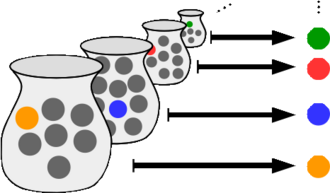
狄利克雷逼近定理可由鸽笼原理证明。
以上内容摘自维基百科「狄利克雷逼近定理」,按 CC BY-SA 4.0 使用,去掉了参考文献、外部链接等尾部小节,公式改写成了纯文本。全文、配图和出处见原文。
英文维基百科补充中文条目比较短,下面是英文条目「Dirichlet's approximation theorem」的原文
In number theory, Dirichlet's theorem on Diophantine approximation, also called Dirichlet's approximation theorem, states that for any real numbers α and N, with 1≤ N, there exist integers p and q such that 1≤ q≤ N and (公式略)
Here (公式略) represents the integer part of N.
This is a fundamental result in Diophantine approximation, showing that any real number has a sequence of good rational approximations: in fact an immediate consequence is that for a given irrational α, the inequality (公式略)
is satisfied by infinitely many integers p and q. This shows that any irrational number has irrationality exponent at least 2.
The Thue–Siegel–Roth theorem says that, for algebraic irrational numbers, the exponent of 2 in the corollary to Dirichlet's approximation theorem is the best we can do: such numbers cannot be approximated by any exponent greater than 2. The Thue–Siegel–Roth theorem uses advanced techniques of number theory, but many simpler numbers such as the golden ratio (1+√5)/2 can be much more easily verified to be inapproximable beyond exponent 2.
Simultaneous version
The simultaneous version of the Dirichlet's approximation theorem states that given real numbers α ₁,…,α _(d) and a natural number N then there are integers p₁,…,p_(d),q∈ Z,1≤ q≤ N such that (公式略)
Method of proof
Proof by the pigeonhole principle
This theorem is a consequence of the pigeonhole principle. Peter Gustav Lejeune Dirichlet who proved the result used the same principle in other contexts (for example, the Pell equation) and by naming the principle (in German) popularized its use, though its status in textbook terms comes later. The method extends to simultaneous approximation.
Proof outline: Let α be an irrational number and N be an integer. For every k=0,1,...,N we can write kα =mₖ+xₖ such that mₖ is an integer and 0≤ xₖ<1.
One can divide the interval [0,1) into N smaller intervals of measure 1/N. Now, we have N+1 numbers x₀,x₁,...,x_(N) and N intervals. Therefore, by the pigeonhole principle, at least two of them are in the same interval. We can call those xᵢ,xⱼ such that i<j. Now: |(j-i)α -(mⱼ-mᵢ)|=|jα -mⱼ-(iα -mᵢ)|=|xⱼ-xᵢ|<1/N
Dividing both sides by j-i will result in: (公式略)
And we proved the theorem.
Proof by Minkowski's theorem
Another simple proof of the Dirichlet's approximation theorem is based on Minkowski's theorem applied to the set (公式略)
Since the volume of S is greater than 4, Minkowski's theorem establishes the existence of a non-trivial point with integral coordinates. This proof extends naturally to simultaneous approximations by considering the set (公式略)
Related theorems
Legendre's theorem on continued fractions
In his Essai sur la théorie des nombres (1798), Adrien-Marie Legendre derives a necessary and sufficient condition for a rational number to be a convergent of the simple continued fraction of a given real number. A consequence of this criterion, often called Legendre's theorem within the study of continued fractions, is as follows:
Theorem. If α is a real number and p, q are positive integers such that (公式略), then p/q is a convergent of the continued fraction of α.
This theorem forms the basis for Wiener's attack, a polynomial-time exploit of the RSA cryptographic protocol that can occur for an injudicious choice of public and private keys (specifically, this attack succeeds if the prime factors of the public key n = pq satisfy p < q < 2p and the private key d is less than (1/3)n1/4).
以上内容摘自英文维基百科「Dirichlet's approximation theorem」,按 CC BY-SA 4.0 使用,去掉了参考文献、外部链接等尾部小节,公式改写成了纯文本。全文、配图和出处见原文。