格物
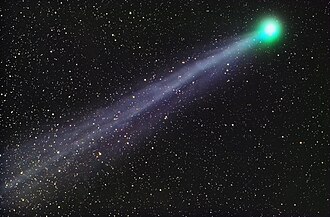
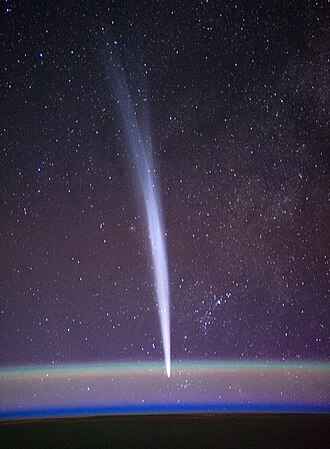
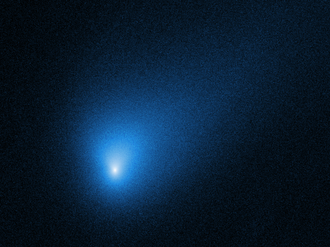
图:John Vermette · CC BY-SA 4.0 · Wikimedia Commons
- 发现 / 发明时间
- 2014 年
- 发现者 / 提出者
- 特里·洛弗乔伊
- 学科
- 天文学
相关科学家
百科正文
历史
2014年12月时,彗星的视星等大约为7.4,可以被双筒望远镜观测到。12月中旬时,彗星可以在漆黑的天空下用肉眼观测。12月18至19日,彗星穿过球状星团M79。2015年1月,它的视星等接近4,是继海尔-博普彗星之后最亮的彗星之一。1月7日,彗星距地球约0.469天文单位;1月9日经过天赤道,彗星在北半球清晰可见。1月30日彗星经过近日点,距离太阳1.29天文单位,此时它每秒会挥发出20吨水。
C/2014 Q2发源于奥尔特云,没有固定的轨道周期。1950年左右彗星进入柯伊伯带前,轨道周期约为11,000年,远日点距太阳995天文单位;2050年左右离开柯伊伯带后,轨道周期约为8,000年,远日点距太阳约800天文单位。
彗星运动时挥发出多种有机化合物,如乙醇和羟乙醛,目前已发现21种。这些分子说明在太阳系的形成与演化早期时,原始外围已存在多种有机小分子。
以上内容摘自维基百科「C/2014 Q2」,按 CC BY-SA 4.0 使用,去掉了参考文献、外部链接等尾部小节,公式改写成了纯文本。全文、配图和出处见原文。
英文维基百科补充中文条目比较短,下面是英文条目「C/2014 Q2 (Lovejoy)」的原文
C/2014 Q2 (Lovejoy) is a non-periodic comet discovered on 17 August 2014 by Terry Lovejoy using a 0.2-meter (8 in) Schmidt–Cassegrain telescope. It was discovered as a 15th-magnitude object in the southern constellation of Puppis. It is the fifth comet discovered by Terry Lovejoy.
Observational history
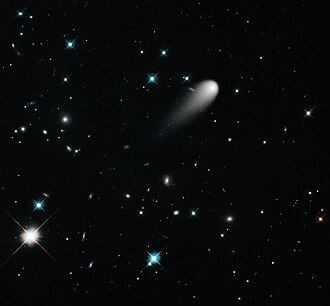
By December 2014, the comet had brightened to roughly magnitude 7.4, making it a small telescope and binoculars target. By mid-December, the comet was visible to the naked eye for experienced observers with dark skies and keen eyesight. On 28–29 December 2014, the comet passed 1/3° from globular cluster Messier 79. In January 2015, it brightened to roughly magnitude 4, and became one of the brightest comets located high in a dark sky since comet C/1995 O1 (Hale–Bopp) in 1997. On 7 January 2015, the comet passed 0.469 AU (70.2 million km; 43.6 million mi) from Earth. It crossed the celestial equator on 9 January 2015, becoming better seen from the Northern Hemisphere. The comet came to perihelion (closest approach to the Sun) on 30 January 2015, at a distance of 1.29 AU (193 million km; 120 million mi) from the Sun. At perihelion, its water production rate exceeded 20 metric tons per second.
Orbit
C/2014 Q2 originated from the Oort cloud, but is not a dynamically new comet. Before entering the planetary region (epoch 1950), C/2014 Q2 had an orbital period of about 11000 years, with an aphelion about 995 AU (148.8 billion km; 92.5 billion mi) from the Sun. After leaving the planetary region (epoch 2050), it will have an orbital period of about 8,000 years, with aphelion of about 800 AU.
Physical characteristics
Nucleus size and rotation
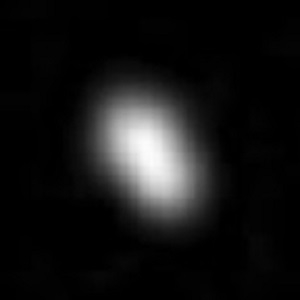
The nucleus of Comet Lovejoy was estimated to be 6.0 km (3.7 mi) in radius, with a rotation period that is completed once every 17.89±0.17 hours.
Chemical composition
The comet was observed to release 21 different organic molecules in gas, including ethanol and glycolaldehyde, a simple sugar. The presence of organic molecules suggests that they are preserved materials synthesized in the outskirts of the solar nebula or at earlier stages of the Solar System formation. The observed gas production rate from the comet was relatively high, estimated to be approximately 5×1029 molecules/sec, which caused the density of ionized water vapor to be effectively constant throughout its inner coma.
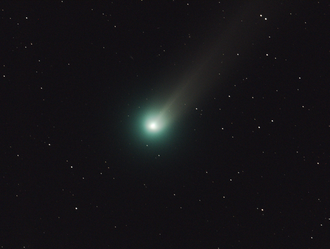
Its blue-green glow is the result of organic molecules (mostly diatomic carbon) and water released by the comet fluorescing under the intense UV and optical light of the Sun as it passes through space.
以上内容摘自英文维基百科「C/2014 Q2 (Lovejoy)」,按 CC BY-SA 4.0 使用,去掉了参考文献、外部链接等尾部小节,公式改写成了纯文本。全文、配图和出处见原文。