格物
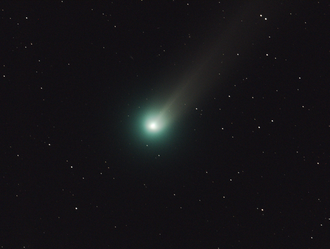
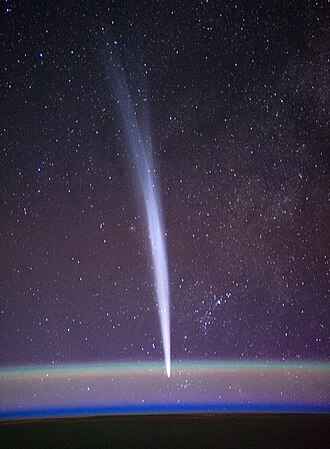
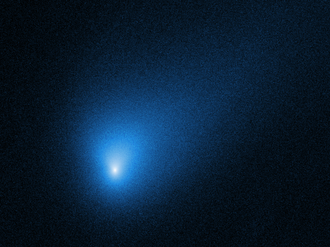
图:NASA/MSFC/MEO/Aaron Kingery · Public domain · Wikimedia Commons
- 发现 / 发明时间
- 2013 年
- 发现者 / 提出者
- 特里·洛弗乔伊
- 学科
- 天文学
相关科学家
百科正文
历史
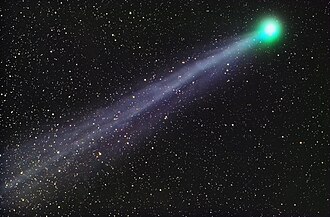
2013年11月1日,C/2013 R1用肉眼即可观测,此时它位于鬼宿星团,天球位置在木星和轩辕十四之间。此时若用双筒望远镜观测,彗星就像个绿色的、不可分辨的球状星团。
11月19日,彗星距地球0.3967天文单位,亮度最大,视星等约为4.5。11月27日,彗星位于猎犬座,靠近北斗七星勺柄的底部。11月28日至12月4日,彗星位于牧夫座,并于12月1日经过七公增五。12月4日至12月12日,彗星位于北冕座。
12月14日至次年1月14日,C/2013 R1位于武仙座,并于12月14日经过天纪二。2013年12月22日,彗星掠过近日点,距日0.81天文单位。此时若从地球上观测,距角为51度。2014年9月,彗星已暗到18等。
以上内容摘自维基百科「C/2013 R1」,按 CC BY-SA 4.0 使用,去掉了参考文献、外部链接等尾部小节,公式改写成了纯文本。全文、配图和出处见原文。
英文维基百科补充中文条目比较短,下面是英文条目「C/2013 R1 (Lovejoy)」的原文
C/2013 R1 (Lovejoy) is a non-periodic comet discovered on 7 September 2013 using a 0.2 m (7.9 in) Schmidt–Cassegrain telescope. It is the fourth comet discovered by Terry Lovejoy. It crossed the celestial equator on 14 October 2013, which made it better observed from the Northern Hemisphere.
Observational history
By 1 November 2013, the comet was visible to the naked eye near the Beehive Cluster (M44), about halfway between Jupiter and Regulus. It became more impressive than C/2012 S1 (ISON). In binoculars, the comet has the appearance of a green, unresolved globular cluster.
C/2013 R1 made its closest approach to Earth on 19 November 2013 at a distance of 0.3967 AU (59.35 million km), and reached an apparent magnitude of about 4.5. On 27 November 2013 the comet was in the constellation of Canes Venatici, near the bottom of the handle of the Big Dipper. From 28 November until 4 December 2013, the comet was in the constellation Boötes. On 1 December 2013 it passed the star Beta Boötis. From 4 December until 12 December 2013, the comet was in the constellation Corona Borealis.
From 12 December until 14 January 2014, the comet was in the constellation Hercules. On 14 December 2013, it passed the star Zeta Herculis. The comet came to perihelion (closest approach to the Sun) on 22 December 2013 at a distance of 0.81 AU (121,000,000 km; 75,000,000 mi) from the Sun. At perihelion, the comet had an elongation of 51 degrees from the Sun. By September 2014, the comet had faded to magnitude 18.
Physical characteristics
Chemical composition
Narrow-band spectroscopy of the comet in December 2013 revealed that the coma of C/2013 R1 has a relatively high abundance in H2O and CO2 molecules. Additional photometry from TRAPPIST until July 2014 determined that the detected organic compounds on its coma (OH, NH, CN, C3, and C2) were partly caused by the breakdown of HCN outgassing from the comet.
Infrared observations from the Keck Observatory detected enriched amounts of CO, as well as hydrocarbons like CH4, C2H6, and CH3OH, indicating the variability of chemicals found in other Oort cloud comets. Other complex organic compounds, such as HCOOH, CH3CHO, (CH2OH)2 and NH2CHO, were also detected from the comet.
Nucleus size and rotation
The nucleus of C/2013 R1 is estimated to be about 1.266±0.10 km in radius, with a low bulk density of roughly about 480±70 kg/m3. Measurements of the dust emission structures around the comet determined that it has a rotation period about 47.8±1.2 hours in length.
以上内容摘自英文维基百科「C/2013 R1 (Lovejoy)」,按 CC BY-SA 4.0 使用,去掉了参考文献、外部链接等尾部小节,公式改写成了纯文本。全文、配图和出处见原文。