格物
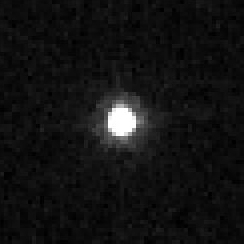
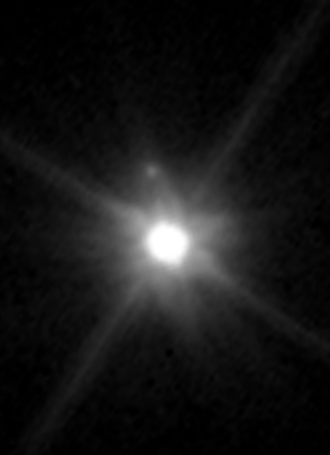
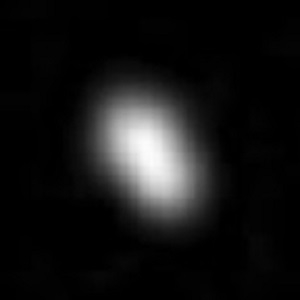
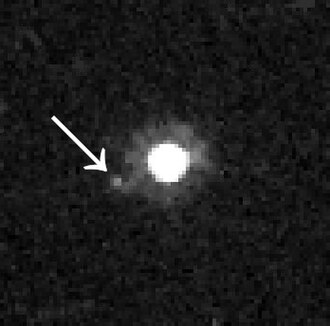
图:Hubble Space Telescope/Keith Noll · Public domain · Wikimedia Commons
- 类型
- 共振海王星外天体
- 发现 / 发明时间
- 2010 年
- 发现者 / 提出者
- 安杰依·乌戴斯基、斯科特·谢泼德、马尔钦·库比亚克 (天文学家)、查德·特鲁希略
- 命名来源
- 戴维娜
- 学科
- 天文学、物理学
相关科学家

百科正文
蕊神星由智利拉斯坎帕纳斯天文台的天文学家安杰伊·乌达尔斯基、斯科特·桑德·谢泼德、马尔钦·库比亚克和查德·特鲁希略于2010年3月13日发现。根据它的星等和假定反照率,估计它的直径约为470公里。该小行星以德娃娜命名,德娃娜是斯拉夫女神,掌管荒野、森林和狩猎,以纪念它是在乌达尔斯基领导的华沙大学光学重力透镜实验项目中被发现的。
距离
蕊神星每591年又4个月(215,992 天)绕太阳运行一次,距离为32.6至108.3 AU。它的轨道离心率为0.54,与黄道面的倾角为29°。目前它距离太阳39.1 AU,并将于2038年抵达近日点。一千万年的轨道整合显示,这个天体与海王星的共振数为2:7。
帕洛马山天文台的近地小行星追踪组于2002年拍摄了一张发现前的影像。这将蕊神星的观测弧延长到发现前的8年。自此之后,蕊神星在6个冲日上被观测了143次,其轨道品质为1。
物理性质
2010年,赫雪尔太空望远镜观察到蕊神星的热辐射,让天文学家得以估计其直径约为470公里。2019年5月17日,蕊神星的一次恒星掩星被观测到,得出的单弦直径为504公里。
在发现天文台用2.5米伊连·杜邦望远镜进行的光度测定获得了一条自转光变曲线,并于2013年5月发表。光线曲线显示自转周期为7.07±0.05小时;亮度变化为0.12等级
美国天文学家麦克·布朗于2012年3月使用凯克望远镜进行观测,但没有发现卫星。因此目前无法确定蕊神星的质量。
以上内容摘自维基百科「小行星471143」,按 CC BY-SA 4.0 使用,去掉了参考文献、外部链接等尾部小节,公式改写成了纯文本。全文、配图和出处见原文。
英文维基百科补充中文条目比较短,下面是英文条目「471143 Dziewanna」的原文
471143 Dziewanna (provisional designation 2010 EK139) is a trans-Neptunian object in the scattered disc, orbiting the Sun in the outermost region of the Solar System.
Dziewanna was discovered on 13 March 2010 by astronomers Andrzej Udalski, Scott Sheppard, Marcin Kubiak and Chad Trujillo at the Las Campanas Observatory in Chile. Based on its absolute magnitude and its albedo, it is estimated to have a diameter of approximately 433 kilometers.
Observation history
Discovery
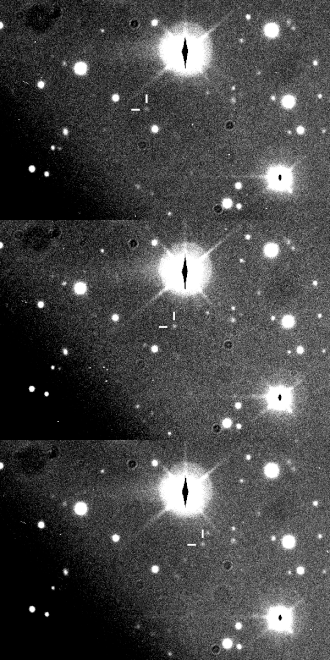
Dziewanna was discovered on 13 March 2010 by Andrzej Udalski, Scott S. Sheppard, Marcin Kubiak, and Chad Trujillo using the 1.3-meter Warsaw telescope at Las Campanas Observatory in Chile. The object was reobserved on 5 April 2010 by the discoverers and on 8 April 2010 by amateur astronomer Jennie McCormick at Farm Cove Observatory in Auckland, New Zealand. The discovery of Dziewanna was announced by the Minor Planet Center on 8 April 2010, although the number of observations was not sufficient to accurately determine the object's orbit. Two hours after the discovery announcement, Andrew Lowe reported precovery observations of Dziewanna in Palomar Observatory's Near-Earth Asteroid Tracking survey images from 2002 and 2003, which revealed that the object followed a highly eccentric orbit around the Sun.
Observations and precoveries
A precovery image was taken by the Near-Earth Asteroid Tracking at Palomar Observatory in 2002. This extends Dziewanna's observation arc to 8 years prior to discovery. It has since been observed 143 times over 6 oppositions and has an orbit quality of 1.
Nomenclature
On 25 September 2018, it was named after Devana (Polish form: Dziewanna), a Slavic goddess of the wilderness, forests and the hunt, in honor of the fact that it was discovered during the Polish Optical Gravitational Lensing Experiment of Warsaw University, which was led by Udalski.
Orbit and classification
Orbital characteristics
Dziewanna orbits the Sun at a distance of 32.6 to 108.3 AU once every 591 years and 4 months (215,992 days). Its orbit has an eccentricity of 0.54 and an inclination of 29° with respect to the ecliptic. It is currently 33.9 AU from the Sun and will reach perihelion in 2038. In 2033 it will have a very southernly declination of –53°.
Classification
A ten-million-year integration of the orbit shows that this object is in a 2:7 resonance with Neptune.
Dziewanna also belongs to the scattered disc, which is a population of TNOs that have distant, inclined, and eccentric orbits that come close to Neptune at perihelion.
The scattered disc population, which includes the dwarf planets Eris and Gonggong, are strongly influenced by Neptune's gravitational perturbations and consequently experience gravitational scattering.
Physical characteristics
Size and albedo
Dziewanna's shape is unknown. In 2010, the thermal radiation of Dziewanna was observed by the Herschel Space Telescope, which allowed astronomers to estimate its albedo at 0.25+0.02−0.05, and its diameter at about 470 km (290 mi). A stellar occultation by Dziewanna was observed on 17 May 2019, yielding a minimum length of 504 km (313 mi) for the longest axis, based on a single chord. A 2019 study using thermal measurements to derive an albedo of 0.297+0.113−0.078, and a diameter of approximately 433+63−64 km.
Surface and spectra
According to Benecchi and Sheppard, Dziewanna's color indices are: g′−r′ 0.80 ± 0.02, g′−i′ 1.13 ± 0.01, and r′−i′ 0.33 ± 0.02. According to the SsODNet, its g-r is 0.464+0.023−0.023, and its albedo is 0.1918+0.0286−0.0084. Its albedo according to Pál and colleagues, is 0.25+0.02−0.05.
Rotation and light curves
A rotational lightcurve was obtained from photometric observations at the discovering observatory, with the 2.5-meter Irénée du Pont Telescope, and published in May 2013. The lightcurve shows that the rotation period is 7.07±0.05 hours; the variation in brightness is of magnitude 0.12 (U=2).
Unknown mass
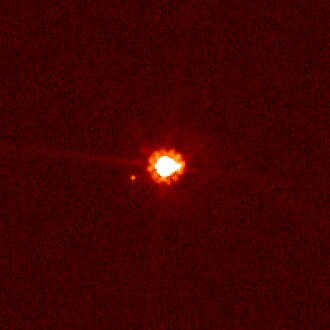
Observations by American astronomer Michael Brown at the Keck telescope in March 2012 failed to find a satellite. There is therefore currently no means to determine Dziewanna's mass. A 2021 study by Muñoz-Gutiérrez assumed a mass of 3.225×10¹⁹ kg for Dziewanna. However, the true mass still remains unknown currently.
以上内容摘自英文维基百科「471143 Dziewanna」,按 CC BY-SA 4.0 使用,去掉了参考文献、外部链接等尾部小节,公式改写成了纯文本。全文、配图和出处见原文。