格物
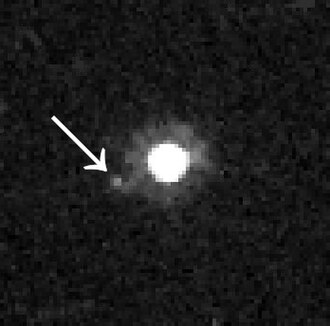
图:Kwamikagami · CC BY-SA 4.0 · Wikimedia Commons
- 类型
- 小行星卫星
- 发现 / 发明时间
- 2006 年
- 发现者 / 提出者
- 迈克尔·E·布朗、Terry-Ann Suer
- 命名来源
- Weywot
- 学科
- 天文学
相关科学家

百科正文
发现
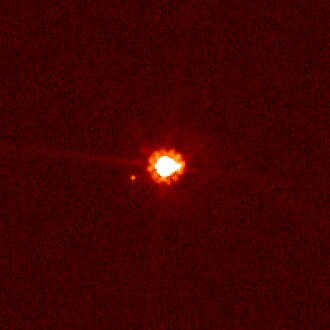
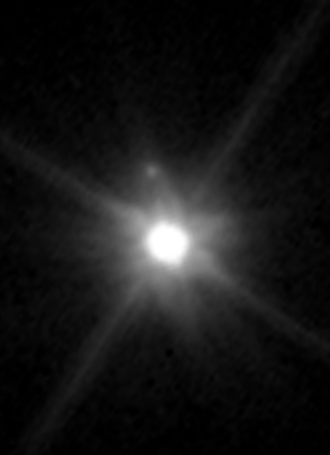
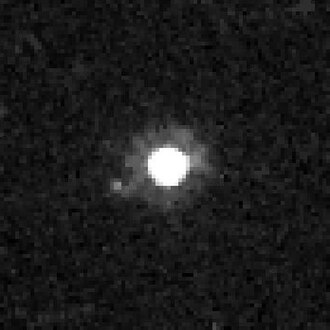
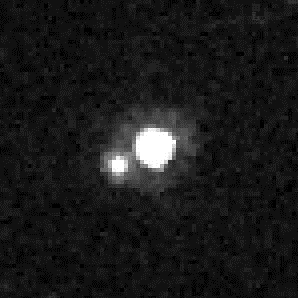
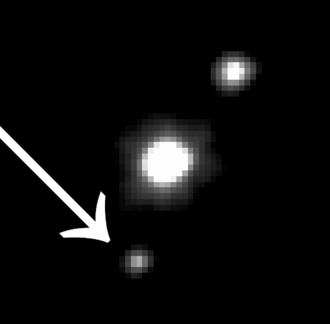
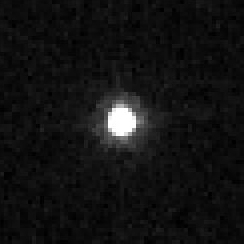
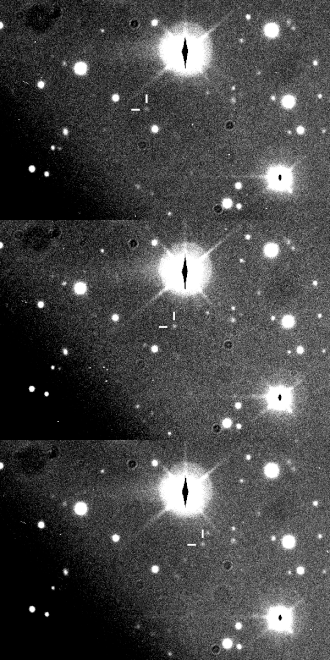
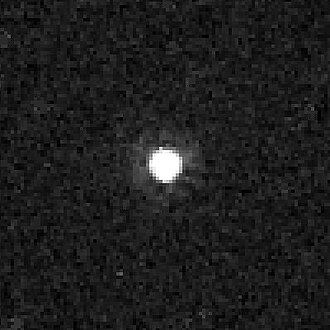
米高·布朗根据2006年2月14日所拍摄的照片发现创卫一,于2007年2月22日宣布发现消息。
性质
创卫一在距离创神星0.35角秒的位置被天文学家所发现,视星等比创神星还暗5.6等。创卫一环绕在距离创神星13329公里的轨道,轨道偏心率约为0.11。假设创卫一反射率和密度与创神星相等,则创卫一的直径约为165公里。然而,一项基于2023年掩星再分析的2026年研究估计,更准确的体积当量直径为146公里。
米高·布朗认为它很可能是创神星遭到碰撞后遗留的碎片,他推测它的冰幔因此随之消失。天文学家估计创卫一的质量只有2.4+1.2−1.1×10¹⁸ 公斤。
以上内容摘自维基百科「創衛一」,按 CC BY-SA 4.0 使用,去掉了参考文献、外部链接等尾部小节,公式改写成了纯文本。全文、配图和出处见原文。
英文维基百科补充中文条目比较短,下面是英文条目「Weywot」的原文
Weywot (formal designation (50000) Quaoar I) is the only confirmed moon of the trans-Neptunian dwarf planet Quaoar. It was discovered by Michael Brown and Terry-Ann Suer using images taken by the Hubble Space Telescope on 14 February 2006. It is named after the Tongva sky god and son of Quaoar.
Weywot is an elongated body with an average diameter of 146 km (91 mi). It has an extremely dark, water ice-rich surface with an albedo of about 0.04, making it one of the darkest known moons beyond Neptune. Weywot follows a nearly circular orbit around Quaoar, revolving every 12.4 days at an average distance of 13,300 km (8,300 mi). It is thought to play a role in maintaining Quaoar's outer ring by gravitationally influencing it in an orbital resonance.
Observational history
Discovery
Weywot was first imaged by the Hubble Space Telescope on 14 February 2006, during Michael Brown's survey for satellites around large trans-Neptunian objects (TNOs) using Hubble's high-resolution Advanced Camera for Surveys. Consecutive images from that date showed that Weywot appeared stationary relative to Quaoar and was visibly separated at an angular distance of 0.35 arcseconds. After Brown's Hubble survey concluded in late 2006, he and his colleague Terry-Ann Suer reported their newly discovered TNO satellites to the Central Bureau for Astronomical Telegrams, which published their discovery of Weywot alongside the three TNO satellites Vanth, Tinia, and the nameless moon of 208996 Achlys on 22 February 2007.
To determine Weywot's orbit, Brown reobserved it with Hubble in March 2007 and March 2008. Together with his colleague Wesley Fraser, Brown published the first preliminary orbit of Weywot in May 2010. Fraser and Brown were unable to precover Weywot in earlier ultraviolet Hubble images from 2002, either because the satellite was obscured by Quaoar or it was too faint in ultraviolet light.
Name
Weywot was not assigned a provisional designation when its discovery was announced. Brown left the choice of a name up to the Tongva, whose creator-god Quaoar had been named after. The Tongva chose the sky god Weywot, son of Quaoar. The name of Weywot was officially announced by the Minor Planet Center in a notice published on 4 October 2009.
Physical characteristics
Size, shape, and rotation
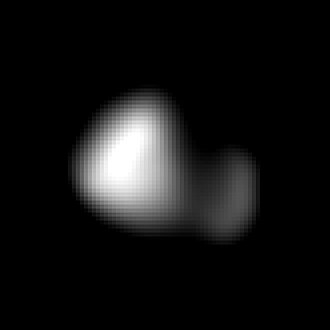
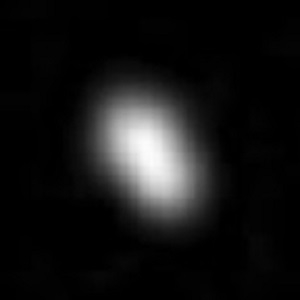
Weywot is the largest moon of Quaoar, having a mean diameter of 146 ± 10 km (90.7 ± 6.2 mi). It has an elongated and flattened shape, approximately a triaxial ellipsoid with dimensions of 164 km × 146 km × 130 km (102 mi × 91 mi × 81 mi). This shape does not match that expected for a tidally-distorted body in hydrostatic equilibrium, meaning Weywot must have a somewhat rigid, possibly rubble pile interior structure.
Due to its elongated shape, Weywot's apparent brightness fluctuates with a peak-to-trough amplitude of 0.119±0.036 magnitudes as it rotates in Earth's point of view. Weywot's brightness varies with the same period as its orbit around Quaoar, which indicates that the moon is tidally locked to the dwarf planet. This agrees with theoretical predictions that Weywot should become tidally locked to Quaoar within 150 million years after its formation.
Weywot appears extremely faint from Earth, having an apparent magnitude of about 24.5 in visible light. This makes it approximately 5.6 magnitudes or 170 times fainter than Quaoar in visible light.
Orbit
Weywot orbits Quaoar at an average distance of 13,300 km (8,300 mi) and takes 12.4 days to complete one revolution. Its orbit is slightly inclined relative to Quaoar's rings (and presumably Quaoar's equator) at an angle of approximately 6°, and is nearly circular with an eccentricity of approximately 0.01. The moon's orbit also exhibits apsidal precession at a rate of 0.48+0.24−0.21 deg/yr and nodal precession at a rate of −0.49+0.21−0.24 deg/yr.
Influence on the Quaoar system
Quaoar has two known rings that lie very close to Weywot's mean-motion orbital resonances (MMRs), where their orbital periods are fractions of Weywot's. These rings, named Q2R and Q1R, orbit Quaoar at distances of approximately 2,530 and 4,100 km (1,570 and 2,550 mi), respectively. The inner edge of Q1R is bounded by Weywot's 6:1 MMR at 4,035 km (2,507 mi), while the outer edge of Q2R is bounded by Weywot's much weaker 12:1 MMR at 2,543 km (1,580 mi). Both rings also are bounded by spin-orbit resonances with Quaoar, and those together with Weywot's MMRs are believed to play a role in keeping the rings narrow.
以上节选摘自英文维基百科「Weywot」,按 CC BY-SA 4.0 使用,去掉了参考文献、外部链接等尾部小节,公式改写成了纯文本。篇幅所限,较长的小节只摘了开头一部分,有的小节没有收;全文、配图和出处见原文。