格物
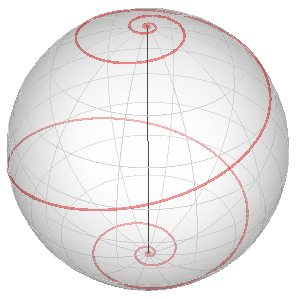
图:Alva2004 · CC BY-SA 4.0 · Wikimedia Commons
- 发现 / 发明时间
- 1537 年
- 发现者 / 提出者
- 佩德罗·努内斯
- 学科
- 数学
- 上级概念
- 螺线
相关科学家
百科正文
英文维基百科补充中文条目比较短,下面是英文条目「Rhumb line」的原文
In navigation, a rhumb line (also rhumb or loxodrome) is an arc crossing all meridians of longitude at the same angle. It is a path of constant azimuth relative to true north, which can be steered by maintaining a course of fixed bearing.
- The rhumb line is, in general, not the
- shortest route to the destination; that is given by the
- great circle. However, it is possible to follow a
- rhumb line using only a magnetic compass (accounting for the
magnetic declination) or a celestial determination of true north.
The course of a rhumb line is given by a straight line in the
Mercator projection. This is a defining property of this projection.
Introduction
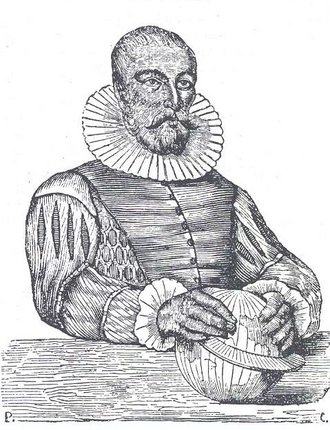
The effect of following a rhumb line course on the surface of a globe was first discussed by the Portuguese mathematician Pedro Nunes in 1537, in his Treatise in Defense of the Marine Chart, with further mathematical development by Thomas Harriot in the 1590s.
A rhumb line can be contrasted with a great circle, which is the path of shortest distance between two points on a sphere. On a great circle, the bearing to the destination point does not remain constant. If one were to drive a car along a great circle one would hold the steering wheel fixed, but to follow a rhumb line one would have to turn the wheel, turning it more sharply as the poles are approached. In other words, a great circle is locally "straight" with zero geodesic curvature, whereas a rhumb line has non-zero geodesic curvature.
Etymology and historical description
The word loxodrome comes from Ancient Greek λοξός loxós: "oblique" + δρόμος drómos: "running" (from δραμεῖν drameîn: "to run"). The word rhumb may come from Spanish or Portuguese rumbo/rumo ("course" or "direction") and Greek ῥόμβος rhómbos, from rhémbein.
The 1878 edition of The Globe Encyclopaedia of Universal Information describes a loxodrome line as:
Loxodrom′ic Line is a curve which cuts every member of a system of lines of curvature of a given surface at the same angle. A ship sailing towards the same point of the compass describes such a line which cuts all the meridians at the same angle. In Mercator's Projection (q.v.) the Loxodromic lines are evidently straight.
A misunderstanding could arise because the term "rhumb" had no precise meaning when it came into use.
Mathematical description
For a sphere of radius 1, the azimuthal angle λ, the polar angle −π/2 ≤ φ ≤ π/2 (defined here to correspond to latitude), and Cartesian unit vectors i, j, and k can be used to write the radius vector r as r (λ,φ)=(cos λ · cos φ)i +(sin λ · cos φ)j +(sin φ)k.
Orthogonal unit vectors in the azimuthal and polar directions of the sphere can be written (公式略)
which have the scalar products (公式略)
λ̂ for constant φ traces out a parallel of latitude, while φ̂ for constant λ traces out a meridian of longitude, and together they generate a plane tangent to the sphere.
The unit vector (公式略)
has a constant angle β with the unit vector φ̂ for any λ and φ, since their scalar product is (公式略)
Application
Its use in navigation is directly linked to the style, or projection of certain navigational maps. A rhumb line appears as a straight line on a Mercator projection map.
The name is derived from Old French or Spanish respectively: "rumb" or "rumbo", a line on the chart which intersects all meridians at the same angle. On a plane surface this would be the shortest distance between two points. Over the Earth's surface at low latitudes or over short distances it can be used for plotting the course of a vehicle, aircraft or ship. Over longer distances and/or at higher latitudes the great circle route is significantly shorter than the rhumb line between the same two points.
Generalizations
On the Riemann sphere
The surface of the Earth can be understood mathematically as a Riemann sphere, that is, as a projection of the sphere to the complex plane. In this case, loxodromes can be understood as certain classes of Möbius transformations.
Spheroid
The formulation above can be easily extended to a spheroid. The course of the rhumb line is found merely by using the ellipsoidal isometric latitude. In formulas above on this page, substitute the conformal latitude on the ellipsoid for the latitude on the sphere. Similarly, distances are found by multiplying the ellipsoidal meridian arc length by the secant of the azimuth.
以上节选摘自英文维基百科「Rhumb line」,按 CC BY-SA 4.0 使用,去掉了参考文献、外部链接等尾部小节,公式改写成了纯文本。篇幅所限,较长的小节只摘了开头一部分,有的小节没有收;全文、配图和出处见原文。