格物

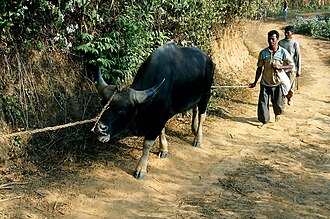
图:travelwayoflife · CC BY-SA 2.0 · Wikimedia Commons
- 学名
- Bos grunniens
- 分类等级
- 种
- 上级类群
- 牛属
- 大类
- 哺乳动物
- 命名
- 卡尔·林奈,1766 年
- 用途
- Yak racing
- 数据库
- NCBI 分类 · GBIF
百科正文
起源
牦牛起源于青藏高原。在更新世冰期,牦牛曾扩散至中国华北、西伯利亚东部和亚洲中北部地区。
分类
现存牦牛包括两个亚种:
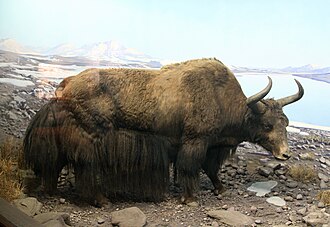
野牦牛(Bos grunniens mutus):原生亚种,体型庞大,具有粗壮的犄角,通常生性凶猛,适应在野外生存。数量不足1.5万头。
家牦牛(Bos grunniens grunniens):驯化亚种,体型较小,性情温和,犄角更细且间距更窄。被誉为“高原之舟”。全球超过2200万头。
家牦牛与野牦牛之间没有生殖隔离,二者杂交后代可育。
形态
野生的牦牛的肩高可达两米,驯养的牦牛一般只有一半高,野牦牛和家牦牛都有长毛来御寒,野牦牛一般是棕色或黑色的,家牦牛也有白色的。
公牦牛通常在一般情况下较喜爱和异性的母牦牛相处、嬉闹,不喜爱和同性别的牦牛成群结队,接触也较少些。
生理
牦牛的生理机能很好地适应了高海拔寒冷地区的生活;它们的肺和心脏比生活在低海拔地区的牛大。由于牦牛在整个生命过程中保存了胚胎血红蛋白,它们的血液能很好地运输氧气。但同时,牦牛在低海拔地区的生活存在问题,在超过15°C的温度下往往会遭受热衰竭,此外,牦牛能适应寒冷天气,是因为它拥有一层厚厚的皮下脂肪,但却因为几乎完全没有功能性汗腺,所以几乎无法在低地生存。
利用与保护
牦牛主要因为它们的奶和肉而被驯养,不过当地的藏族牧民、商人和登山者也用它们来驮运重物。
野牦牛是易危物种,属于中国国家一级保护动物。中国科学家在世界上首次成功克隆牦牛,牦牛是青藏高原生存、经济和文化不可或缺的物种。
以上内容摘自维基百科「牦牛」,按 CC BY-SA 4.0 使用,去掉了参考文献、外部链接等尾部小节,公式改写成了纯文本。全文、配图和出处见原文。
英文维基百科补充中文条目比较短,下面是英文条目「Yak」的原文
The yak (Bos grunniens) is a species of long-haired domesticated Asian cattle found throughout the Himalayan region, the Tibetan Plateau, Tajikistan, the Pamir Mountains, and as far north as Mongolia and Siberia. It is descended from the wild yak (Bos mutus).
Etymology
The English word Yak originates from the Tibetan: གཡག་, Wylie: g.yag. In Tibetan and Balti it refers only to the male of the species, the female being called Tibetan: འབྲི་, Wylie: 'bri or Tibetan: གནག, Wylie: gnag in Tibetan and Tibetan: ཧཡག་མོ་, Wylie: hYag-mo in Balti. In English, as in most other languages that have borrowed the word, yak is usually used for both sexes, with bull or cow referring to each sex separately.
Taxonomy
Belonging to the genus Bos, yaks are related to cattle and bison. Mitochondrial DNA analyses to determine the evolutionary history of yaks have been inconclusive.
The yak may have diverged from cattle at any point between one and five million years ago, and there is some suggestion that it may be more closely related to bison than to the other members of its designated genus. Apparent close fossil relatives of the yak, such as Bos baikalensis, have been found in eastern Russia, suggesting a possible route by which yak-like ancestors of the modern American bison could have entered the Americas.
The species was originally designated as Bos grunniens ("grunting ox") by Linnaeus in 1766.
Physical characteristics
Yaks are heavily built animals with bulky frames, sturdy legs, rounded, cloven hooves, and extremely dense, long fur hanging lower than the belly. While wild yaks are generally dark, blackish to brown in colouration, domestic yaks can be quite variable, often having rusty brown and cream patches. They have small ears and broad foreheads, with smooth horns that are generally dark in colour. In males (bulls), the horns sweep out from the sides of the head and then curve backwards; they typically range from 48 to 99 cm (19 to 39 in) in length.
The horns of females (cows) are smaller, at 27 to 64 cm (11 to 25 in) in length, and have a more upright shape.
Reproduction and life history
Yaks mate in the summer, typically between July and September, depending on the local environment. For the remainder of the year, many bulls wander in small bachelor groups away from the large herds. Still, as the rut approaches, they become aggressive and regularly fight with each other to establish dominance. In addition to non-violent threat displays, bellowing, and scraping the ground with their horns, bull yaks compete more directly, repeatedly charging at each other with heads lowered or sparring with their horns. Like bison, but unlike cattle, males wallow in dry soil during the rut, often while scent-marking with urine or dung. Females enter oestrus up to four times a year, and females are receptive only for a few hours in each cycle.
Husbandry
For thousands of years, domesticated yaks have been kept in Mongolia and Tibet, primarily for their milk, fibre (wool), and meat, and as beasts of burden. Their dried droppings are an important fuel, used all over Tibet, and are often the only fuel available on the high, treeless Tibetan Plateau. Yaks transport goods across mountain passes for local farmers and traders and are an attraction for climbing and trekking expeditions:
Only one thing makes it hard to use yaks for long journeys in barren regions. They will not eat grain, which could be carried on the journey. They will starve unless they can be brought to a place where there is grass.
Customs
In parts of Tibet and Karakorum, yak racing is a form of entertainment at traditional festivals and an important part of their culture. More recently, sports involving domesticated yaks, such as yak skiing or yak polo, are being marketed as tourist attractions in South Asian countries, including in Gilgit-Baltistan, Pakistan.
In Nepal, an annual festival is held to drink the fresh blood of yak, and it is believed that it cures various diseases such as gastritis, jaundice, and body strain. The fresh blood is extracted from the neck of a yak without killing it. The cut is healed after the ceremony is over. The ritual is believed to be originated in Tibet and Mustang.
以上节选摘自英文维基百科「Yak」,按 CC BY-SA 4.0 使用,去掉了参考文献、外部链接等尾部小节,公式改写成了纯文本。篇幅所限,较长的小节只摘了开头一部分,有的小节没有收;全文、配图和出处见原文。