格物
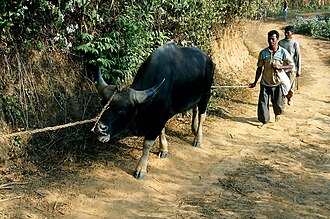
图:Aditya Kabir · Public domain · Wikimedia Commons
- 学名
- Bos frontalis
- 分类等级
- 种
- 上级类群
- 牛属
- 大类
- 哺乳动物
- 命名
- 艾尔默·伯克·兰伯特,1804 年
- 栖息地
- 草原、森林
- 数据库
- NCBI 分类 · GBIF
百科正文
英文维基百科补充中文条目比较短,下面是英文条目「Gayal」的原文
The gayal (Bos frontalis), also known as mithun or Drung ox, is a large semi-domesticated cattle in the Himalayan foothills of Indian Subcontinent and primarily in Northeast India.
Taxonomy
In his first description of 1804, Aylmer Bourke Lambert applied the binomial Bos frontalis to a domestic specimen probably from Chittagong.
In 2003, the International Commission on Zoological Nomenclature fixed the first available specific name based on a wild population that the name for this wild species is valid by virtue of its being antedated by a name based on a domestic form. Most authors have adopted the binomial Bos frontalis for the domestic species as valid for the taxon.
Phylogenetic analysis corroborates the taxonomic assessment that the gayal is an independent Bos species originating matrilineally from gaur, zebu and taurine cattle.
There are two major hypotheses on the origin of the gayal:
It was domesticated from wild gaur;
It is a hybrid descendant from crossing of wild gaur and domestic cattle, either Bos indicus or Bos taurus.
Analysis of the genome of the gayal was published in 2017.
Characteristics
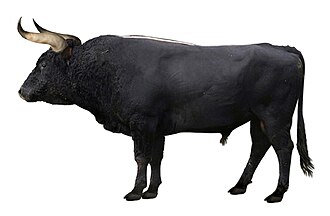
The gayal differs in several important particulars from the gaur:
It is somewhat smaller, with proportionately shorter limbs, and stands much lower at the withers.
The ridge on the back is less developed, and bulls have a larger dewlap on the throat.
The head is shorter and broader, with a perfectly flat forehead and a straight line between the bases of the horns.
The thick and massive horns are less flattened and much less curved than in the gaur, extending almost directly outwards from the sides of the head, and curving somewhat upwards at the tips, but without any inward inclination. Their extremities are thus much farther apart than in the gaur.
The female gayal is much smaller than the bull, and has scarcely any dewlap on the throat.
The skin colour of the head and body is blackish-brown in both sexes, and the lower portion of the limbs are white or yellowish.
Distribution and habitat
Gayal occur on the southern slopes of the Eastern Himalayas in Northeast India, Bangladesh, Myanmar, Bhutan and in Yunnan, China at elevations of 300 to 5,000 m (980 to 16,400 ft) and temperature ranges from 20 to 30 °C (68 to 86 °F). Their preferred habitat is characterized by undisturbed forested regions on hilly terrain with streams, ponds, and lakes where abundant shrubs, trees, bamboo, and coarse grasses can be found. They are also drawn to salt lick hotspots.
In India, semi-domesticated gayals are kept by several ethnic groups living in the forested hills of Tripura, Mizoram, Assam, Arunachal Pradesh, Manipur and Nagaland. They also occur in the Chittagong Hill Tracts. In northern Burma, they occur in the Kachin State, and in adjacent Yunnan only in the Trung (Chinese: 独龙河) and Salween River basins.
In culture
The gayal is the state animal of Arunachal Pradesh and Nagaland. Gayal are reared for meat, milk, and ceremonial purposes, and are of economic, social, and cultural importance in many different ethnic groups in its range. They are known primarily as a meat animal, being used most often as a dairy animal in Northeast India and Bhutan. 24 ethnic groups across China, Bangladesh, Myanmar, and India have been recorded as being associated with gayal farming.
The role of the gayal is central to the lives of many residents of these areas, including transhumant ones who pair gayal herding with sago palm harvesting.
National Research Centre on Mithun
The National Research Centre on Mithun was established at Medziphema in the Chümoukedima District of Nagaland under the Indian Council of Agricultural Research.
The mandate of the institute was redefined in 1997 and 2006. Currently, the National Research Centre on Mithun is functioning for developing the scientific and sustainable mithun rearing system and for catering the needs of mithun farmers with the following mandates:
Identification, evaluation and characterization of mithun germplasm available in the country.
Conservation and improvement of mithun for meat and milk.
Act as a repository of germplasm and information centre on mithun.
以上节选摘自英文维基百科「Gayal」,按 CC BY-SA 4.0 使用,去掉了参考文献、外部链接等尾部小节,公式改写成了纯文本。篇幅所限,较长的小节只摘了开头一部分,有的小节没有收;全文、配图和出处见原文。