格物

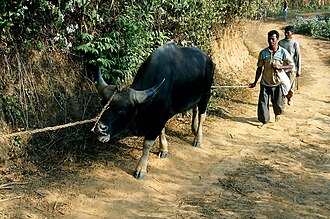
图:Buyung Sukananda · CC BY-SA 4.0 · Wikimedia Commons
- 学名
- Bos javanicus
- 分类等级
- 种
- 上级类群
- 牛属
- 大类
- 哺乳动物
- 命名
- Eduard Joseph d'Alton,1823 年
- 保护状况(IUCN)
- 极危物种
- 栖息地
- 森林
- 数据库
- NCBI 分类 · GBIF · IUCN 红色名录
百科正文
特征
爪哇野牛体形似黄牛,肩高160厘米,体长230厘米,体重500-810公斤,尾长65-70厘米。臀部有一独特的、圆盘状白斑。和印度野牛一样,爪哇野牛的四肢膝盖以下的毛也是白色。
习性
爪哇野牛一般独居或2-3头同栖,有时会组成有20-30只的大群,以草、竹子、野果、树叶和树枝为食。
繁殖
孕期7-8个月。每年春末夏初产崽,每胎1崽;哺乳期6-9个月;2-3岁性成熟。寿命20年。
分布
爪哇野牛分部在缅甸、泰国、柬埔寨、老挝、越南、婆罗洲、爪哇岛和巴厘岛、中国西双版纳勐腊县。1849年被引入北澳大利亚。栖息于南亚和东南亚的热带雨林中。
驯化
可驯化
以上内容摘自维基百科「爪哇野牛」,按 CC BY-SA 4.0 使用,去掉了参考文献、外部链接等尾部小节,公式改写成了纯文本。全文、配图和出处见原文。
英文维基百科补充中文条目比较短,下面是英文条目「Banteng」的原文
The banteng (Bos javanicus;), also known as the tembadau, is a species of wild bovine found in Southeast Asia, with domestic-wild hybrids present in parts of Northern Australia.
The head-and-body length is between 1.9 and 3.68 m (6.2 and 12.1 ft). Wild banteng are typically larger and heavier than their domesticated counterparts, but are otherwise similar in appearance. The banteng shows extensive sexual dimorphism; adult bulls are generally dark brown to black, larger and more sturdily built than adult cows, which are thinner and usually pale brown or chestnut red. There is a big white patch on the rump. Horns are present on both sexes, and are typically 60 to 95 cm (24 to 37 in) long. Three subspecies are generally recognised.
Banteng are active during the day as well as at night, though activity at night is more in areas frequented by humans. Herds comprise two to forty individuals, and generally a single bull. Being herbivorous, banteng feed on vegetation such as grasses, sedges, shoots, leaves, flowers, and fruits. Banteng can survive without water for long stretches during droughts, but drink regularly if possible, especially from standing water. Not much is known about the reproductive physiology of banteng, but it might be similar to that observed in taurine cattle. After a gestation of nearly 285 days (nine to ten months), a week longer than that typically observed in taurine cattle, a single calf is born. Banteng occur in a variety of habitats throughout their range, including open deciduous forests, semi-evergreen forests, lower montane forests, grasslands, and abandoned farms.
The largest populations of wild banteng occur in Java, Cambodia, and possibly in Kalimantan (particularly East Kalimantan and North Kalimantan) and Thailand. Domesticated banteng occur in Bali and many eastern Indonesian islands (such as Sulawesi, Sumbawa, and Sumba), Australia, Malaysia, and New Guinea. Feral populations are found in Sabah and the Northern Territory of Australia. Domesticated populations are primarily used for their highly demanded meat, and are used as draught animals to a lesser extent. The wild banteng is classified as Critically Endangered on the IUCN Red List, and populations have decreased by more than 50% in the past few decades. Rampant poaching (for food, game, traditional medicine and horns), habitat loss and fragmentation and susceptibility to disease are major threats throughout its range. Wild banteng are legally protected in all countries in their range, and are largely restricted to protected areas (possibly barring Cambodia). The banteng is the second endangered species to be successfully cloned, and the first clone to survive beyond infancy.
以上节选摘自英文维基百科「Banteng」,按 CC BY-SA 4.0 使用,去掉了参考文献、外部链接等尾部小节,公式改写成了纯文本。篇幅所限,较长的小节只摘了开头一部分,有的小节没有收;全文、配图和出处见原文。