格物
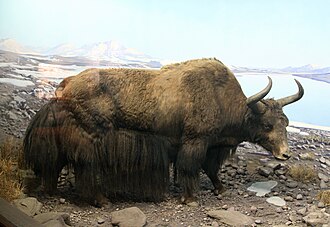
图:Jim, the Photographer · CC BY 2.0 · Wikimedia Commons
- 学名
- Bos mutus
- 分类等级
- 种
- 上级类群
- 牛属
- 大类
- 哺乳动物
- 命名
- 尼古拉·米哈伊洛维奇·普热瓦利斯基,1883 年
- 保护状况(IUCN)
- 易危物种
- 特有于
- 中华人民共和国
- 栖息地
- 草原
- 数据库
- NCBI 分类 · GBIF · IUCN 红色名录
百科正文
英文维基百科补充中文条目比较短,下面是英文条目「Wild yak」的原文
The wild yak (Bos mutus) is a large, wild bovine native to the Himalayas. It is the ancestor of the domestic yak (Bos grunniens).
Evolution
The ancestor of the wild and domestic yak is thought to have genetically diverged from the aurochs (Bos primigenius) between one and five million years ago. The wild yak is now normally treated as a separate species from the domestic yak (Bos grunniens). Based on genomic evidence, the closest relatives of yaks are considered to be bison, which have historically been considered members of their own titular genus, rendering the genus Bos paraphyletic.
Description
The wild yak is heavily built with a bulky frame, sturdy legs, and rounded cloven hooves. To protect against the cold, the udder in females and the scrotum in males are small, and covered in a layer of hair. Females have four teats. Both sexes have long shaggy hair, with a dense woolly undercoat over the chest, flanks, and thighs for insulation against the cold. In males especially, this undercoat may form a long "skirt" that can reach the ground. The tail is long and horse-like, and the coat is typically black or dark brown, covering most of the body, with a grey muzzle. Wild golden-brown individuals have been reported, which are known as the wild golden yak (Chinese: 金色野牦牛; pinyin: jīnsèyě máoniú). It is considered an endangered subspecies in China, with an estimated population of 170 wild individuals.
Two morphological types have been identified, so-called Qilian and Kunlun.
Distribution and habitat
The wild yak once ranged up to southern Siberia to the east of Lake Baikal. Fossil remains were recovered in Denisova Cave. Today, the wild yak occurs primarily in northern Tibet and western Qinghai, extending into the southernmost parts of Xinjiang and into Ladakh in India; small, isolated populations of wild yak also live farther afield, primarily in western Tibet and eastern Qinghai. It was thought to be regionally extinct in Nepal in the 1970s, but was rediscovered in Humla in 2014.
The primary habitat of the wild yak consists of treeless uplands between 3,000 and 5,500 m (9,800 and 18,000 ft), dominated by mountains and plateaus. It's most common in alpine tundra with a relatively thick carpet of grasses and sedges rather than the more barren steppe country.
Behaviour and ecology
The diet of wild yaks consists largely of grasses and sedges, such as Carex, Stipa, and Kobresia. They also eat a smaller amount of herbs, winterfat shrubs, and mosses, and have even been reported to eat lichen. Historically, the main natural predator of the wild yak has been the Himalayan wolf, but Himalayan black bears, Himalayan brown bears and snow leopards have also been reported as predators in some areas, likely of young or infirm wild yaks.
Thubten Jigme Norbu, the elder brother of the 14th Dalai Lama, reported on his journey from Kumbum in Amdo to Lhasa in 1950:
Before long I was to see the vast herds of drongs with my own eyes. The sight of those beautiful and powerful beasts who from time immemorial have made their home on Tibet's high and barren plateaux never ceased to fascinate me.
Conservation
The wild yak is currently listed as Vulnerable on the IUCN Red List. It was previously classified as Endangered, but was downlisted in 1996 based on the estimated rate of population decline and current population sizes. The latest assessment in 2008 suggested a total population of no more than 10,000 mature individuals.
The wild yak is experiencing threats applied by several sources. Poaching, including commercial poaching, has remained the most serious threat; males are particularly affected because of their more solitary habits. Disturbance by and interbreeding with livestock herds is also common. This may include the transmission of cattle-borne diseases, although no direct evidence of this has yet been found. Conflicts with herders themselves, as in preventive and retaliatory killings for abduction of domestic yaks by wild herds, also occur but appear to be relatively rare.
Impact on humans
The wild yak is a reservoir for zoonotic diseases of both bacterial and viral origins. Such bacterial diseases include anthrax, botulism, tetanus, and tuberculosis.
以上节选摘自英文维基百科「Wild yak」,按 CC BY-SA 4.0 使用,去掉了参考文献、外部链接等尾部小节,公式改写成了纯文本。篇幅所限,较长的小节只摘了开头一部分,有的小节没有收;全文、配图和出处见原文。