格物
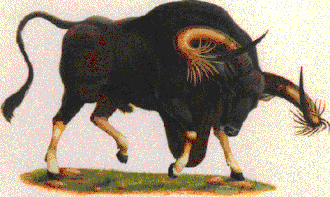
图:The Royal Government of Cambodia · CC0 · Wikimedia Commons
- 学名
- Bos sauveli
- 分类等级
- 种
- 上级类群
- 牛属
- 大类
- 哺乳动物
- 命名
- Achille Urbain,1937 年
- 保护状况(IUCN)
- 极危物种
- 数据库
- NCBI 分类 · GBIF · IUCN 红色名录
百科正文
特征
林牛体型巨大,体长达220 - 240 厘米,体重达900千克。身材较高但比较狭窄。体毛大都是棕褐色,老年雄性黑色。
习性
栖息在热带和亚热带的开阔山地森林。白天藏在隐蔽的森林中,夜晚在林间的草地中饮食。喜群居,通常每群20头,以雌兽、幼仔和亚成体组成。雄兽在交配期间才和雌兽接触。
分布
分布于柬埔寨北部,但也可能分布在老挝南部,越南西部,和泰国东部。
保护等级
被IUCN列为极危。总共数量不到250头。
以上内容摘自维基百科「林牛」,按 CC BY-SA 4.0 使用,去掉了参考文献、外部链接等尾部小节,公式改写成了纯文本。全文、配图和出处见原文。
英文维基百科补充中文条目比较短,下面是英文条目「Kouprey」的原文
The kouprey (Bos sauveli), also known as the forest ox and grey ox, is a possibly extinct species of forest-dwelling wild bovine native to Southeast Asia. It was first scientifically described in 1937.
The name kouprey is derived from the Khmer language and means "forest ox". The kouprey was defined as the national mammal of Cambodia in 2005.
The kouprey is listed as Critically Endangered and possibly extinct on the IUCN Red List. The last confirmed sighting of a wild individual took place in 1969.
Taxonomy and phylogeny
The kouprey was described by Achille Urbain in 1937 based on an adult individual that was caught in northern Cambodia and was kept at the Paris Zoological Park.
In 2006, a comparison of mitochondrial DNA sequences indicated that the kouprey may be a hybrid between zebu and banteng. However, the authors of the study rescinded their conclusion.
Description
The kouprey has a light and gracile build, in comparison to other wild cattle species. Both sexes have notched nostrils. It is 2.1–2.2 m (7–7.3 ft) long from nose to rear, 1.7–1.9 m (5.6–6.3 ft) tall at the shoulders and weighs 700–900 kg (1,500–2,000 lb).
Calves have a reddish bay colour and turn grey at around 5 months of age. Their horns start appearing at the age of 6 months. The pelage of cows and bulls diverges as they mature; cows turn a mouse to brownish grey, while bulls become progressively darker, until individuals of 12 years or older are entirely dark brown.
Distribution and habitat
The range of the kouprey once stretched from eastern Thailand and southern Laos to the western edge of Vietnam and northern Cambodia. Archaeological evidence shows that it also occurred in northern Yunnan, China.
The primary habitat of the kouprey is described as a mix of open grassland and dense open canopy forests featuring grassy glades, waterholes and salt licks.
Behaviour and ecology
Kouprey behaviour is described as similar to that of the banteng, with the two species often being found grazing alongside each other, though not intermixing. Herds, made up of cows, their calves, and periodically bulls, are always led by a mature cow. Kouprey are active, if nervous, animals, being quick to flee if approached. Bulls have been observed to plough up soil with their horns, especially around mineral licks and waterholes, which leads to the tips fraying.
Threats
The kouprey is thought to have never been numerous, likely never exceeding 2,000 individuals during the 20th century. In 1989, the total kouprey population in Cambodia was estimated at less than 200 individuals, with between 40 and 100 surviving in Laos, and less than 30 in Vietnam. As of 2016, the IUCN Red List puts the wild population at no more than 50 individuals, with a decreasing population trend. Kouprey have been hunted by local people for their meat, horns and skulls, the latter being highly symbolic culturally.
Conservation
Conservation efforts for the kouprey began in 1960 when Norodom Sihanouk, then head of state of Cambodia, gave the species protected status and created three natural reserves for it. These protected areas continued to be maintained by Norodom Sihanouk's successor, Lon Nol, but became neglected during the time of Khmer Rouge rule under Pol Pot. During this period, the majority of the country's Forestry Bureau staff were killed, and all documents relating to the reserves were destroyed.
Cultural significance
Potential depictions of kouprey in rock art have been documented in the Cardamon Mountains of Cambodia, and carvings in the temples of Angkor Wat have been found to resemble the animal as well.
The kouprey is the national animal of Cambodia, being designated as such by Norodom Sihanouk in 1960, its name is also the nickname of the country's national football team.
Several statues depicting and dedicated to the kouprey have been established across Cambodia and Thailand, including in the country's capital city, Phnom Penh.
以上节选摘自英文维基百科「Kouprey」,按 CC BY-SA 4.0 使用,去掉了参考文献、外部链接等尾部小节,公式改写成了纯文本。篇幅所限,较长的小节只摘了开头一部分,有的小节没有收;全文、配图和出处见原文。