格物
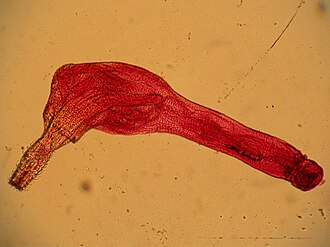
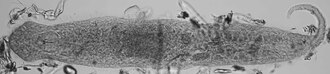
图:Dr. Neil Campbell, University of Aberdeen, Scotland, UK · Public domain · Wikimedia Commons
- 学名
- Acanthocephala
- 分类等级
- 门
- 上级类群
- 螺旋动物
- 大类
- 其他动物
- 命名
- 寇卢特,1771 年
- 数据库
- NCBI 分类 · GBIF
下级类群(3)

百科正文
发现
最早对棘头动物的可识别描述由意大利作家弗朗切斯科·雷迪于1684年完成。 1771年,寇卢特 (Joseph Gottlieb Kölreuter) 首次提出了Acanthocephala这一学名。1776年,菲利普·路德维希·施塔蒂乌斯·米勒独立将其命名为棘吻虫属。1809年,卡尔·鲁道尔菲 (Karl Rudolphi) 正式将其定名为棘头动物门 (Acanthocephala)。
演化史
该类群已知最古老的成员是生活在中侏罗世(约1.65亿年前)的道虎沟侏罗棘头虫,发现于中国海房沟组。此类群的化石记录还包括在巴西晚白垩纪包鲁群粪化石中发现的卵,距今约7000万至8000万年,可能来自鳄形类的成员。该类群的起源可能要早得多。
分类
- 古棘头虫纲 Palaeacanthocephala
- 棘吻目 Echinorhynchida
- 多形目 Polymorphida
- 目 Heteramorphida
- 原棘头虫纲 Archiacanthocephala
- 无孔目 Apororhynchida
- 巨吻目 Gigantorhynchida
- 链珠目 Moniliformida
- 寡棘吻目 Oligacanthorhynchida
- 始棘头虫纲 Eoacanthocephala
- 圆棘头目 Gyracanthocephala
- 新棘吻目 Neoechinorhynchida
- 多棘头虫纲 Polyacanthocephala
- 多棘头虫目 Polyacanthorhynchida
以上内容摘自维基百科「棘头动物门」,按 CC BY-SA 4.0 使用,去掉了参考文献、外部链接等尾部小节,公式改写成了纯文本。全文、配图和出处见原文。
英文维基百科补充中文条目比较短,下面是英文条目「Acanthocephala」的原文
Acanthocephala (Greek ἄκανθος, akanthos 'thorn' + κεφαλή, kephale 'head') is a group of parasitic worms known as acanthocephalans, thorny-headed worms, or spiny-headed worms, characterized by the presence of an eversible proboscis, armed with spines, which it uses to pierce and hold the gut wall of its host. Acanthocephalans have complex life cycles, involving at least two hosts, which may include invertebrates, fish, amphibians, birds, and mammals. About 1,420 species have been described.
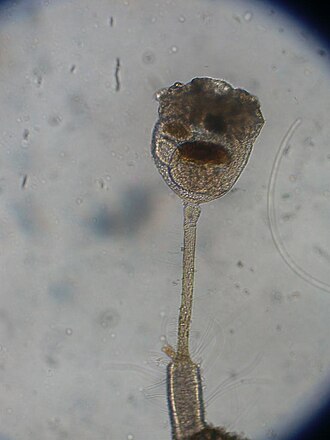
The Acanthocephala were long thought to be a discrete phylum. Recent genome analysis has shown that they are descended from, and should be considered as, highly modified rotifers. This unified taxon is sometimes known as Syndermata, or simply as Rotifera, with the acanthocephalans described as a subclass of a rotifer class Hemirotatoria.
History
The earliest recognisable description of Acanthocephala – a worm with a proboscis armed with hooks – was made by Italian author Francesco Redi (1684). In 1771, Joseph Koelreuter proposed the name Acanthocephala. Philipp Ludwig Statius Müller independently called them Echinorhynchus in 1776. Karl Rudolphi in 1809 formally named them Acanthocephala.
Evolutionary history
The oldest known member of the group is the Middle Jurassic (living approximately 165 million years ago) taxon Juracanthocephalus daohugouensis known from the Jiulongshan Formation (China). The fossil record of the group also includes eggs found in a coprolite from the Late Cretaceous Bauru Group of Brazil, around 70–80 million years old, likely from a crocodyliform. The group may have originated substantially earlier.
Phylogeny
Acanthocephalans are highly adapted to a parasitic mode of life, and have lost many organs and structures through evolutionary processes. This makes determining relationships with other higher taxa through morphological comparison problematic. A 2016 phylogenetic analysis of the gene order in the mitochondria suggests that Seisonidea and Acanthocephala are sister clades and that the Eurotatoria are the sister clade to this group, producing the cladogram below.
Morphology
Several morphological characteristics distinguish acanthocephalans from other phyla of parasitic worms.
Digestion
Acanthocephalans lack a mouth or alimentary canal. This is a feature they share with the cestoda (tapeworms), although the two groups are not closely related. Adult stages live in the intestines of their host and uptake nutrients which have been digested by the host, directly, through their body surface. The acanthocephalans lack an excretory system, although some species have been shown to possess flame cells (protonephridia).
Life cycles
Acanthocephalans have complex life cycles, involving a number of hosts, for both developmental and resting stages. Complete life cycles have been worked out for only 25 species.
Reproduction
The Acanthocephala are dioecious (an individual organism is either male or female). There is a structure called the genital ligament which runs from the posterior end of the proboscis sheath to the posterior end of the body. In the male, two testes lie on either side of this. Each opens in a vas deferens which bears three diverticula or vesiculae seminales.
Economic impact
Acanthocephalosis, a disease caused by Acanthacephalus infection, is prevalent in aquaculture, occurring in Atlantic salmon, rainbow and brown trout, tilapia, and tambaqui. Increasing occurrence in Brazilian farming of tambaqui has been reported, and in 2003 Acanthacephalus was first reported in cultured red snapper in Taiwan.
The life cycle of Polymorphus spp. normally occurs between sea ducks (e.g. eiders and scoters) and small crabs. Infections found in commercial-sized lobsters in Canada were probably acquired from crabs that form an important dietary item of lobsters.
Human infections
Although they rarely infect humans, worms in the phylum Acanthocephala cause the disease acanthocephaliasis in humans. The earliest known infection was found in a prehistoric man in Utah. This infection was dated to 1869 ± 160 BC. The species involved was thought to be Moniliformis clarki which is still common in the area.
The first report of an isolate in historic times was by Lambl in 1859 when he isolated Macracanthorhynchus hirudinaceus from a child in Prague. Lindemann in 1865 reported that this organism was commonly isolated in Russia.
以上节选摘自英文维基百科「Acanthocephala」,按 CC BY-SA 4.0 使用,去掉了参考文献、外部链接等尾部小节,公式改写成了纯文本。篇幅所限,较长的小节只摘了开头一部分,有的小节没有收;全文、配图和出处见原文。