格物
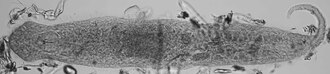
图:Ludwik Gąsiorowski · CC BY-SA 4.0 · Wikimedia Commons
- 学名
- Gnathostomulida
- 分类等级
- 门
- 上级类群
- 螺旋动物
- 大类
- 其他动物
- 数据库
- NCBI 分类 · GBIF
百科正文
描述
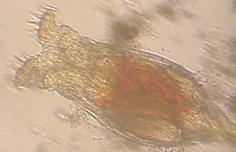
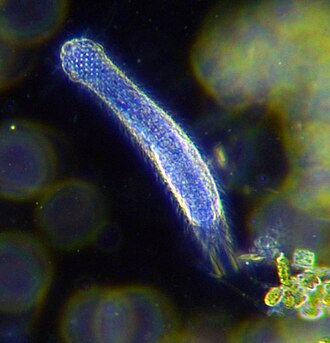
颚口动物体呈长柱形,半透明,分头、躯干及尾部。体长0.5至1毫米。
体表覆有一层上皮细胞,每个上皮细胞各具一根纤毛,借以在砂砾间滑行或游泳。此外也会利用肌肉的收缩进行运动。
没有体腔,也没有循环系统或呼吸系统。神经系统亦很简单。有口和肠盲囊,没有真正的肛门,但有组织连结肠盲囊与表皮,可充当肛门孔。口内有一梳状的基板及具齿的侧颚,以颚刮取细菌、真菌等为食。
多数雌雄同体。每个个体具有一个卵巢和一到二颗睾丸。受精后,单个卵穿破体壁并附着在附近的砂粒上;母体能够迅速治愈由此产生的伤口。卵孵化后会生出成虫的微型版本,无幼虫阶段。
颚口动物没有已知的化石记录。尽管其颚骨和某些牙形石之间存在(有争议的)相似性。
以上内容摘自维基百科「颚口动物门」,按 CC BY-SA 4.0 使用,去掉了参考文献、外部链接等尾部小节,公式改写成了纯文本。全文、配图和出处见原文。
英文维基百科补充中文条目比较短,下面是英文条目「Gnathostomulid」的原文
Gnathostomulids, or jaw worms, are a small phylum of nearly microscopic marine animals. They inhabit sand and mud beneath shallow coastal waters and can survive in relatively anoxic environments. They were first recognised and described in 1956.
Anatomy
Most gnathostomulids measure 0.5 to 1 millimetre (0.02 to 0.04 in) in length. They are often slender to thread-like worms, with a generally transparent body. In many Bursovaginoidea, one of the major group of gnathostomulids, the neck region is slightly narrower than the rest of the body, giving them a distinct head.
Like flatworms they have a ciliated epidermis, but in contrast to flatworms, they have one cilium per cell. The cilia allow the worms to glide along in the water between sand grains, although they also use muscles, allowing the body to twist or contract, for movement.
They have no body cavity, and no circulatory or respiratory system. The nervous system is simple, and restricted to the outer layers of the body wall. The only sense organs are modified cilia, which are especially common in the head region.
The mouth is located just behind the head, after a rostrum, on the underside of the body. It has a pair of cuticular jaws, supplied by strong muscles, and often bearing minute teeth. A "basal plate" on the lower surface that bears a comb-like structure is also present. The basal plate is used to scrape smaller organisms off of the grains of sand that make up their anoxic seabed mud habitat. This bilaterally symmetrical pharynx with its complex cuticular mouth parts make them appear closely related to rotifers and their allies, together making up the Gnathifera. The ultrastructure of the jaws made of rods with electron dense core in transmission electron microscopy sections also support their close relation with Rotifera and Micrognathozoa. Jaws are absent in the two species making up the small genus Agnathiella (family Agnathiellidae). The mouth of gnathostomulids opens into a blind-ending tube in which digestion takes place; there is no true anus. However, there is tissue connecting the intestine to the epidermis which may serve as an anal pore.
Reproduction
Gnathostomulids are simultaneous hermaphrodites. Each individual possesses a single ovary and one or two testes. After fertilization, the single egg ruptures through the body wall and adheres to nearby sand particles; the parent is able to rapidly heal the resulting wound. The egg hatches into a miniature version of the adult, without a larval stage.
Taxonomy
There are approximately 100 described species and certainly many more as yet undescribed. The known species are grouped in two orders. The filospermoids are very long and are characterized by an elongate rostrum. The bursovaginoids have paired sensory organs and are characterized by the presence of a penis and a sperm-storage organ called a bursa.
Gnathostomulids have no known fossil record, though there are (debatable) similarities between the jaws of modern gnathostomulids and certain conodont elements. (Ochietti & Cailleux, 1969; Durden et al, 1969)
They appear to be a sister clade to the Syndermata.
以上内容摘自英文维基百科「Gnathostomulid」,按 CC BY-SA 4.0 使用,去掉了参考文献、外部链接等尾部小节,公式改写成了纯文本。全文、配图和出处见原文。