格物
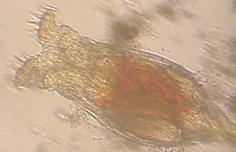
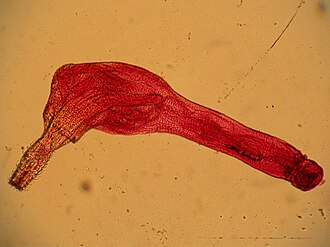
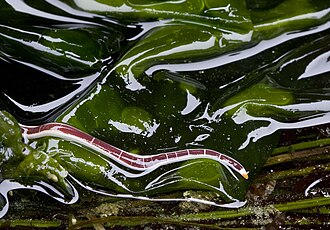
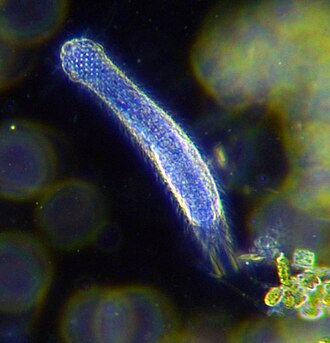
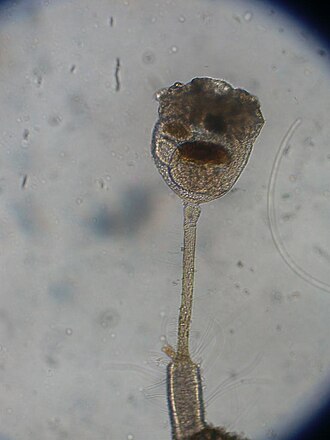
图:Public domain · Wikimedia Commons
- 学名
- Rotifera
- 分类等级
- 门
- 上级类群
- 螺旋动物
- 大类
- 其他动物
- 命名
- 乔治·居维叶,1817 年
- 数据库
- NCBI 分类 · GBIF
下级类群(1)
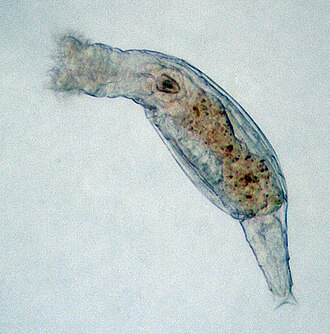
- 真轮纲 Eurotatoria 纲
百科正文
下级分类
轮形动物各子类群之间的关系尚未明确。
- 传统上按照生殖器特征分为两大类群三个纲:
- 真轮形动物 Eurotatoria
- 单巢纲 Monogonta:雌虫仅有一个卵巢
簇轮虫目 Flosculariacea:如簇轮虫(Floscularia)、镜轮虫(Testudinella)
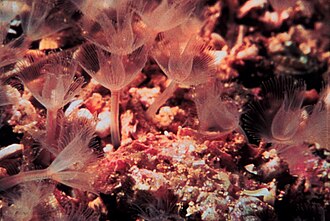
胶鞘轮虫目 Collothecacea:如胶鞘轮虫(Collotheca)、花环轮虫(Stephanoceros)等
游泳轮虫目 Ploima:包括大多数轮虫,如龟甲轮虫(Keratella)、疣毛轮虫(Synchaeta)、须足轮虫(Euchlanis)等
- 双巢纲 Digononta:孤雌生殖,未发现雄性存在,雌虫有两个卵巢
- 蛭态轮虫目 Bdelloidea:如旋轮虫(Philonida)
- 副轮形动物 Pararotatoria
- 尾盘纲 Seisonidea:又称摇轮虫纲,有头的寄生性轮虫
摇轮虫目 Seisonida:仅包括摇轮虫科(Seisonidae)下的摇轮虫属(Seison)和副摇轮虫属(Paraseison);有的分类法将该目划到双巢纲(Digononta)之下
以上内容摘自维基百科「轮形动物门」,按 CC BY-SA 4.0 使用,去掉了参考文献、外部链接等尾部小节,公式改写成了纯文本。全文、配图和出处见原文。
英文维基百科补充中文条目比较短,下面是英文条目「Rotifer」的原文
The rotifers (, from Latin rota 'wheel' and -fer 'bearing'), sometimes called wheel animals or wheel animalcules, make up a phylum (Rotifera) of microscopic and near-microscopic pseudocoelomate animals.
They were possibly first described by Rev. John Harris in 1696, and other forms were described by Antonie van Leeuwenhoek in 1703. Most rotifers are around 0.1–0.5 mm (0.0039–0.0197 in) long (although their size can range from 50 μm (0.0020 in) to over 2 mm (0.079 in)), and they are common in freshwater environments throughout the world with a few saltwater species.
Some rotifers are free swimming and truly planktonic, others move by inchworming along a substrate, and some are sessile, living inside tubes or gelatinous holdfasts that are attached to a substrate. About 25 species are colonial (e.g., Sinantherina semibullata), either sessile or planktonic. Rotifers are an important part of the freshwater zooplankton, being a major foodsource and with many species also contributing to the decomposition of soil organic matter. Genetic evidence indicates that the parasitic acanthocephalans are a highly specialised group of rotifers.
Most species of the rotifers are cosmopolitan, but there are also some endemic species, like Cephalodella vittata to Lake Baikal. Recent barcoding evidence, however, suggests that some 'cosmopolitan' species, such as Brachionus plicatilis, B. calyciflorus, Lecane bulla, among others, are actually species complexes. In some recent treatments, rotifers are placed with acanthocephalans in a larger clade called Syndermata.
In June 2021, biologists reported the restoration of bdelloid rotifers after being frozen for 24,000 years in the Siberian permafrost. The earliest record of the rotifer clade is of an acanthocephalan from the Middle Jurassic of China. Earlier purported fossils of rotifers have been suggested in Devonian and Permian fossil beds.
Taxonomy and naming
John Harris first described the rotifers (in particular a bdelloid rotifer) in 1696 as "an animal like a large maggot which could contract itself into a spherical figure and then stretch itself out again; the end of its tail appeared with a forceps like that of an earwig". In 1702, Antonie van Leeuwenhoek gave a detailed description of Rotifer vulgaris and subsequently described Melicerta ringens and other species. He was also the first to publish observations of the revivification of certain species after drying.
Anatomy
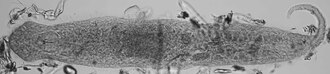
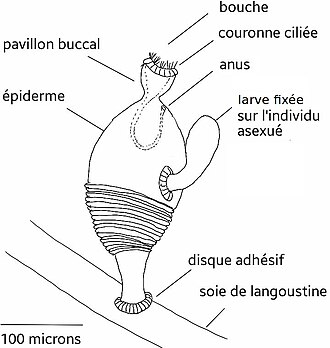
Rotifers have bilateral symmetry and a variety of different shapes. The body of a rotifer is divided into a head, trunk, and foot, and is typically somewhat cylindrical. The trunk contains visceral organs, and often, sensory antennae. There is a well-developed cuticle, found everywhere except in the corona, which is secreted by a fibrous layer in the syncytial epidermis.
Feeding
Rotifers eat particulate organic detritus, dead bacteria, algae, and protozoans. They eat particles up to 10 micrometres in size. Like crustaceans, rotifers contribute to nutrient recycling. For this reason, they are used in fish tanks to help clean the water, to prevent clouds of waste matter. Rotifers affect the species composition of algae in ecosystems through their choice in grazing. Rotifers may compete with cladocera and copepods for planktonic food sources.
Reproduction and life cycle
Rotifers are dioecious and reproduce sexually or parthenogenetically. They are sexually dimorphic, with the females always being larger than the males. In some species, this is relatively mild, but in others the female may be up to ten times the size of the male. In parthenogenetic species, males may be present only at certain times of the year (Monogononta), or absent altogether (Bdelloidea).
The female reproductive system consists of one or two ovaries, each with a vitellarium gland that supplies the eggs with yolk.
Predators
Rotifers fall prey to many animals, such as copepods, fish (e.g. herring, salmon), bryozoa, comb jellies, jellyfish, starfish, and tardigrades.
Genome size
The genome size of a bdelloid rotifer, Adineta vaga, was reported to be around 244 Mb. The genomes of Monogononts seem to be significantly smaller than those of Bdelloids. In Monogononta the nuclear DNA content (2C) in eight different species of four different genera ranged almost fourfold, from 0.12 to 0.46 pg. Haploid "1C" genome sizes in Brachionus species range at least from 0.056 to 0.416 pg.
以上节选摘自英文维基百科「Rotifer」,按 CC BY-SA 4.0 使用,去掉了参考文献、外部链接等尾部小节,公式改写成了纯文本。篇幅所限,较长的小节只摘了开头一部分,有的小节没有收;全文、配图和出处见原文。