格物
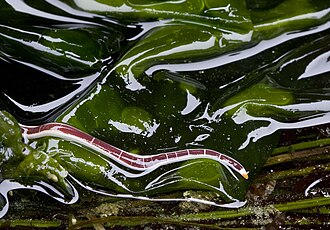
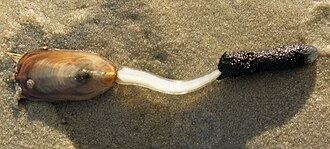
图:Marlin Harms · CC BY 2.0 · Wikimedia Commons
- 学名
- Nemertea
- 分类等级
- 门
- 上级类群
- 螺旋动物
- 大类
- 其他动物
- 命名
- Max Schultze,1851 年
- 数据库
- NCBI 分类 · GBIF
分类阶元
下级类群(2)

百科正文
与扁形动物一样,纽形动物也是两侧对称、三胚层的动物,早期曾被认为是无体腔动物,但最新研究表明其属于真体腔动物,且分子遗传学等研究表明其与软体动物门有一定亲缘关系,纽形动物门与触手冠动物共同组成了隐担轮动物。脑部只由一环四个神经节组成,但具有完整的消化道(即有口和肛门,口在前下方,肛门在尾端)、肉食性且无心脏。纽形动物具备最原始的闭管式循环系统,一般为2~3条纵行血管,但不出现搏动。纽形动物还具有一个捕食及防卫的可伸缩的长吻。除所有淡水品种外,多数种类为雌雄异体,说明纽形动物较扁形动物更为进化,因此现行分类系统中都将纽形动物独立成一个门。
分类
无刺纲 Anopla
古纽目 Paleonemertea:例如管居纽虫。
异纽目 Heteronemertea:例如脑纹纽虫(Cerebratulus)及线纽虫(Lineus)。
有刺纲 Enopla
又名有针纲。
针纽纲 Hoplonemertea
例如端纽虫(Amphiporus)、小体纽虫、地纽虫(Geonemertes)等。
单针目 Monostilifera
多针目 Polystilifera
以上内容摘自维基百科「纽形动物门」,按 CC BY-SA 4.0 使用,去掉了参考文献、外部链接等尾部小节,公式改写成了纯文本。全文、配图和出处见原文。
英文维基百科补充中文条目比较短,下面是英文条目「Nemertea」的原文
Nemertea is a phylum of animals also known as ribbon worms or proboscis worms, consisting of about 1300 known species. Most ribbon worms are very slim, usually only a few millimeters wide, although a few have relatively short but wide bodies. Many have patterns of yellow, orange, red and green coloration.
The foregut, stomach and intestine run a little below the midline of the body, the anus is at the tip of the tail, and the mouth is under the front. A little above the gut is the rhynchocoel, a cavity which mostly runs above the midline and ends a little short of the rear of the body. All species have a proboscis which lies in the rhynchocoel when inactive but everts to emerge just above the mouth to capture the animal's prey with venom. A highly extensible muscle in the back of the rhynchocoel pulls the proboscis in when an attack ends. A few species with stubby bodies filter feed and have suckers at the front and back ends, with which they attach to a host.
The brain is a ring of four ganglia, positioned around the rhynchocoel near the animal's front end. At least a pair of ventral nerve cords connect to the brain and run along the length of the body. Most nemerteans have various chemoreceptors, and on their heads some species have a number of pigment-cup ocelli, which can detect light but can not form an image. Nemerteans respire through the skin. They have at least two lateral vessels which are joined at the ends to form a loop, and these and the rhynchocoel are filled with fluid. There is no heart, and the flow of fluid depends on contraction of muscles in the vessels and the body wall. To filter out soluble waste products, flame cells are embedded in the front part of the two lateral fluid vessels, and remove the wastes through a network of pipes to the outside.
All nemerteans move slowly, using their external cilia to glide on surfaces on a trail of slime, while larger species use muscular waves to crawl, and some swim by dorso-ventral undulations. A few live in the open ocean while the rest find or make hiding places on the bottom. About a dozen species inhabit freshwater, mainly in the tropics and subtropics, and another dozen species live on land in cool, damp places. Most nemerteans are carnivores, feeding on annelids, clams and crustaceans. Some species of nemerteans are scavengers, and a few live commensally inside the mantle cavity of molluscs.
In most species the sexes are separate, but all the freshwater species are hermaphroditic. Nemerteans often have numerous temporary gonads (ovaries or testes), and build temporary gonoducts (ducts from which the ova or sperm are emitted) opening to a gonopore, one per gonad, when the ova and sperm are ready. The eggs are generally fertilised externally. Some species shed them into the water, and others protect their eggs in various ways. The fertilized egg divides by spiral cleavage and grows by determinate development, in which the fate of a cell can usually be predicted from its predecessors in the process of division. The embryos of most taxa develop either directly to form juveniles (like the adult but smaller) or larvae that resemble the planulas of cnidarians. However, some form a pilidium larva, in which the developing juvenile has a gut which lies across the larva's body, and usually eats the remains of the larva when it emerges. The bodies of some species fragment readily, and even parts cut off near the tail can grow full bodies.
以上节选摘自英文维基百科「Nemertea」,按 CC BY-SA 4.0 使用,去掉了参考文献、外部链接等尾部小节,公式改写成了纯文本。篇幅所限,较长的小节只摘了开头一部分,有的小节没有收;全文、配图和出处见原文。