格物
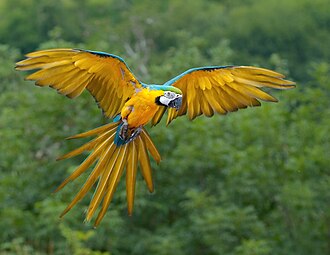
图:Luc Viatour · CC BY 2.0 · Wikimedia Commons
生命之树 › 真核生物 › 动物界 › 真后生动物亚界 › 两侧对称动物 › 后口动物总门 › 脊索动物门 › 脊椎动物亚门 › 有颌下门 › 肉鳍鱼总纲 › 四足形类 › 希望螈目 › 四足总纲 › 爬行动物 › 坚尾龙类 › 鸟纲 › 今鸟亚纲 › 今颚下纲 › 新鸟总目 › 鹦形目 › 鹦鹉总科 › 金刚鹦鹉科 › 金刚鹦鹉亚科 › 金刚鹦鹉属
蓝黄金刚鹦鹉种
Ara ararauna
蓝黄金刚鹦鹉,又名琉璃金刚鹦鹉,属于鹦鹉科中的金刚鹦鹉属。生长于南美洲的沼泽森林,由巴拿马南部至巴西、玻利维亚及巴拉圭一带。但可能已绝迹于特立尼达和多巴哥。
摘自维基百科「藍黃金剛鸚鵡」,CC BY-SA 4.0
- 学名
- Ara ararauna
- 分类等级
- 种
- 英文名
- Blue-and-yellow Macaw
- 上级类群
- 金刚鹦鹉属
- 大类
- 鸟类
- 命名
- 卡尔·林奈,1758 年
- 中文别名
- 琉璃金刚鹦鹉
- 保护状况(IUCN)
- 无危物种
- 数据库
- NCBI 分类 · GBIF · IUCN 红色名录
百科正文
它们的身长可达76至84厘米,重约900至1300克。鸟身为亮丽的蓝色,前额有少许绿色羽毛,脸部有着白色的皮肤,皮上有横向黑色的细羽毛;耳孔旁边的羽毛、前胸、下腹以至尾巴为黄色,尾巴上方为蓝色,而鸟喙呈黑色,可咬开坚硬的果壳。
人工饲养
蓝黄金刚鹦鹉拥有摄人的外表及良好的语言能力,是最受饲养者欢迎的鹦鹉之一,但饲养它们往往需要较多的努力及知识,因为它们不同于饲养猫狗。它们有高度的智力,脾性温和友善,只要满足到它们的需要,它们会是很好的宠物。
但即使得到良好照顾,蓝黄金刚鹦鹉仍会鸣叫,而且非常吵耳。大声鸣叫及用鸟喙破坏物件是它们的天性,即使在人工饲养的环境下,它们亦会做出这些行为。可以训练鹦鹉只咬玩具,但当没有人看管的情况下,如果鹦鹉没有被在笼内,它们会大肆破坏。
野外的蓝黄金刚鹦鹉主要进食水果、坚果、各种棕榈树的果实、种子、花朵、嫩芽,以及寄生植物、昆虫等。每天清晨和傍晚,它们会到河岸食用泥土,原因是他们的食物中很多是未成熟的种子或果实,其中含有毒素,进食泥土不但可以协助排出这些毒素,更可补充矿物质并帮助消化。目前,这些泥土河岸已经被列为观光景点。
而人工饲养蓝黄金刚鹦鹉,需要给予多种不同的食物,只有种子的膳食会引起健康问题,如维他命缺乏。良好的膳食应该是包括营养补充剂、种子、果仁、干果,并定时给予新鲜的水果及蔬菜。有一些食物对鸟类或鹦鹉是有害的,例如樱桃核、巧克力、咖啡碱。巧克力、咖啡碱在鸟类体内的新陈代谢与人类的有所不同。
以上内容摘自维基百科「藍黃金剛鸚鵡」,按 CC BY-SA 4.0 使用,去掉了参考文献、外部链接等尾部小节,公式改写成了纯文本。全文、配图和出处见原文。
英文维基百科补充中文条目比较短,下面是英文条目「Blue-and-yellow macaw」的原文
The blue-and-yellow macaw (Ara ararauna), also known as the blue-and-gold macaw, is a large Neotropical parrot with a mostly blue dorsum, light yellow/orange venter, and gradient hues of green on top of its head. It is a member of the large group of neotropical parrots known as macaws. It inhabits forest (especially varzea, but also in open sections of terra firme or unflooded forest), woodland, and savannah of tropical Central and South America, as well as the island of Trinidad in the Caribbean. They are popular in aviculture because of their striking color, ability to talk, ready availability in the marketplace, and close bonding to humans. It is the most commonly kept macaw species in captivity worldwide as a pet or companion parrot and is also the cheapest among the large macaws. As of 2025, there are 1 million blue and gold macaws living in captivity worldwide, one of the highest populations of any large parrot in captivity.
Taxonomy
The blue-and-yellow macaw was formally described by the Swedish naturalist Carl Linnaeus in 1758 in the tenth edition of his Systema Naturae. He placed it with all the other parrots in the genus Psittacus and coined the binomial name Psittacus ararauna. This macaw is now one of the eight extant species within the Ara genus, first proposed in 1799 by the French naturalist Bernard Germain de Lacépède. The genus name is from ará meaning "macaw" in the Tupi language of Brazil. The word is an onomatopoeia based on the sound of their call. The specific epithet ararauna comes from the Tupi Arára úna meaning "big dark parrot" for the hyacinth macaw.
Description
These birds can reach a length of 81–91 cm (32–36 in) and weigh 1.0–1.5 kg (2–3 lb), making them some of the larger members of their family. They are vivid in appearance with bright aqua blue feathers on the top of their body, except for the head, which is lime colored. The bottom, however, is a rich, deep yellow/light orange. Their beak is black, as well as the feathers under their chin. Its feet are of a gray color, save for black talons. The bird has white skin, with its face having nearly no feathers besides a few black ones spaced apart from each other, forming a striped pattern around the eyes. The irises are pale light yellow.
Distribution and habitat
This species occurs in Panama, Trinidad and Tobago, Colombia, Suriname, French Guiana, Venezuela, Guyana, Peru, Brazil, Bolivia, Ecuador, and Paraguay. The range extends slightly into Central America, where it is restricted to Panama. While most breed in rural and forested areas, small numbers breed in urban cities such as Rondonópolis, Mato Grosso, Brazil, nesting in dead palms planted for ornamental purposes alongside city roads. Although they were nearly extirpated in Trinidad due to human activity during the 1970s, a recent programme of reintroduction has proved successful.
Breeding
The blue-and-yellow macaw generally mates for life. They nest almost exclusively in dead palms, and most nests are in Mauritia flexuosa palms. The female typically lays two or three eggs. The female incubates the eggs for about 28 days. One chick is dominant and gets most of the food; the others perish in the nest. Chicks fledge from the nest about 97 days after hatching. The male bird's color signals readiness for breeding. The brighter and bolder the colors, the better the chance of getting a mate.
Conservation and threats
The blue-and-yellow macaw is on the verge of being extirpated in Paraguay, but it still remains widespread and fairly common in a large part of mainland South America. The species is therefore listed as Least Concern by BirdLife International. Its wild population has not been quantified but is believed to be above 10,000 individuals and is in decline. It is listed on CITES Appendix II, trade restricted.
Aviculture
Even well-tended blue-and-yellow macaws are known to "scream" for attention and make other loud noises. Loud vocalizations, especially "flock calls", and destructive chewing are natural parts of their behavior and should be expected in captivity. Due to their large size, they also require plentiful space in which to fly around. According to World Parrot Trust, an enclosure for a blue-and-yellow macaw should, if possible, be at least 15 m (50 ft) in length. Captive macaws, kept with good diet, exercise, and veterinary care, are known to have lived 60 or more years.
以上节选摘自英文维基百科「Blue-and-yellow macaw」,按 CC BY-SA 4.0 使用,去掉了参考文献、外部链接等尾部小节,公式改写成了纯文本。篇幅所限,较长的小节只摘了开头一部分,有的小节没有收;全文、配图和出处见原文。