格物
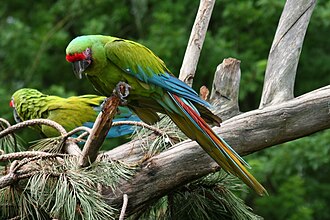
图:Alois Staudacher · CC BY-SA 3.0 · Wikimedia Commons
生命之树 › 真核生物 › 动物界 › 真后生动物亚界 › 两侧对称动物 › 后口动物总门 › 脊索动物门 › 脊椎动物亚门 › 有颌下门 › 肉鳍鱼总纲 › 四足形类 › 希望螈目 › 四足总纲 › 爬行动物 › 坚尾龙类 › 鸟纲 › 今鸟亚纲 › 今颚下纲 › 新鸟总目 › 鹦形目 › 鹦鹉总科 › 金刚鹦鹉科 › 金刚鹦鹉亚科 › 金刚鹦鹉属
大绿金刚鹦鹉种
Ara ambiguus
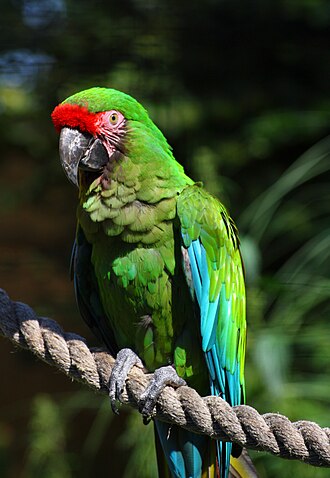
大绿金刚鹦鹉 生活在哥伦比亚、哥斯达黎加、巴拿马以及尼加拉瓜等地。成年体长85厘米。身体主要为黄绿色,与军舰金刚鹦鹉很接近,但本种颜色略浅。前额有小片红色羽毛,脸颊两侧有黑色条纹状羽毛,飞羽及尾内侧羽为橄榄黄,黑色喙,浅黄色虹膜。野外状态下,主要活动在森林低地、季节性干燥的地区,喜群居。食物包括水果、坚果、浆果、种子及植物嫩芽。
繁殖期在每年的1至4月,每次产卵1-3枚,孵化期26天,羽化期12周。
摘自维基百科「大绿金刚鹦鹉」,CC BY-SA 4.0
- 学名
- Ara ambiguus
- 分类等级
- 种
- 英文名
- Great Green Macaw
- 上级类群
- 金刚鹦鹉属
- 大类
- 鸟类
- 命名
- 约翰·马特乌斯·贝希施泰因,1811 年
- 保护状况(IUCN)
- 极危物种
- 数据库
- NCBI 分类 · GBIF · IUCN 红色名录
百科正文
英文维基百科补充中文条目比较短,下面是英文条目「Great green macaw」的原文
The great green macaw (Ara ambiguus), also known as Buffon's macaw or the great military macaw, is a critically endangered Central and South America parrot found in Nicaragua, Honduras, Costa Rica, Panama, Colombia and Ecuador. Two allopatric subspecies are recognized; the nominate subspecies, Ara ambiguus ssp. ambiguus, occurs from Honduras to Colombia, while Ara ambiguus ssp. guayaquilensis appears to be endemic to remnants of dry forests on the southern Pacific coast of Ecuador. The nominate subspecies lives in the canopy of wet tropical forests and in Costa Rica is usually associated with the almendro tree, Dipteryx oleifera.
Taxonomy
The great green macaw belongs to the genus Ara, which includes other large parrots, such as the scarlet macaw, the military macaw, and the blue-and-yellow macaw.
This bird was first described and illustrated in 1801 by the French naturalist François Le Vaillant for his Histoire Naturelle Des Perroquets under the name "le grand Ara militaire", using a skin deposited at the Muséum national d'histoire naturelle in Paris.
Description
Great green macaws are the largest parrots in their natural range, the second heaviest macaw species (although they are relatively shorter tailed than other large macaws such as the red-and-green macaw and are thus somewhat shorter), and the third heaviest parrot species in the world. This species averages 85–90 cm (33.5–35.5 in) in length and 1.3 kg (2.9 lb) in weight. They are mainly green and have a reddish forehead and pale blue lower back, rump and upper tail feathers. The tail is brownish-red tipped with very pale blue.
Distribution and habitat
The great green macaw lives in tropical forests in the Atlantic wet lowlands of Central America from Honduras to Panama and Colombia, and in South America in the Pacific coastal lowlands in Panama, Colombia and western Ecuador, where they also occur in deciduous (seasonal), dry tropical forests. In Colombia, where both species occur, it prefers more humid woodlands than the closely related military macaw.
Ecology
To improve the state of knowledge of the natural history the great green macaw in Costa Rica a large study using radio telemetry was launched by George V. N. Powell and conducted by a team of researchers from 1994 to 2000. The main objectives were to determine the home range of A. ambiguus, characterize the habitats that it frequents and learn more about its feeding habits, ecological associations, abundance, and reproduction and nesting habits.
Behaviour
Birds are usually observed in pairs or small groups of up to four to eight birds, very rarely more.
Cultural associations
With a 2004 resolution, the city council voted to consider the subspecies Ara ambiguus ssp. guayaquilensis, known in the city as papagayo de Guayaquil, as an emblematic symbol of Guayaquil in Ecuador. A July 2005 city ordinance declared it so. A 12m high ceramic monument to this subspecies by the artist Juan Marcelo Sánchez was unveiled in the city in 2006.
The macaw was also declared an official symbol of the village of El Castillo, Nicaragua, in the 2000s.
Conservation
Status
This species of parrot is considered critically endangered by the IUCN. In 2001 Chassot et al.. thought it should be considered at risk of extinction in Costa Rica. The species is protected from international trade under CITES Appendix I. While conservation projects have had success educating people and releasing great green macaws into the wild, the global population was estimated at 500–1,000 mature individuals in the IUCN's 2020 Red List assessment, which classifies the species as Critically Endangered (criterion A4abcd) with a decreasing population trend.
以上节选摘自英文维基百科「Great green macaw」,按 CC BY-SA 4.0 使用,去掉了参考文献、外部链接等尾部小节,公式改写成了纯文本。篇幅所限,较长的小节只摘了开头一部分,有的小节没有收;全文、配图和出处见原文。