格物

图:David Friel · CC BY 2.0 · Wikimedia Commons
生命之树 › 真核生物 › 动物界 › 真后生动物亚界 › 两侧对称动物 › 后口动物总门 › 脊索动物门 › 脊椎动物亚门 › 有颌下门 › 肉鳍鱼总纲 › 四足形类 › 希望螈目 › 四足总纲 › 爬行动物 › 坚尾龙类 › 鸟纲 › 今鸟亚纲 › 今颚下纲 › 新鸟总目 › 鹦形目 › 鹦鹉总科 › 金刚鹦鹉科 › 金刚鹦鹉亚科 › 金刚鹦鹉属
蓝喉金刚鹦鹉种
Ara glaucogularis
蓝喉金刚鹦鹉 是栖息于玻利维亚东部一个名为Los Llanos de Moxos小地区的独有品种。时至2005年,野外的蓝喉金刚鹦鹉相信只剩余少于200只。它们消失的主要原因是为当地及国际鸟类贸易造成的非法偷捕活动,此外牧场发展砍伐了蓝喉金刚鹦鹉栖息的树木。动物园正进行许多的人工繁殖及保育计划,以拯救蓝喉金刚鹦鹉。
摘自维基百科「藍喉金剛鸚鵡」,CC BY-SA 4.0
- 学名
- Ara glaucogularis
- 分类等级
- 种
- 英文名
- Blue-throated Macaw
- 上级类群
- 金刚鹦鹉属
- 大类
- 鸟类
- 命名
- Roberto Dabbene,1921 年
- 保护状况(IUCN)
- 极危物种
- 特有于
- 莫霍大平原
- 数据库
- NCBI 分类 · GBIF · IUCN 红色名录
百科正文
它们并非栖息于森林,而是玻利维亚贝尼省(Beni)的草原,筑巢于棕榈树丛中。
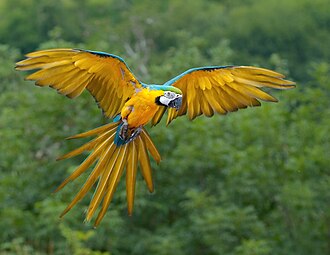
蓝喉金刚鹦鹉重约750克,长约85厘米。翅膀及尾部呈亮丽的蓝绿色,喉部呈蓝色,胸部上方及腹部呈亮黄色。它们有很大的喙、长尾巴及黄色的虹膜。蓝喉金刚鹦鹉与蓝黄金刚鹦鹉为竞争对手,但在巢穴争夺上,蓝喉金刚鹦鹉通常落败。
人工繁殖蓝喉金刚鹦鹉相对地容易,美国有很多的宠物蓝喉金刚鹦鹉。
蓝喉金刚鹦鹉现时被列入世界自然保护联盟红色名录极危物种,并列于华盛顿公约附录一及二。玻利维亚于1984禁止此品种的出口,但非法出口依然存在。现时未有机制限制国内的交易,保育团体仍正在努力保护蓝喉金刚鹦鹉。
国际雀鸟联盟(BirdLife International)(2004)Ara glaucogularis。2006年IUCN红色名录的极危物种,资料说明了此物种的生境范围及被编入极危级别的原因
以上内容摘自维基百科「藍喉金剛鸚鵡」,按 CC BY-SA 4.0 使用,去掉了参考文献、外部链接等尾部小节,公式改写成了纯文本。全文、配图和出处见原文。
英文维基百科补充中文条目比较短,下面是英文条目「Blue-throated macaw」的原文
The blue-throated macaw (Ara glaucogularis), also known as the Caninde macaw or Wagler's macaw, is a macaw endemic to a small area of north-central Bolivia, known as Los Llanos de Moxos. In 2014 this species was designated by law as a natural patrimony of Bolivia. Until 2010, it was hunted by native people to make feathered "Moxeño" headdresses for "machetero" ritual dances.
Recent population and range estimates suggest that about 208–303 adult individuals remain in the wild. Its demise was brought upon by nesting competition, avian predation, and a small native range, exacerbated by indigenous hunting and capture for the pet trade. Current threats continue to include hunting and trapping as well as tree cutting, invasive species, disease, and use of powders or foams used to extinguish fires. It is listed as Critically Endangered by the IUCN in the wild and is protected by trading prohibitions.
The name "Wagler's macaw" is in honor of German herpetologist and ornithologist Johann Georg Wagler, who processed many of Johan Baptist von Spix's Brazilian collections at LMU Munich, and first described the blue macaws for a European readership in Monographia Psittacorum (1832).
Taxonomy
Ara is from a Tupi Indian word for macaw; glauco (glaucous Latin for greyish-blue or green) + gularis (Latin: throat). The blue-throated macaw is one of 8 extant species (and a few extinct species) in genus Ara of large long-tailed parrots collectively called macaws. The genus Ara is one of six genera of Central and South American macaws in the tribe Arini, which also includes all the other long-tailed New World parrots.
Description
The blue-throated macaw is about 85 cm (33 in) long including the length of its tail feathers and has a wingspan of approximately three feet or 90 cm. It weighs about 900 g (32 oz) to 1,100 g (39 oz). There is little easily observable sexual dimorphism; however, males tend to be a little bigger than females with approximate masses of 750 g and 950 g respectively.
Upperparts are turquoise-blue, slightly duller on crown and brighter on rump.
Distribution and habitat
The blue-throated macaw lives in the Llanos de Moxos of the Beni Department of Bolivia, nesting in "Islas" (islands) of palm trees that dot the level plains. It is not a forest-dwelling bird. This species is one of the rarest in the world. There are two areas inhabited by two sub-populations of Ara glaucogularis: one is to the northwest of Trinidad (the capital city of Beni), and the other is to the south of Trinidad.
Behaviour
Blue-throated macaws are most frequently found in monogamous pairs, but small groups of 7–9 do occur and one large roosting group of 70 is known. It is not known if these macaws will pair with another mate if their original mate dies. Their main mode of locomotion is flying, but they are also able to climb trees, maneuver along branches and walk on the ground. These birds are active during the day and usually stay in one general area. Blue-throated macaws communicate mostly by sound.
Conservation status and programs
The blue-throated macaw has a very small population and is on the verge of extinction in the wild. It is listed on the IUCN Red List as critically endangered. It is also listed in Appendix I by CITES. Trapping is illegal as blue-throated macaws have been protected by the national legislation of Bolivia. According to locals the wild population of the blue-throated macaw in the 1980s was thought to number 500–1000 individuals.
Endangered Species Act
On November 4, 2013, the blue-throated macaw was listed under the Endangered Species Act, per the USFWS Final rule. Because of their large captive population, the American Federation of Aviculture asked that captive-born blue-throated macaws not be listed through a 19-page submission to the federal government.
[1]
Aviculture
They are relatively easy to find in captivity, and the captive population consists of about 1000–1100 individuals. Individuals are kept in several zoos around the world, among them the Santa Cruz zoo in Bolivia. Captive blue-throated macaws have successfully hybridized with the military macaw, producing offspring known by aviculturists as Corrientes macaws.
Several breeding and conservation schemes in zoos have now been set up to save this species.
以上节选摘自英文维基百科「Blue-throated macaw」,按 CC BY-SA 4.0 使用,去掉了参考文献、外部链接等尾部小节,公式改写成了纯文本。篇幅所限,较长的小节只摘了开头一部分,有的小节没有收;全文、配图和出处见原文。