格物
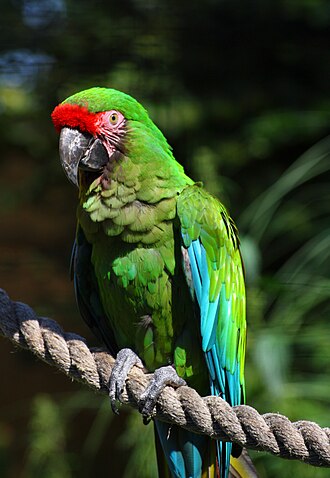
图:neiljs · CC BY 2.0 · Wikimedia Commons
生命之树 › 真核生物 › 动物界 › 真后生动物亚界 › 两侧对称动物 › 后口动物总门 › 脊索动物门 › 脊椎动物亚门 › 有颌下门 › 肉鳍鱼总纲 › 四足形类 › 希望螈目 › 四足总纲 › 爬行动物 › 坚尾龙类 › 鸟纲 › 今鸟亚纲 › 今颚下纲 › 新鸟总目 › 鹦形目 › 鹦鹉总科 › 金刚鹦鹉科 › 金刚鹦鹉亚科 › 金刚鹦鹉属
军舰金刚鹦鹉种
Ara militaris
军舰金刚鹦鹉,或称军用金刚鹦鹉、军金刚鹦鹉,这些中文名称只是其英文名称“Military Macaw”的翻译。英文名称的起源是因为第一批进口欧洲的这个鹦鹉品称,多半是由军事人员运送,所以此鹦鹉被命名为军舰金刚鹦鹉。
摘自维基百科「軍艦金剛鸚鵡」,CC BY-SA 4.0
- 学名
- Ara militaris
- 分类等级
- 种
- 英文名
- Military Macaw
- 上级类群
- 金刚鹦鹉属
- 大类
- 鸟类
- 命名
- 卡尔·林奈,1766 年
- 保护状况(IUCN)
- 易危物种
- 数据库
- NCBI 分类 · GBIF · IUCN 红色名录
百科正文
军舰金刚鹦鹉是一种大型鹦鹉,其栖息的生境散落于墨西哥、哥伦比亚、委内瑞拉、秘鲁、厄瓜多尔、玻利维亚及阿根廷。
不同地区的军舰金刚鹦鹉,其生境亦有所不同,有的居住于潮湿的低地森林、长满树的山丘及峡谷;而在墨西哥,军舰金刚鹦鹉栖息于干燥或半干燥的树林、河岸的潮湿低地,或季节性地移居至茂密的棘林。
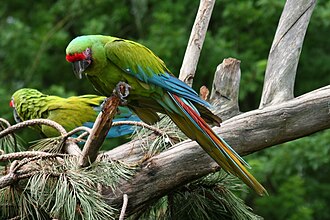
军舰金刚鹦鹉身体大部分为青绿色,上鸟喙处有一小片红色的羽毛,脸部的裸皮为浅红色,当兴奋或是激动的时候裸皮会变成深粉红色。脸颊边缘和下巴为橄榄棕色以及黑棕色,尾巴内侧和飞行羽为橄榄黄,鸟喙为黑色,虹膜为浅黄色。
生存危机
生境被破坏及宠物市场买卖是军舰金刚鹦鹉主要的生存危机。但现时军舰金刚鹦鹉,即使于保护区内,仍未受到有效的保护。
军舰金刚鹦鹉现时被列入IUCN红色名录的易危级别,及列于华盛顿公约附录一及二,禁止进行交易,并于委内瑞拉受法例保护。
以上内容摘自维基百科「軍艦金剛鸚鵡」,按 CC BY-SA 4.0 使用,去掉了参考文献、外部链接等尾部小节,公式改写成了纯文本。全文、配图和出处见原文。
英文维基百科补充中文条目比较短,下面是英文条目「Military macaw」的原文
The military macaw (Ara militaris) is a medium to large-sized macaw, named after its green and red plumage vaguely resembling a military uniform. It is native from west-central Mexico south through northern Argentina and Bolivia. While most wild populations are currently listed by the IUCN as vulnerable—and listed as endangered by Mexico—the species is still seen commonly in zoos and parks worldwide. The military macaw may be bred in captivity with relative ease, and is usually available through the pet trade. It is among the longest-lived one can own, requiring advanced knowledge, experience and confidence to keep them healthy, stimulated and thriving.
Taxonomy
The military macaw was formally described in 1766 by Swedish naturalist Carl Linnaeus in the 12 edition of his Systema Naturae, where he placed it within the genus Psittacus, coining the binomial name Psittacus militaris. Linnaeus did not specify a type locality, but it was designated as 'Colombia' in 1912. The military macaw is, now, one of ten species in the genus Ara, designated in 1799 by French naturalist Bernard Germain de Lacépède. The name Ara comes directly from the Tupi word ará ("macaw"), of the native Brazilian Tupi people. The word is also an onomatopoeia of the typically raucous vocalizations made by macaws. The specific epithet militaris is Latin meaning "military".
Three subspecies are recognised:
Description
Military macaws measure from 70 to 85 centimeters (28 to 33 inches) long on-average, with a 99–110 cm (39–43 in) wingspan. The birds are mostly green-plumed, with light-blue and yellow flight and tail feathers, and a bright-red patch on the forehead. Their face is bare, as with most macaws, being whitish in colour with black striations. The large, strong bill is a slate-grey, blackish tone, and the iris is yellow.
They are very visually-similar to great green macaws, but can be distinguished by their smaller size, completely black bill, and overall darker, deeper plumage. The two can also be separated by differences in calls and communication, while great green macaws prefer humid forest habitats; military macaws are usually a deciduous forest species.
Behavior
Military macaws live in large flocks and can live about 50–60 years in the wild. They can often be heard long before they are seen. They are very noisy birds making a variety of loud cracking and shrieking sounds, including a loud kraa-aak. Military macaw activity has been observed most frequently in the morning and the evening meaning they are most likely a crepuscular species.
Food and feeding
Military macaws leave their roosts in flocks around dawn to forage. Their diet consists of mostly seeds but also includes fruits and leaves. They have been observed using Pseudalcantarea grandis for water and consuming latex from Plumeria rubra. They have a somewhat narrow diet, meaning that they only eat a small percentage of species of plants that are available to them.
Distribution and habitat
Military macaws typically inhabit tropical deciduous and semi-deciduous forests. They are a canopy species because they require large canopy trees of deciduous and subdeciduous forests for feeding, breeding, and nesting behavior. They also use canopy trees for protection from predators and heat. They typically live at elevations of 600 to 1,500 m (2,000 to 4,900 ft), higher in the mountains than most macaws ever range. However, these macaws may seasonally fly down to lowlands, where they are likely in humid forests and thorny woodlands. They will nest in the tops of trees 8–28 m off the ground, and more often in cliff faces over 600 ft (180 m) above the ground.
Conservation
Military macaws are estimated to only have a breeding population of 2000–7000 individuals and is continuing to decrease. According to the ICUN red list, military macaws are listed as vulnerable as they face threats from habitat loss due to crops, deforestation, mining, and roads, with already extremely fragmented populations. A 2013 paper found that the habitat for populations in tropical dry forests has been reduced by almost 32%. Military macaws are listed as CITES Appendix I which means commercial international trade in wild specimens is prohibited. Despite this, research shows that the trafficking of parrots from South America to North America is still common.
以上节选摘自英文维基百科「Military macaw」,按 CC BY-SA 4.0 使用,去掉了参考文献、外部链接等尾部小节,公式改写成了纯文本。篇幅所限,较长的小节只摘了开头一部分,有的小节没有收;全文、配图和出处见原文。