格物

图:Jacques Barraband · Public domain · Wikimedia Commons
- 学名
- Ara tricolor
- 分类等级
- 种
- 英文名
- Cuban Macaw
- 上级类群
- 金刚鹦鹉属
- 大类
- 鸟类
- 命名
- 约翰·马特乌斯·贝希施泰因,1811 年
- 保护状况(IUCN)
- 绝灭
- 数据库
- NCBI 分类 · GBIF · IUCN 红色名录
百科正文
描述
古巴红鹦鹉约长45-50厘米。它的前额由红色渐变至橙色,到了颈背呈黄色。眼睛周围没有羽毛及呈白色,喙呈深褐色,有黄色的瞳孔。面部、下颚、胸部、腹部及大腿都呈橙色,双脚则呈褐色。上背部有红褐色的羽毛,边缘呈绿色。臀部、尾巴羽毛及下背部呈蓝色。双翼羽毛是褐色、红色及紫蓝色的。尾巴上表面呈深红色,渐变至尖端的蓝色,尾巴下表面则呈红褐色。成年的雄鸟及雌鸟在外表上没有分别。
灭绝
古巴红鹦鹉估计于1800年左右在古巴很普遍,且可能也生活在青年岛上。于19世纪初期,在这些地方的人口急遽增加,并开始大量砍伐树林。虽然它们的肉质并不可口,但也被捕猎来作为食物。为了捕捉雏鸟作为宠物,它们的巢穴受到破坏。直至1849年前,它们仍能保持它们的数量,但后来数量急遽下降至灭绝。最少共有19个古巴红鹦鹉的标本,最后的标本是于1864年在以扎巴特市附近被射杀的。一份未被确认的纪录显示它们生存至1885年才灭绝。
以上内容摘自维基百科「古巴紅鸚鵡」,按 CC BY-SA 4.0 使用,去掉了参考文献、外部链接等尾部小节,公式改写成了纯文本。全文、配图和出处见原文。
英文维基百科补充中文条目比较短,下面是英文条目「Cuban macaw」的原文
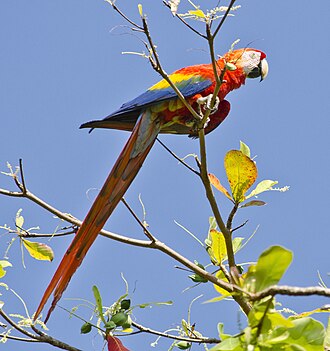
The Cuban macaw or Cuban red macaw (Ara tricolor) is an extinct species of macaw native to the main island of Cuba and the nearby Isla de la Juventud. It became extinct in the late 19th century. Its relationship with other macaws in its genus was long uncertain, but it was thought to have been closely related to the scarlet macaw, which has some similarities in appearance. It may also have been closely related, or identical, to the hypothetical Gosse's macaw (A. gossei). A 2018 DNA study found the Cuban macaw to be the sister species of two red and two green species of extant macaws.
At about 45–50 cm (18–20 in) long, the Cuban macaw was one of the smallest macaws. It had a red, orange, yellow, and white head, and a red, orange, green, brown, and blue body. Little is known of its behavior, but it is reported to have nested in hollow trees, lived in pairs or families, and fed on seeds and fruits. The species' original distribution on Cuba is unknown, but it may have been restricted to the central and western parts of the island. It was mainly reported from the vast Zapata Swamp, where it inhabited open terrain with scattered trees.
The Cuban macaw was traded and hunted by Native Americans, and by Europeans after their arrival in the 15th century. Many individuals were brought to Europe as cagebirds, and 19 museum skins exist today. A few subfossil and archeological remains have been found on Cuba. It had become rare by the mid-19th century due to pressure from hunting, trade, and habitat destruction. Hurricanes may also have contributed to its demise. The last reliable accounts of the species are from the 1850s on Cuba and 1864 on Isla de la Juventud, but it may have persisted until 1885.
Taxonomy
Early explorers of Cuba, such as Christopher Columbus and Diego Álvarez Chanca, mentioned macaws there in 15th- and 16th-century writings. Cuban macaws were described and illustrated in several early accounts about the island. In 1811, the German naturalist Johann Matthäus Bechstein scientifically named the species Psittacus tricolor.
Bechstein's description was based on the bird's entry in the French naturalist François Le Vaillant's 1801 book Histoire Naturelle des Perroquets, wherein it was referred to as l'Ara Tricolor.
Description
The Cuban macaw had a red forehead fading to orange and then to yellow at the nape of the neck. It had white unfeathered areas around the eyes, and yellow irises. The face, chin, chest, abdomen and thighs were orange. The upper back was brownish red with feathers scalloped with green. The rump, undertail feathers, and lower back were blue. The wing feathers were brown, red and purplish blue. The upper surface of the tail was dark red fading to blue at the tip, and the under surface of the tail was brownish red.
Behavior and ecology
Little is known about the behavior of the Cuban macaw and its extinct Caribbean relatives. Gundlach reported that it vocalized loudly like its Central American relatives and that it lived in pairs or families. Its speech imitation abilities were reportedly inferior to those of other parrots. Nothing is known about its breeding habits or its eggs, but one reported nest was a hollow in a palm.
The skull roof of the subfossil cranium was flattened, indicating the Cuban macaw fed on hard seeds, especially from palms.
Distribution and habitat
The range of the Cuban macaw's distribution at the time of European settlement on the main island of Cuba is unclear, but the species was reportedly becoming rare by the mid-19th century. It may have been restricted to the central and western part of Cuba. Most accounts from the 19th century are based on Gundlach's reports from the immense Zapata Swamp, where the species was somewhat common near the northern edge. By the 1870s, it was becoming rarer and had retreated to the interior.
Extinction
Hunting has been proposed as a factor in the extinction of the Cuban macaw. Parrots were hunted, kept as pets, and traded by Native Americans in the Caribbean before the arrival of Europeans. The Cuban macaw was reportedly "stupid" and slow to escape, and therefore was easily caught. It was killed for food; the Italian traveler Gemelli Careri found the meat tasty, but Gundlach considered it tough. Historical evidence suggests the Cuban macaw was hunted in Havana in the 16th-18th centuries.
以上节选摘自英文维基百科「Cuban macaw」,按 CC BY-SA 4.0 使用,去掉了参考文献、外部链接等尾部小节,公式改写成了纯文本。篇幅所限,较长的小节只摘了开头一部分,有的小节没有收;全文、配图和出处见原文。