格物

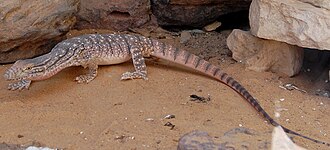
图:D. Gordon E. Robertson · CC BY-SA 3.0 · Wikimedia Commons
- 学名
- Varanus niloticus
- 分类等级
- 种
- 上级类群
- 巨蜥属
- 大类
- 爬行动物
- 命名
- 卡尔·林奈,1766 年
- 保护状况(IUCN)
- 无危物种
- 主要食物
- 鱼、无尾目、蟾蜍、爬行动物、龟鳖目、蛇亚目
- 数据库
- NCBI 分类 · GBIF · IUCN 红色名录
百科正文
英文维基百科补充中文条目比较短,下面是英文条目「Nile monitor」的原文
The Nile monitor (Varanus niloticus) is a large member of the monitor family (Varanidae) found throughout most of Sub-Saharan Africa, particularly in drier regions, and along the Nile River and its tributaries in East Africa. Additionally, there are modern, invasive populations in North America. The population found in West African forests and savannahs is sometimes recognized as a separate species, the West African Nile monitor (V. niloticus stellatus) and Ornate monitor (V. niloticus ornatus). While it is dwarfed by its larger relatives, such as the Komodo dragon, the Asian water monitor or the crocodile monitor, it is still one of the largest lizards in the world, reaching (and even surpassing) Australia's perentie in size. Other common names include the African small-grain lizard, as well as iguana and various forms derived from it, such as guana, water leguaan or river leguaan (leguan, leguaan, and likkewaan mean monitor lizard in South African English, and can be used interchangeably).
A feral population of Nile monitors (descended from escaped or intentionally-released pets) has become established in several locations in South Florida. In addition to any illegally-released animals, it is speculated that during particularly intense hurricane seasons in Florida, many reptiles potentially escape when their enclosures are damaged or inadvertently unlocked; as Florida has a semi-tropical to tropical climate, many reptiles are housed outdoors, and poorly-secured enclosures may become damaged during bad storms. Along with Nile monitors, Florida is infamous for its feral populations of agamas, Argentine black and white tegus, Burmese pythons, green iguanas, Madagascar giant day geckos, and panther and veiled chameleons, among others. Many of these species are thought to be descendants of hurricane escapees.
Taxonomy
Members of the Nile monitor species group were already well known to Africans in ancient times. For example, they were commonly caught, likely as food, in the Djenné-Djenno culture at least a millennium ago.
The Nile monitor twice was given a scientific name by Carl Linnaeus: First as Lacerta monitor in 1758 in the 10th edition of Systema Naturae, the starting point of zoological nomenclature. He described it again in 1766 as Lacerta nilotica. Despite being older, the name proposed in 1758 is invalid because it was rejected in ICZN opinion 540, making the name of 1766 valid. The genus Varanus was coined in 1820 by Blasius Merrem.
Description
The Nile monitor is Africa's longest lizard. They grow from about 120 to 220 cm (3 ft 11 in to 7 ft 3 in) in length, with the largest specimens attaining 244 cm (8 ft). In an average-sized specimen, the snout-to-vent length will be around 50 cm (1 ft 8 in). In body mass, adults have been reported to vary widely, one study claiming only 0.8 to 1.7 kg (1.8 to 3.7 lb), others state weights ranging from 5.9 to 15 kg (13 to 33 lb) in big monitors. Variations may be due to age or environmental conditions. Exceptionally large specimens may scale as much as 20 kg (44 lb), but this species weighs somewhat less on average than the bulkier rock monitor.
Distribution and habitat
Nile monitors are native to Sub-Saharan Africa and along the Nile. They are not found in any of the desert regions of Africa (notably Sahara, Kalahari and much of the Horn of Africa), however, they thrive around rivers. Nile monitors were reported to live in and around the Jordan River, Dead Sea, and wadis of the Judaean Desert in Israel until the late 19th century, though they are now extinct in the region.
Invasive species
In Florida in the United States, established breeding populations of Nile monitors have been known to exist in different parts of the state since at least 1990.
In captivity
Nile monitors are often found in the pet trade despite their highly aggressive demeanor and resistance to taming. Juvenile monitors will tail whip as a defensive measure, and as adults, they are capable of inflicting moderate to serious wounds from biting and scratching. Nile monitors require a large cage as juveniles quickly grow when fed a varied diet, and large adults often require custom-built quarters.
There are few lizards less suited to life in captivity than the Nile monitor. Buffrenil (1992) considered that, when fighting for its life, a Nile monitor was a more dangerous adversary than a crocodile of a similar size.
以上节选摘自英文维基百科「Nile monitor」,按 CC BY-SA 4.0 使用,去掉了参考文献、外部链接等尾部小节,公式改写成了纯文本。篇幅所限,较长的小节只摘了开头一部分,有的小节没有收;全文、配图和出处见原文。