格物
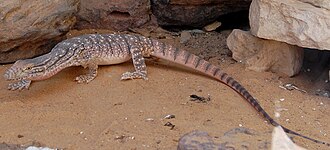
图:Knockout mouse · CC BY-SA 3.0 · Wikimedia Commons
- 学名
- Varanus griseus
- 分类等级
- 种
- 上级类群
- 巨蜥属
- 大类
- 爬行动物
- 命名
- 弗朗索瓦·马里·多丹,1803 年
- 保护状况(IUCN)
- 无危物种
- 数据库
- NCBI 分类 · GBIF · IUCN 红色名录
百科正文
特征
荒漠巨蜥体长约1呎10吋,尾巴长约2呎4吋,牙齿尖锐。吻端凹陷,鼻孔斜开,较接近眼窝。脚趾较短,尾巴圆或稍为扁平。头部的鳞片非常细小,背部鳞片细小及光滑。在颈部两侧的鳞片呈锥形。腹部鳞片光滑,共有110-125行。它们呈灰黄色,或多或少有一些褐色的斑纹。幼蜥有黄色圆点及深褐色的斑纹。
分布
荒漠巨蜥分布在土耳其、摩洛哥、阿尔及利亚、突尼斯、利比亚、埃及、以色列、叙利亚、黎巴嫩、伊朗、阿拉伯、阿曼、土库曼、哈萨克、乌兹别克、塔吉克斯坦、吉尔吉斯斯坦、撒哈拉西部、毛利塔尼亚、马里、尼日尔、乍得、苏丹、阿富汗、伊朗、巴基斯坦及印度西南部。
以上内容摘自维基百科「荒漠巨蜥」,按 CC BY-SA 4.0 使用,去掉了参考文献、外部链接等尾部小节,公式改写成了纯文本。全文、配图和出处见原文。
英文维基百科补充中文条目比较短,下面是英文条目「Desert monitor」的原文
The desert monitor (Varanus griseus) is a species of monitor lizard of the order Squamata found living throughout North Africa and Central and South Asia. The desert monitor is carnivorous, feeding on a wide range of vertebrates and invertebrates.
Description
Desert monitors normally display a variety of body coloration from light brown and yellow to grey. They average about 1 meter in length, but can reach total body lengths of almost 2 meters. These lizards can also have horizontal bands on either their backs or tails, along with yellow spots across their backs. Their young are normally a brightly coloured orange and have distinctive bands across their backs which may be lost as they mature. Their nostrils are slits located farther back on their snouts (closer to the eyes than the nose), and their overall body size is dependent on the available food supply, the time of year, environmental climate, and reproductive state. Males are generally larger and more robust than females. Those differences allow males to be distinguished from females. Like all lizards, they go through periods of molting in which they shed their outer layer of skin to expand their overall body size.
Distribution
The desert monitor has a wide distribution across many countries and regions. It can be found in Jordan, Turkey, Morocco, Algeria, Tunisia, Libya, Egypt, Israel, Syria, Lebanon, Iraq, Oman, Turkmenistan, Kazakhstan, Uzbekistan, Tajikistan, Kyrgyzstan, Western Sahara, Mauritania, Palestine, Mali, Niger, Chad, Sudan, Afghanistan, Iran (including the Kavir desert), Pakistan, and northwest India. Its type locality is Dardsha, located on the coast of the Caspian Sea.
Subspecies
- Three subspecies have been described:
- V. g. griseus (grey monitor)
- V. g. caspius (Caspian monitor)
- V. g. koniecznyi (Indian desert monitor)
Nota bene: Böhme et al. 2023 argues that all three subspecies should be elevated to full species status due to their parapatric distribution and genetic distance.
Varanus griseus griseus
V. g. griseus (grey monitor) has five to eight narrow grey bands on its back, as well as 19-28 bands on its tail. Its tail is more rounded that those of the other subspecies, and the final size of the adult depends on which habitat they are living. Their coloration can be from simple grey (in desert-like ecosystems) to bright orange (in areas with large amounts of plant growth). Their most common prey is lizards and snakes, but can also include ground-nesting birds and small mammals.
Biology
Desert monitors goes into hibernation from about September to April. In April is a mass exodus from their hibernation, and they become most active between May and July. During the middle of the day, the lizards mainly stay in their burrows and only come to the desert surface to search for food. The monitor lizards require approximately 3 to 4 full hibernation periods (years) to reach their full size (about 55–65 cm excluding their tails) and at least 3 hibernation periods before they become sexually mature. The overall lifespan of desert monitors in the wild does not normally exceed around 8 years in both males and females.
Metabolism
Desert monitors are cold-blooded ectotherms whose behaviours therefore depend on the outside temperatures. Many lizards become sluggish in cold weather and even may become inactive if the temperature decreases substantially.
Conservation
A great deal of the land previously inhabited by the subspecies V. g. caspius has been turned into farmland, which puts pressure on the species. Around 17,000 skins of this lizard are involved in commercial trade every year. The species is listed under Appendix I of the Convention on International Trade in Endangered Species of Wild Fauna and Flora (CITES) meaning commercial international trade is prohibited. In northern Africa, central Asia, and parts of India, the species is unprotected from hunting laws and is still hunted commercially. The leather trade of this species has caused some populations to be nearly wiped out.
Vehicle collisions are a common cause of death for desert monitors. This is because the species uses the surfaces of roads for basking, and also uses roads when scavenging for roadkill.
A common cause of death in Morocco is the presence of concrete wells used for retaining rainwater, locally called matfias.
以上节选摘自英文维基百科「Desert monitor」,按 CC BY-SA 4.0 使用,去掉了参考文献、外部链接等尾部小节,公式改写成了纯文本。篇幅所限,较长的小节只摘了开头一部分,有的小节没有收;全文、配图和出处见原文。