格物
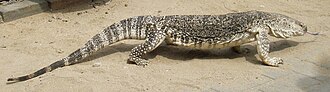
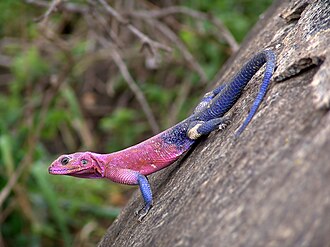
图:SqueakyMarmot · CC BY 2.0 · Wikimedia Commons
- 学名
- Varanidae
- 分类等级
- 科
- 上级类群
- 有鳞目
- 大类
- 爬行动物
- 命名
- 布拉修斯·梅雷姆,1820 年
- 数据库
- NCBI 分类 · GBIF
下级类群(1)
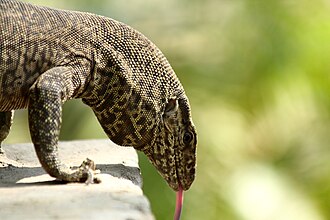
- 巨蜥属 Varanus 属
百科正文
英文维基百科补充中文条目比较短,下面是英文条目「Varanidae」的原文
The Varanidae are a family of lizards in the superfamily Varanoidea and suborder Anguimorpha. The family, a group of carnivorous and frugivorous lizards, includes the living genus Varanus and a number of extinct genera more closely related to Varanus than to the earless monitor lizard (Lanthanotus). Varanus includes the Komodo dragon (the largest living lizard), crocodile monitor, savannah monitor, the goannas of Australia and Southeast Asia, and various other species with a similarly distinctive appearance. Their closest living relatives are the earless monitor lizard and Chinese crocodile lizard. The oldest members of the family are known from the Late Cretaceous of Mongolia.
Taxonomy
The Varanidae were defined (using morphological characteristics) by Estes, de Queiroz and Gauthier (1988) as the clade containing the most recent common ancestor of Lanthanotus and Varanus and all of its descendants. A similar definition was formulated by Conrad et al. (2008) (also using morphological data), who defined the Varanidae as the clade containing Varanus varius, Lanthanotus borneensis, and all descendants of their last common ancestor. Using one of these definitions leads to the inclusion of the earless monitor lizard (L. borneensis) in the family Varanidae.
Lee (1997) created a different definition of the Varanidae, defining them as the clade containing Varanus and all taxa more closely related to Varanus than to Lanthanotus; this definition explicitly excludes the earless monitor lizard from the Varanidae. Whether L. borneensis is included in or excluded from the Varanidae depends on the author; for example, Vidal et al. (2012) classify the earless monitor lizard as a member of a separate family Lanthanotidae, while Gauthier et al. (2012) classify it as a member of Varanidae.
Genera
- Genera marked with † are extinct
- Genera included in Varanidae according to Dong et al., 2022
- †Ovoo Norell, Gao, & Conrad, 2008 (Mongolia, Late Cretaceous)
- †Aiolosaurus Gao and Norell, 2000 (Mongolia, Late Cretaceous)
- †Cherminotus Borsuk-Bialynicka, 1984 (Mongolia, Late Cretaceous)
- †Saniwides Borsuk-Bialynicka, 1984 (Mongolia, Late Cretaceous)
- †Paravaranus Borsuk-Bialynicka, 1984 (Mongolia, Late Cretaceous)
- †Proplatynotia Borsuk-Bialynicka, 1984 (Mongolia, Late Cretaceous)
- †Telmasaurus Gilmore, 1943 (Mongolia, Late Cretaceous)
- †Saniwa Leidy, 1870 (Europe, North America, Eocene)
- †Archaeovaranus Dong et al., 2022 (China, Eocene)
- Varanus Shaw, 1790
Phylogeny
Below is a cladogram from Dong et al. 2022.
Biology
Monitor lizards are reputed to be among the most intelligent lizards. Most species forage widely and have large home ranges, and many have high stamina. Although most species are carnivorous, three arboreal species in the Philippines (Varanus olivaceus, Varanus mabitang, and Varanus bitatawa) are primarily frugivores. Among species of living varanids, the limbs show positive allometry, being larger in larger-bodied species, although the feet become smaller as compared with the lengths of the other limb segments.
Varanids possess unidirectional pulmonary airflow, including air-sacs akin to those of birds.
以上内容摘自英文维基百科「Varanidae」,按 CC BY-SA 4.0 使用,去掉了参考文献、外部链接等尾部小节,公式改写成了纯文本。全文、配图和出处见原文。