 格物

图:Paweł Kuźniar · CC BY-SA 3.0 · Wikimedia Commons
生命之树 › 真核生物 › 动物总界 › 动物界 › 真后生动物亚界 › 两侧对称动物 › 后口动物总门 › 脊索动物门 › 脊椎动物亚门 › 有颌下门 › 肉鳍鱼总纲 › 四足形类 › 希望螈目 › 四足总纲 › 爬行动物 › 坚尾龙类 › 鸟纲 › 今鸟亚纲 › 今颚下纲 › 新鸟总目 › 雀形目 › 鸣禽亚目 › 䴓科
䴓属属
Sitta
䴓(shī)科,俗称“五子雀”,是雀形目中的一个科,分布在欧洲、亚洲和澳洲。常在树干、树枝、岩石上等地方觅食(昆虫、种子等),身体小,头颈短,尾巴也长得很短。䴓有很特殊的生活习惯:喜欢在洞里筑巢,还会储存食物以便过冬天,而且是唯一一种能头向下尾朝上往下爬树的鸟类(啄木鸟只能头朝上往上爬)。
摘自维基百科「鳾屬」,CC BY-SA 4.0
- 学名
- Sitta
- 分类等级
- 属
- 上级类群
- 䴓科
- 大类
- 鸟类
- 命名
- 卡尔·林奈,1758 年
- 数据库
- NCBI 分类 · GBIF
分类阶元
- 域真核生物
- 未标等级无定形生物 Amorphea
- 演化支后鞭毛生物 Opisthokonta
- 总界动物总界 Holozoa
- 未标等级蜷丝生物 Filozoa
- 未标等级领鞭毛动物 Choanozoa
- 界动物界 Animalia
- 亚界真后生动物亚界 Eumetazoa
- 未标等级副同源异形基因动物 Parahoxozoa
- 亚界两侧对称动物 Bilateria
- 总门后口动物总门 Deuterostomia
- 门脊索动物门 Chordata
- 亚门脊椎动物亚门 Vertebrata
- 下门有颌下门 Gnathostomata
- 未标等级正真口类 Euteleostomi
- 总纲肉鳍鱼总纲 Sarcopterygii
- 未标等级扇鳍鱼类 Rhipidistia
- 亚纲四足形类 Tetrapodomorpha
- 未标等级始四足目 Eotetrapodiformes
- 下纲希望螈目 Elpistostegalia
- 未标等级坚头类 Stegocephalia
- 总纲四足总纲 Tetrapoda
- 未标等级爬行形类 Reptiliomorpha
- 未标等级羊膜动物 Amniota
- 未标等级蜥形纲 Sauropsida
- 纲爬行动物 Reptilia
- 未标等级真爬行动物类 Eureptilia
- 未标等级卢默龙类 Romeriida
- 未标等级双孔亚纲 Diapsida
- 未标等级新双弓类 Neodiapsida
- 未标等级蜥蜴亚目 Sauria
- 未标等级主龟龙类 Archelosauria
- 未标等级主龙形下纲 Archosauromorpha
- 未标等级主龙型类 Archosauriformes
- 未标等级镶嵌踝类主龙 Crurotarsi
- 未标等级主龙类 Archosauria
- 未标等级鸟跖类 Avemetatarsalia
- 未标等级鸟颈类主龙 Ornithodira
- 未标等级恐龙形类 Dinosauromorpha
- 未标等级恐龙型类 Dinosauriformes
- 未标等级龙群类 Dracohors
- 演化支恐龙 Dinosauria
- 未标等级蜥臀目 Saurischia
- 演化支兽脚亚目 Theropoda
- 未标等级新兽脚类 Neotheropoda
- 未标等级鸟吻类 Averostra
- 下目坚尾龙类 Tetanurae
- 演化支俄里翁龙类 Orionides
- 未标等级鸟兽脚类 Avetheropoda
- 演化支虚骨龙类 Coelurosauria
- 未标等级暴盗龙类 Tyrannoraptora
- 未标等级手盗龙形态类 Maniraptoromorpha
- 纲鸟纲 Aves
- 亚纲今鸟亚纲 Neornithes
- 下纲今颚下纲 Neognathae
- 总目新鸟总目 Neoaves
- 未标等级雀类 Passerea
- 未标等级陆鸟类 Telluraves
- 未标等级南鸟类 Australavis
- 未标等级真隼形类 Eufalconimorphae
- 未标等级鹦雀总目 Psittacopasserae
- 目雀形目 Passeriformes
- 演化支真雀类 Eupasseres
- 亚目鸣禽亚目 Passeri
- 科䴓科 Sittidae
- 属䴓属 Sitta
下级类群(28)

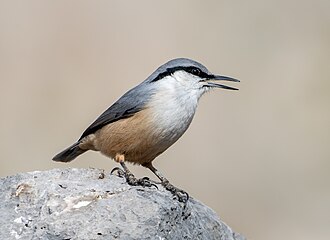
- 茶腹䴓 Sitta europaea 种
- 西部岩䴓 Sitta neumayer 种
- 绒额䴓 Sitta frontalis 种
- 科西嘉䴓 Sitta whiteheadi 种
- 岩䴓 Sitta tephronota 种
- 红胸䴓 Sitta canadensis 种
- 白胸䴓 Sitta carolinensis 种
- 阿尔及利亚䴓 Sitta ledanti 种
- 克鲁氏䴓 Sitta krueperi 种
- 蓝䴓 Sitta azurea 种
- 印度䴓 Sitta castanea 种
- 丽䴓 Sitta formosa 种
- 黑头䴓 Sitta villosa 种
- 克什米尔䴓 Sitta cashmirensis 种
- 巨䴓 Sitta magna 种
- Sitta pygmaea 种
- 白眉䴓 Sitta victoriae 种
- 棕头䴓 Sitta pusilla 种
- 白尾䴓 Sitta himalayensis 种
- 白脸䴓 Sitta leucopsis 种
- 栗臀䴓 Sitta nagaensis 种
- 硫黄嘴䴓 Sitta oenochlamys 种
- 淡紫䴓 Sitta solangiae 种
- 滇䴓 Sitta yunnanensis 种
- 栗腹䴓 Sitta cinnamoventris 种
- 藏䴓 Sitta przewalskii 种
- Sitta arctica 种
- 缅甸䴓 Sitta neglecta 种
百科正文
䴓科只有䴓属(Sitta)一个属,过去曾归为本科的红翅旋壁雀(Trichodroma muraria)现在被单独列为旋壁雀科(Tichodromadidae)。
- 常见的䴓属鸟类包括:
- 白胸䴓 Sitta carolinensis
- 茶腹䴓 Sitta europea
- 丽䴓 Sitta formosa
- 绒额䴓 Sitta frontalis
- 阿尔及利亚䴓 Sitta ledanti
- 喜山䴓 Sitta leucopsis
- 巨䴓 Sitta magna
- 淡紫䴓 Sitta solangiae
- 黑头䴓 Sitta villosa
- 滇䴓 Sitta yunnanensis
以上内容摘自维基百科「鳾屬」,按 CC BY-SA 4.0 使用,去掉了参考文献、外部链接等尾部小节,公式改写成了纯文本。全文、配图和出处见原文。
英文维基百科补充中文条目比较短,下面是英文条目「Nuthatch」的原文
The nuthatches constitute a genus, Sitta, of small passerine birds belonging to the family Sittidae. Characterised by large heads, short tails, and powerful bills and feet, nuthatches advertise their territory using loud, simple songs. Most species exhibit grey or bluish upper parts and a black eye stripe.
Most nuthatches breed in the temperate or montane woodlands of the Northern Hemisphere, although two species have adapted to rocky habitats in the warmer and drier regions of Eurasia. The greatest diversity, though, is in South Asia, and similarities between the species have made identifying distinct species difficult. All members of this genus nest in holes or crevices; most are nonmigratory and live in their habitat year-round, although the North American red-breasted nuthatch migrates to warmer regions during the winter. A few nuthatch species have restricted ranges and face threats from deforestation.
Nuthatches are omnivorous, eating mostly insects, nuts, and seeds. They forage for insects hidden in or under bark by climbing along tree trunks and branches, sometimes upside down. They forage within their territories when breeding, but they may join mixed feeding flocks at other times.
Their habit of wedging a large food item in a crevice and then hacking at it with their strong bills gives this group its English name.
Taxonomy
The nuthatch family, Sittidae, was described by René-Primevère Lesson in 1828.
Sometimes, the wallcreeper (Tichodroma muraria), which is restricted to the mountains of southern Eurasia, was placed in the same family as the nuthatches, but in a separate subfamily "Tichodromadinae", in which case the nuthatches were classified in the subfamily "Sittinae", but the wallcreeper is now placed in a separate family, the Tichodromadidae.
Description
Nuthatches are compact birds with short legs, compressed wings, and square, 12-feathered tails. They have long, sturdy, pointed bills and strong toes with long claws. Nuthatches have blue-grey backs (violet-blue in some Asian species, which also have red or yellow bills) and white underparts, which are variably tinted with buff, orange, rufous, or lilac. Although head markings vary between species, a long black eye stripe, with contrasting white supercilium, dark forehead, and blackish cap is common.
Species
The species diversity for the Sittidae is greatest in southern Asia (possibly the original home of this family), where about 15 species occur, but it has representatives across much of the Northern Hemisphere. The currently recognised nuthatch species are tabulated below.
Distribution and habitat
Members of the nuthatch family live in most of North America and Europe and throughout Asia south to the Wallace Line. They are sparsely represented in Africa; one species lives in a small area of northeastern Algeria and a population of the Eurasian nuthatch subspecies, S. e. hispaniensis, lives in the mountains of Morocco. Most species are resident year-round.
Behaviour
Nesting, breeding, and survival
All nuthatches nest in cavities; except for the two species of rock nuthatches, all use tree holes, making a simple cup lined with soft materials on which to rest eggs. In some species, the lining consists of small, woody objects such as bark flakes and seed husks, while in others, it includes the moss, grass, hair, and feathers typical of passerine birds.
Members of the red-breasted nuthatch superspecies excavate their own tree holes, although most other nuthatches use natural holes or old woodpecker nests.
Conservation status
Some nuthatches, such as the Eurasian nuthatch and the North American species, have extensive ranges and large populations, and few conservation problems, although locally they may be affected by woodland fragmentation. In contrast, some of the more restricted species face severe pressures.
The endangered white-browed nuthatch is found in only the Mount Victoria area of Burma, where forest up to 2,000 m (6,600 ft) above sea level has been almost totally cleared and habitat between 2,000 and 2,500 m (6,600 and 8,200 ft) is heavily degraded.
以上节选摘自英文维基百科「Nuthatch」,按 CC BY-SA 4.0 使用,去掉了参考文献、外部链接等尾部小节,公式改写成了纯文本。篇幅所限,较长的小节只摘了开头一部分,有的小节没有收;全文、配图和出处见原文。