格物
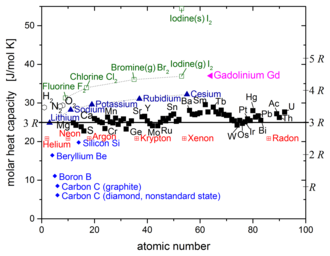
图:Nick B. · CC BY-SA 4.0 · Wikimedia Commons
- 类型
- 定律、经验方程
- 发现 / 发明时间
- 1819 年
- 发现者 / 提出者
- 皮埃尔·路易·杜隆、亚历克西·泰雷兹·珀蒂
- 命名来源
- 皮埃尔·路易·杜隆、亚历克西·泰雷兹·珀蒂
- 属于
- 热力学
- 学科
- 物理学
相关科学家
百科正文
定律的内容为:许多固体其比热容(单位焦耳/(开尔文· 千克))均为3R/M,其中R为普适气体常数(单位焦耳/(开尔文·摩尔))M为摩尔质量(单位千克/摩尔)。换言之,晶体的无量纲热容 (公式略) 恒等于3,其中C为总热容,n为摩尔数,N为包含的原子总数,k为玻尔兹曼常数。
尽管杜隆-珀蒂定律形式极为简单,但它多数晶体在高温下(300K以上)热容的描述仍是十分精确的。在低温下,由于量子效应逐渐明显,本定律不再适用。对晶体低温热容较好的描述是固体物理学中的德拜模型(德拜T3定律)。固体热容的现代理论认为,热容来自固体中晶格的振动。这是爱因斯坦首先提出来的。因此,杜隆-珀蒂定律陈述的是气体经典热容。
以上内容摘自维基百科「杜隆-珀蒂定律」,按 CC BY-SA 4.0 使用,去掉了参考文献、外部链接等尾部小节,公式改写成了纯文本。全文、配图和出处见原文。
英文维基百科补充中文条目比较短,下面是英文条目「Dulong–Petit law」的原文
The Dulong–Petit law, a thermodynamic law proposed by French physicists Pierre Louis Dulong and Alexis Thérèse Petit in 1839, states that the classical expression for the molar heat capacity of certain chemical elements is constant for temperatures far from the absolute zero.
In modern terms, Dulong and Petit found that the heat capacity of a mole of many solid elements is about 3R, where R is the universal gas constant. The modern theory of the heat capacity of solids states that it is due to lattice vibrations in the solid.
The first theoretical proof of the law was given by Ludwig Boltzmann using statistical mechanics in 1877.
History
Experimentally Pierre Louis Dulong and Alexis Thérèse Petit had found in 1819 that the heat capacity per weight (the mass-specific heat capacity) for 13 measured elements was close to a constant value, after it had been multiplied by a number representing the presumed relative atomic weight of the element. These atomic weights had shortly before been proposed by an atomic theory due to John Dalton and subsequently refined by Jacob Berzelius.
Dulong and Petit were unaware of the relationship with R, since this constant had not yet been defined from the later kinetic theory of gases. The value of 3R is about 25 joules per kelvin, and Dulong and Petit essentially found that this was the heat capacity of certain solid elements per mole of atoms they contained.
The Kopp's law developed in 1865 by Hermann Franz Moritz Kopp extended the Dulong–Petit law to chemical compounds from further experimental data.
Equivalent forms of statement of the law
An equivalent statement of the Dulong–Petit law in modern terms is that, regardless of the nature of the substance, the specific heat capacity c of a solid element (measured in joules per kelvin-kilogram) is equal to 3R/M, where R is the gas constant (measured in joules per kelvin-mole) and M is the molar mass (measured in kilograms per mole). Thus, the heat capacity per mole of many elements is 3R.
The initial form of the Dulong–Petit law was cM=K,
where K is a constant which we know today is about 3R.
In modern terms, the mass m of the sample divided by molar mass M gives the number of moles n: m/M=n.
Therefore, using uppercase C for the full heat capacity (in joules per kelvin), we have C(M/m)=C/n=K=3R,
C/n=3R.
That is, the heat capacity of most solid crystalline substances is 3R per mole of substance.
Dulong and Petit did not state their law in terms of the gas constant R (which was not then known).
Application limits
Despite its simplicity, Dulong–Petit law offers a fairly good prediction for the heat capacity of many elementary solids with relatively simple crystal structure at high temperatures. This agreement is because in the classical statistical theory of Ludwig Boltzmann, the heat capacity of solids approaches a maximum of 3R per mole of atoms because full vibrational-mode degrees of freedom amount to 3 degrees of freedom per atom, each corresponding to a quadratic kinetic-energy term and a quadratic potential-energy term. By the equipartition theorem, the average of each quadratic term is 1/2kBT, or 1/2RT per mole (see derivation below). Multiplied by 3 degrees of freedom and the two terms per degree of freedom, this amounts to 3R molar heat capacity.
The Dulong–Petit law fails at room temperatures for light atoms bonded strongly to each other, such as in metallic beryllium and in carbon as diamond.
Derivation for an Einstein solid
A system of vibrations in a crystalline solid lattice can be modeled as an Einstein solid, i.e. by considering N quantum harmonic oscillator potentials along each degree of freedom. Then, the free energy of the system can be written as F=Nε ₀+Nk_(B)T∑ _(α)ln (1-e⁻ħ ω _(α)/k_(B)T),
where the index α sums over all the degrees of freedom. In the 1907 Einstein model (as opposed to the later Debye model), we consider only the high-energy limit: (公式略)
- Then 1-e⁻ħ ω _(α)/k_(B)T≈ ħ ω _(α)/k_(B)T,
- and we have (公式略)
- Define geometric mean frequency by ln ω =1/g∑ _(α)ln ω _(α),
where g measures the total number of spatial degrees of freedom of the system. Then we have F=Nε ₀-gNk_(B)Tln k_(B)T+gNk_(B)Tln ħ ω.
Using energy E=F-T((∂ F)/(∂ T))_(V),
we have E=Nε ₀+gNk_(B)T.
This gives heat capacity at constant volume C_(V)=((∂ E)/(∂ T))_(V)=gNk_(B),
which is independent of the temperature.
For another more precise derivation, see Debye model.
以上节选摘自英文维基百科「Dulong–Petit law」,按 CC BY-SA 4.0 使用,去掉了参考文献、外部链接等尾部小节,公式改写成了纯文本。篇幅所限,较长的小节只摘了开头一部分,有的小节没有收;全文、配图和出处见原文。