格物
- 类型
- 物理定律
- 命名来源
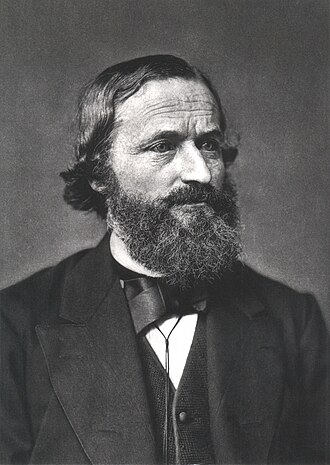
- 古斯塔夫·基尔霍夫
- 属于
- 热力学
- 学科
- 物理学
相关科学家
百科正文
简介
一般研究辐射时采用的黑体模型由于其吸收比等于1(α=1),而实际物体的吸收比则小于1(1>α>0)。基尔霍夫热辐射定律则给出了实际物体的辐射出射度与吸收比之间的关系。 (公式略)
M为实际物体的辐射出射度, M_(b) 为相同温度下黑体的辐射出射度。
而发射率ε的定义即为 (公式略)
所以有ε=α。
所以,在热平衡条件下,物体对热辐射的吸收比恒等于同温度下的发射率。
而对于漫灰体,无论是否处在热平衡下,物体对热辐射的吸收比都恒等于同温度下的发射率。
不同层次的表达式
对于定向的光谱,其基尔霍夫热辐射定律表达式为 ε (λ,θ,φ,T)=α (λ,θ,φ,T)
对于半球空间的光谱,其基尔霍夫热辐射定律表达式为 ε (λ,T)=α (λ,T)
对于全波段的半球空间,其基尔霍夫热辐射定律表达式为 ε (λ,T)=α (λ,T)
θ为纬度角,φ为经度角,λ为光谱的波长,T为温度。
内部链接
热辐射
以上内容摘自维基百科「基尔霍夫热辐射定律」,按 CC BY-SA 4.0 使用,去掉了参考文献、外部链接等尾部小节,公式改写成了纯文本。全文、配图和出处见原文。
英文维基百科补充中文条目比较短,下面是英文条目「Kirchhoff's law of thermal radiation」的原文
In heat transfer, Kirchhoff's law of thermal radiation refers to wavelength-specific radiative emission and absorption by a material body in thermodynamic equilibrium, including radiative exchange equilibrium. It is a special case of Onsager reciprocal relations as a consequence of the time reversibility of microscopic dynamics, also known as microscopic reversibility. It was stated by Gustav Kirchhoff in 1860.
A body at temperature T radiates electromagnetic energy. A perfect black body in thermodynamic equilibrium absorbs all light that strikes it, and radiates energy according to a unique law of radiative emissive power for temperature T (Stefan–Boltzmann law), universal for all perfect black bodies. For a material that is not a perfect black body, Kirchhoff's law states that:
Here, the dimensionless coefficient of absorption (or the absorptivity) is the fraction of incident light (power) at each spectral frequency that is absorbed by the body when it is radiating and absorbing in thermodynamic equilibrium.
In slightly different terms, the emissive power of an arbitrary opaque body of fixed size and shape at a definite temperature can be described by a dimensionless ratio, sometimes called the emissivity: the ratio of the emissive power of the body to the emissive power of a black body of the same size and shape at the same fixed temperature. With this definition, Kirchhoff's law states, in simpler language:
Kirchhoff's law has another corollary: the emissivity cannot exceed one (because the absorptivity cannot, by conservation of energy), so it is not possible to thermally radiate more energy than a black body, at equilibrium. In negative luminescence the angle and wavelength integrated absorption exceeds the material's emission; however, such systems are powered by an external source and are therefore not in thermodynamic equilibrium.
Spectral emission and absorption
Kirchhoff's law of thermal radiation, as originally stated, says that the absorption coefficient for thermal radiation, α, is equal to the emissivity for thermal radiation, ε. This applies in thermal equilibrium (that is, for the absorption and emission of same spectrum of light.)
However, the law can be extended to the absorptivity and emissivity as a function of wavelength: not only is thermal emissivity equal to absorptivity overall, it is equal at each wavelength. Thus, at every wavelength λ, it will be true that α (λ)=ε (λ). Expressed as a function of wavelength, the principle is independent of the requirement for thermal equilibrium.
History
Before Kirchhoff's law was recognized, it had been experimentally established that a good absorber is a good emitter, and a poor absorber is a poor emitter. Naturally, a good reflector must be a poor absorber. This is why, for example, lightweight emergency thermal blankets are based on reflective metallic coatings: they lose little heat by radiation.
Kirchhoff's great insight was to recognize the universality and uniqueness of the function that describes the black body emissive power. But he did not know the precise form or character of that universal function.
Theory
In a blackbody enclosure that contains electromagnetic radiation with a certain amount of energy at thermodynamic equilibrium, this "photon gas" will have a Planck distribution of energies.
One may suppose a second system, a cavity with walls that are opaque, rigid, and not perfectly reflective to any wavelength, to be brought into connection, through an optical filter, with the blackbody enclosure, both at the same temperature. Radiation can pass from one system to the other. For example, suppose in the second system, the density of photons at narrow frequency band around wavelength λ were higher than that of the first system.
Original statements
Gustav Kirchhoff stated his law in several papers in 1859 and 1860, and then in 1862 in an appendix to his collected reprints of those and some related papers.
Prior to Kirchhoff's studies, it was known that for total heat radiation, the ratio of emissive power to absorptive ratio was the same for all bodies emitting and absorbing thermal radiation in thermodynamic equilibrium. This means that a good absorber is a good emitter. Naturally, a good reflector is a poor absorber.
以上节选摘自英文维基百科「Kirchhoff's law of thermal radiation」,按 CC BY-SA 4.0 使用,去掉了参考文献、外部链接等尾部小节,公式改写成了纯文本。篇幅所限,较长的小节只摘了开头一部分,有的小节没有收;全文、配图和出处见原文。