格物
- 类型
- 气体定律
- 命名来源
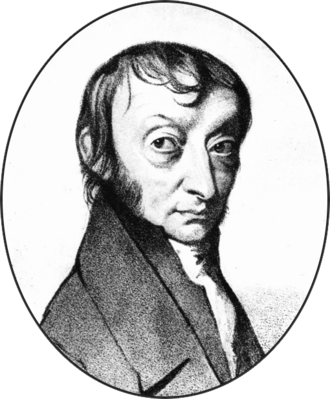
- 阿莫迪欧·阿伏伽德罗
- 属于
- 热力学
- 学科
- 物理学
相关科学家
百科正文
该定律仅适用于理想气体。
内容是:同温、同压时,同体积的任何气体含有相同数目之分子。可被记为: V∝ n
或 (公式略).
- 其中:
- V:气体体积
- n:气体摩尔数
- a:常数,
阿伏伽德罗定律又可以引出另一个重要的定律: 对于任何气体,理想气体常数都具有相同的数值。 (公式略)
- 其中:
- p:气体压力
- T:气体温度
理想气体状态方程
将公式整合后,将 R 作为比例常数,得: pV=nRT
该公式即理想气体状态方程。
摩尔体积
将标准状况设定为 101.325 千帕斯卡、 273.15 K,我们得出一摩尔空气的体积: (公式略)
在100.000 千帕斯卡、273.15 K 时,理想气体的摩尔量是22.712 dm3mol-1。
以上内容摘自维基百科「阿伏伽德罗定律」,按 CC BY-SA 4.0 使用,去掉了参考文献、外部链接等尾部小节,公式改写成了纯文本。全文、配图和出处见原文。
英文维基百科补充中文条目比较短,下面是英文条目「Avogadro's law」的原文
Avogadro's law (sometimes referred to as Avogadro's hypothesis or Avogadro's principle) or Avogadro-Ampère's hypothesis is an experimental gas law relating the volume of a gas to the amount of substance of gas present. The law is a specific case of the ideal gas law. A modern statement is:
"equal volumes of all gases, at the same temperature and pressure, have the same number of molecules."
For a given mass of an ideal gas, the volume and amount (moles) of the gas are directly proportional if the temperature and pressure are constant.
The law is named after Amedeo Avogadro who, in 1811, hypothesized that two given samples of an ideal gas, of the same volume and at the same temperature and pressure, contain the same number of molecules. As an example, equal volumes of gaseous hydrogen and nitrogen contain the same number of molecules when they are at the same temperature and pressure, and display ideal gas behavior. In practice, real gases show small deviations from the ideal behavior and the law holds only approximately, but is still a useful approximation for scientists.
Mathematical definition
- The law can be written as: V∝ n
- V/n=k
- where
- V is the volume of the gas;
- n is the amount of substance of the gas (measured in moles);
k is a constant for a given temperature and pressure.
This law describes how, under the same condition of temperature and pressure, equal volumes of all gases contain the same number of molecules. For comparing the same substance under two different sets of conditions, the law can be usefully expressed as follows: (公式略)
The equation shows that, as the number of moles of gas increases, the volume of the gas also increases in proportion. Similarly, if the number of moles of gas is decreased, then the volume also decreases. Thus, the number of molecules or atoms in a specific volume of ideal gas is independent of their size or the molar mass of the gas.
Derivation from the ideal gas law
The derivation of Avogadro's law follows directly from the ideal gas law, i.e. PV=nRT
where R is the gas constant, T is the Kelvin temperature, and P is the pressure (in pascals).
Solving for V/n, we thus obtain V/n=RT/P
Compare that to k=RT/P
which is a constant for a fixed pressure and a fixed temperature.
An equivalent formulation of the ideal gas law can be written using Boltzmann constant kB, as PV=Nk_(B)T
where N is the number of particles in the gas, and the ratio of R over kB is equal to the Avogadro constant.
In this form, for V/N is a constant, we have (公式略)
If T and P are taken at standard conditions for temperature and pressure (STP), then k′ = 1/n0, where n0 is the Loschmidt constant.
Historical account and influence
Avogadro's hypothesis (as it was known originally) was formulated in the same spirit of earlier empirical gas laws like Boyle's law (1662), Charles's law (1787) and Gay-Lussac's law (1808). The hypothesis was first published by Amedeo Avogadro in 1811, and it reconciled Dalton atomic theory with the "incompatible" idea of Joseph Louis Gay-Lussac that some gases were composite of different fundamental substances (molecules) in integer proportions. In 1814, independently from Avogadro, André-Marie Ampère published the same law with similar conclusions. As Ampère was more well known in France, the hypothesis was usually referred there as Ampère's hypothesis, and later also as Avogadro–Ampère hypothesis or even Ampère–Avogadro hypothesis.
Experimental studies carried out by Charles Frédéric Gerhardt and Auguste Laurent on organic chemistry demonstrated that Avogadro's law explained why the same quantities of molecules in a gas have the same volume. Nevertheless, related experiments with some inorganic substances showed seeming exceptions to the law. This apparent contradiction was finally resolved by Stanislao Cannizzaro, as announced at Karlsruhe Congress in 1860, four years after Avogadro's death. He explained that these exceptions were due to molecular dissociations at certain temperatures, and that Avogadro's law determined not only molecular masses, but atomic masses as well.
Ideal gas law
Boyle, Charles and Gay-Lussac laws, together with Avogadro's law, were combined by Émile Clapeyron in 1834, giving rise to the ideal gas law.
Molar volume
At standard temperature and pressure (100 kPa and 273.15 K), we can use Avogadro's law to find the molar volume of an ideal gas: (公式略)
Similarly, at standard atmospheric pressure (101.325 kPa) and 0 °C (273.15 K): (公式略)
以上节选摘自英文维基百科「Avogadro's law」,按 CC BY-SA 4.0 使用,去掉了参考文献、外部链接等尾部小节,公式改写成了纯文本。篇幅所限,较长的小节只摘了开头一部分,有的小节没有收;全文、配图和出处见原文。