格物
- 类型
- 规律
- 发现者 / 提出者
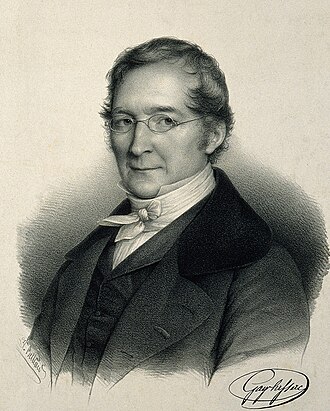
- 约瑟夫·路易·盖-吕萨克
- 命名来源
- 雅克·夏尔
- 属于
- 热力学
- 学科
- 物理学、工程与发明
相关科学家

百科正文
定律概念
当压力不变时,理想气体的体积和温度成正比,即温度每升高(或降低)1°C,其体积也随之增加(或减少)。在数十年后,物理学家鲁道夫·克劳修斯和开尔文男爵建立了热力学第二定律,并提出了热力学温标(即绝对温标)的概念,后来,查理定律被表述为:压强恒定时,一定量气体的体积( V)与其温度( T)成正比。其数学表达式为: V∝ T
此处的 T 为绝对温标。依以上查理定律,一气体在摄氏 t 度的体积 Vₜ 和其温度 t、及其在摄氏0度的体积 V₀ 有以下关系: Vₜ=V₀(1+t/273)
1787年,查理借由研究氧、氮、氢、二氧化碳以及空气等在0°C与100°C间热膨胀的情形,发现每种气体的膨胀率都相同。当压力维持一定时,定量气体温度每升高(或降低)1°C,其体积会增加(或减少)其在0°C时体积的 1/267。(1847年法国化学家亨利·维克托·勒尼奥修正为 1/273.15)。
以上内容摘自维基百科「查理定律」,按 CC BY-SA 4.0 使用,去掉了参考文献、外部链接等尾部小节,公式改写成了纯文本。全文、配图和出处见原文。
英文维基百科补充中文条目比较短,下面是英文条目「Charles's law」的原文
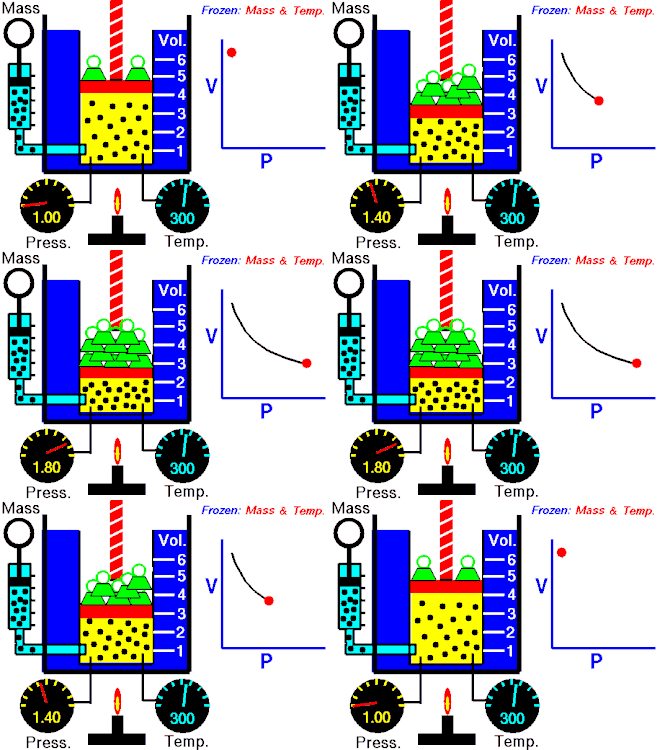
Charles's law (also known as the law of volumes) is an experimental gas law that describes how gases tend to expand when heated. A modern statement of Charles's law is:
When the pressure on a sample of a dry gas is held constant, the Kelvin temperature and the volume will be in direct proportion.
- This relationship of direct proportion can be written as: V∝ T
- So this means: V/T=k, or V=kT
- where:
- V is the volume of the gas,
- T is the temperature of the gas (measured in kelvins), and
k is a constant for a particular pressure and amount of gas.
This law describes how a gas expands as the temperature increases; conversely, a decrease in temperature will lead to a decrease in volume. For comparing the same substance under two different sets of conditions, the law can be written as: (公式略)
The equation shows that, as absolute temperature increases, the volume of the gas also increases in proportion.
History
The law was named after scientist Jacques Charles, who formulated the original law in his unpublished work from the 1780s.
In two of a series of four essays presented between 2 and 30 October 1801, John Dalton demonstrated by experiment that all the gases and vapours that he studied expanded by the same amount between two fixed points of temperature. The French natural philosopher Joseph Louis Gay-Lussac confirmed the discovery in a presentation to the French National Institute on 31 Jan 1802, although he credited the discovery to unpublished work from the 1780s by Jacques Charles. The basic principles had already been described by Guillaume Amontons and Francis Hauksbee a century earlier.
Dalton was the first to demonstrate that the law applied generally to all gases, and to the vapours of volatile liquids if the temperature was well above the boiling point. Gay-Lussac concurred. With measurements only at the two thermometric fixed points of water (0°C and 100°C), Gay-Lussac was unable to show that the equation relating volume to temperature was a linear function. On mathematical grounds alone, Gay-Lussac's paper does not permit the assignment of any law stating the linear relation. Both Dalton's and Gay-Lussac's main conclusions can be expressed mathematically as: V₁₀₀-V₀=kV₀
Relation to absolute zero
Charles's law appears to imply that the volume of a gas will descend to zero at a certain temperature (−266.66 °C according to Gay-Lussac's figures) or −273.15 °C. Gay-Lussac was clear in his description that the law was not applicable at low temperatures:
but I may mention that this last conclusion cannot be true except so long as the compressed vapours remain entirely in the elastic state; and this requires that their temperature shall be sufficiently elevated to enable them to resist the pressure which tends to make them assume the liquid state.
At absolute zero temperature, the gas possesses zero energy and hence the molecules restrict motion.
Gay-Lussac had no experience of liquid air (first prepared in 1877), although he appears to have believed (as did Dalton) that the "permanent gases" such as air and hydrogen could be liquified. Gay-Lussac had also worked with the vapours of volatile liquids in demonstrating Charles's law, and was aware that the law does not apply just above the boiling point of the liquid:
I may, however, remark that when the temperature of the ether is only a little above its boiling point, its condensation is a little more rapid than that of atmospheric air. This fact is related to a phenomenon which is exhibited by a great many bodies when passing from the liquid to the solid-state, but which is no longer sensible at temperatures a few degrees above that at which the transition occurs.
Relation to kinetic theory
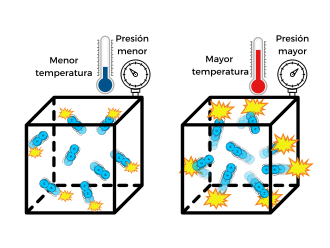
The kinetic theory of gases relates the macroscopic properties of gases, such as pressure and volume, to the microscopic properties of the molecules which make up the gas, particularly the mass and speed of the molecules. To derive Charles's law from kinetic theory, it is necessary to have a microscopic definition of temperature: this can be conveniently taken as the temperature being proportional to the average kinetic energy of the gas molecules, Ek: (公式略)
Under this definition, the demonstration of Charles's law is almost trivial. The kinetic theory equivalent of the ideal gas law relates PV to the average kinetic energy: (公式略)
以上节选摘自英文维基百科「Charles's law」,按 CC BY-SA 4.0 使用,去掉了参考文献、外部链接等尾部小节,公式改写成了纯文本。篇幅所限,较长的小节只摘了开头一部分,有的小节没有收;全文、配图和出处见原文。