格物
- 类型
- 定理
- 命名来源
- 卡尔·弗里德里希·高斯、Ossian Bonnet
- 属于
- 数学定理列表
- 学科
- 物理学、数学
相关科学家
百科正文
定理内容
设 M 是一个紧的二维黎曼流形, ∂ M 是其边界。令 K 为 M 的高斯曲率, k_(g) 为 ∂ M 的测地曲率。则有 ∫ _(M)K dA+∫ _(∂ M)k_(g) ds=2π χ (M),
其中dA是该曲面的面积元,ds是M边界的线元。此处 χ (M) 是 M 的欧拉示性数。
如果 ∂ M 的边界是分段光滑的,我们将 ∫ _(∂ M)k_(g) ds 视作光滑部分相应的积分之和,加上光滑部分在曲线边界上的转过的角度之和。
以上内容摘自维基百科「高斯-博内定理」,按 CC BY-SA 4.0 使用,去掉了参考文献、外部链接等尾部小节,公式改写成了纯文本。全文、配图和出处见原文。
英文维基百科补充中文条目比较短,下面是英文条目「Gauss–Bonnet theorem」的原文
In differential geometry, the Gauss–Bonnet theorem (or Gauss–Bonnet formula) is a fundamental formula which links the curvature of a surface to its underlying topology.
In the simplest application, the case of a triangle on a plane, the sum of its angles is 180 degrees. The Gauss–Bonnet theorem extends this to more complicated shapes and curved surfaces, connecting the local and global geometries.
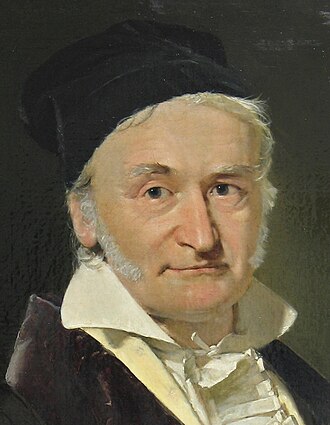
The theorem is named after Carl Friedrich Gauss, who developed a version but never published it, and Pierre Ossian Bonnet, who published a special case in 1848.
Statement
Suppose M is a compact two-dimensional Riemannian manifold with boundary ∂M. Let K be the Gaussian curvature of M, and let kg be the geodesic curvature of ∂M. Then ∫ _(M)K dA+∫ _(∂ M)k_(g) ds=2π χ (M),
where dA is the element of area of the surface, and ds is the line element along the boundary of M. Here, χ(M) is the Euler characteristic of M.
A simple example
Suppose M is the northern hemisphere cut out from a sphere of radius R. Its Euler characteristic is 1. On the left hand side of the theorem, we have K=1/R² and k_(g)=0, because the boundary is the equator and the equator is a geodesic of the sphere. Then, since M has area (公式略), we obtain that ∫ _(M)KdA=2π.
On the other hand, suppose we flatten the hemisphere to make it into a disk. This transformation is a homeomorphism, so the Euler characteristic is still 1.
Interpretation and significance
The theorem applies in particular to compact surfaces without boundary, in which case the integral ∫ _(∂ M)k_(g) ds
can be omitted. It states that the total Gaussian curvature of such a closed surface is equal to 2π times the Euler characteristic of the surface.
For triangles
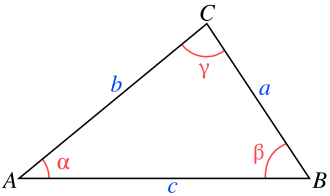
Sometimes the Gauss–Bonnet formula is stated as ∫ _(T)K=2π -∑ α -∫ _(∂ T)κ _(g),
where T is a geodesic triangle. Here we define a "triangle" on M to be a simply connected region whose boundary consists of three geodesics. We can then apply GB to the surface T formed by the inside of that triangle and the piecewise boundary of the triangle.
The geodesic curvature of the bordering geodesics is 0, and the Euler characteristic of T is 1.
Special cases
A number of earlier results in spherical geometry and hyperbolic geometry, discovered over the preceding centuries, were subsumed as special cases of Gauss–Bonnet.
Triangles
In spherical trigonometry and hyperbolic trigonometry, the area of a triangle is proportional to the amount by which its interior angles fail to add up to 180°, or equivalently by the (inverse) amount by which its exterior angles fail to add up to 360°.
Combinatorial analog
There are several combinatorial analogs of the Gauss–Bonnet theorem. We state the following one. Let M be a finite 2-dimensional pseudo-manifold. Let χ(v) denote the number of triangles containing the vertex v. Then (公式略)
where the first sum ranges over the vertices in the interior of M, the second sum is over the boundary vertices, and χ(M) is the Euler characteristic of M.
Similar formulas can be obtained for 2-dimensional pseudo-manifold when we replace triangles with higher polygons.
Generalizations
The Chern theorem (after Shiing-Shen Chern 1945) is the 2n-dimensional generalization of GB (also see Chern–Weil homomorphism).
The Riemann–Roch theorem can also be seen as a generalization of GB to complex manifolds.
A far-reaching generalization that includes all the abovementioned theorems is the Atiyah–Singer index theorem.
A generalization to 2-manifolds that need not be compact is Cohn-Vossen's inequality.
In popular culture
In Greg Egan's novel Diaspora, two characters discuss the derivation of this theorem.
The theorem can be used directly as a system to control sculpture - for example, in work by Edmund Harriss in the collection of the University of Arkansas Honors College.
以上节选摘自英文维基百科「Gauss–Bonnet theorem」,按 CC BY-SA 4.0 使用,去掉了参考文献、外部链接等尾部小节,公式改写成了纯文本。篇幅所限,较长的小节只摘了开头一部分,有的小节没有收;全文、配图和出处见原文。