格物
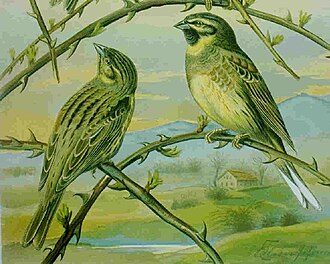
图:Public domain · Wikimedia Commons
生命之树 › 真核生物 › 动物界 › 真后生动物亚界 › 两侧对称动物 › 后口动物总门 › 脊索动物门 › 脊椎动物亚门 › 有颌下门 › 肉鳍鱼总纲 › 四足形类 › 希望螈目 › 四足总纲 › 爬行动物 › 坚尾龙类 › 鸟纲 › 今鸟亚纲 › 今颚下纲 › 新鸟总目 › 雀形目 › 鹀科 › 鹀属
黄道眉鹀种
Emberiza cirlus
The cirl bunting is a passerine bird in the bunting family Emberizidae, a group now separated by most modern authors from the finches, Fringillidae.
摘自英文维基百科「Cirl bunting」(英文维基百科,暂无中文条目),CC BY-SA 4.0
- 学名
- Emberiza cirlus
- 分类等级
- 种
- 英文名
- Cirl Bunting
- 上级类群
- 鹀属
- 大类
- 鸟类
- 命名
- 卡尔·林奈,1766 年
- 保护状况(IUCN)
- 无危物种
- 数据库
- NCBI 分类 · GBIF · IUCN 红色名录
百科正文
本条目暂无中文维基百科条目,下面是英文维基百科原文。
It breeds across southern Europe, on the Mediterranean islands and in north Africa. It is a resident of these warmer areas, and does not migrate in winter. It is common in all sorts of open areas with some scrub or trees, but has a preference for sunny slopes. In the 19th century it was introduced to New Zealand and the persistent population remains in the South Island.
Changes in agricultural practice have affected this species very adversely at the northern fringes of its range, and in England, where it once occurred over much of the south of the country, it is now restricted to south Devon. The cirl bunting is the mascot on the signs for the village of Stokeinteignhead in Devon.
Taxonomy
The cirl bunting was formally described by the Swedish naturalist Carl Linnaeus in 1766 in the twelfth edition of his Systema Naturae under its current binomial name Emberiza cirlus. The genus name Emberiza is from Old German Embritz, a bunting. The specific cirlus is from a local Italian name cirlo, for a type of bunting, from zirlare, "to chirp". The English cirl is derived from cirlus, "probably from zirlare, to whistle as a thrush". The species is monotypic: no subspecies are recognised.
Description
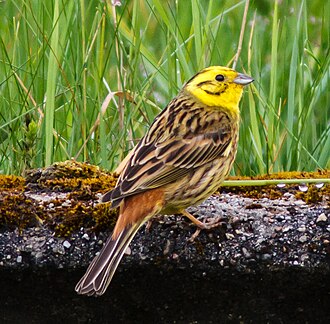
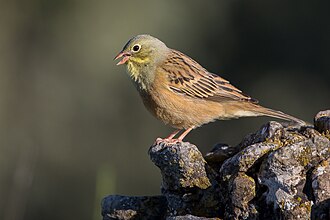
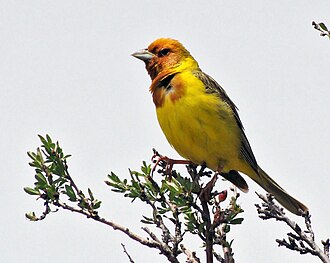
The cirl bunting is like a small yellowhammer (Emberiza citrinella), and is around 15.5 cm (6.1 in) in length with a wing-span 22–25.5 cm (8.7–10.0 in). It has a thick seed-eater's bill. The male has a bright yellow head, with a black crown, eyestripe and throat, and a greenish breast band across its otherwise yellow underparts, and a heavily streaked brown back. The female is much more like the yellowhammer, but has a streaked grey-brown rump and chestnut shoulders.
The monotonous song of the male is a rattling trill, like the Arctic warbler or the terminal rattle of the lesser whitethroat.
Distribution and habitat
The ideal farmland habitat is a mixture of grass and arable fields, divided by thick hedgerows with pockets of dense scrub. They can tolerate a certain degree of urbanisation, and are found in green spaces in towns and cities, even Rome.
They are sedentary in nature and will often travel only 250 metres (820 ft) from their nests to forage in summer, and up to 2 kilometres (1.2 mi) in winter to find stubble.
Behavior and ecology
Breeding
Cirl buntings first breed when they are one year of age. The nest is at low level, within dense cover such as that provided by thick hedgerows and scrub. The ideal scrub is said to be blackthorn, hawthorn, bramble and gorse. The breeding season runs from April until mid-September, usually having two broods but occasionally three. Two to five eggs are laid, which show the hair-like markings characteristic of buntings. They are incubated only by the female and hatch 12–13 days after the last egg is laid. The young are cared for and fed by both parents. They nestlings fledge after 11–13 days but continue to be fed by their parents for a further two or three weeks.
Food and feeding
In the summer their natural food consists of invertebrates for example grasshoppers and crickets to feed their chicks. In the winter they feed on small seeds from over-wintered stubbles, fallow land, set-aside, and the over-winter feeding of stock with grain or hay. They tend to feed in flocks during the winter.
English population
History
A very small cirl bunting population exists in South Devon in England, near the small town of Kingsbridge where the pioneering ornithologist George Montagu discovered the species, as he recorded in his book, the Ornithological Dictionary, 1802. The species appears to have first colonised Britain near Kingsbridge, most likely not long before Montagu described it. It expanded from there across southern England in the nineteenth century. It retreated from the 1930s onwards, so that by 1989 the population again survived mainly near Kingsbridge. Since then, conservation efforts have increased the population more than fivefold, but it remains almost wholly in Devon.
Conservation
Through its Countryside Stewardship Scheme and environmental stewardship, Natural England has various options to conserve the species:
Allow stubbles to overwinter. Leave crops such as spring barley stubble untreated (no fertiliser, pesticide, or cultivation) until the end of the following March. This allows the cirl bunting to feed over the winter on the spilt grain and seeds of broad-leaved arable weeds like fat hen, chickweed, and annual meadow grass Poa annua, which grow in the meantime. The loss of this old farming practice led to the species' decline.
Maintain semi-improved or rough grassland and field margins, particularly tussocky grasses such as cock's-foot. These provide an overwintering habitat for insects, which in turn provides food for the cirl bunting and their chicks.
Sow barley-based wild bird seed mix crop. This crop has an open structure, allowing birds to forage.
Delay spraying insecticides to provide invertebrate food for as long as possible.
Leave hedgerows untrimmed for periods of time. This provides breeding areas and food.
A partnership between Natural England and the RSPB runs the "Cirl Bunting Project", part of a larger project called "Action for Birds". Through the efforts of conservation organisations and landowners, the cirl bunting population has increased from 118 pairs in 1989 to 700 pairs in 2003. However, their range has not expanded.
以上内容摘自英文维基百科「Cirl bunting」,按 CC BY-SA 4.0 使用,去掉了参考文献、外部链接等尾部小节,公式改写成了纯文本。全文、配图和出处见原文。