格物
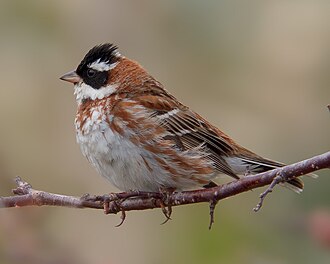
图:Gin tonic · CC BY-SA 3.0 · Wikimedia Commons
- 学名
- Emberiza rustica
- 分类等级
- 种
- 英文名
- Rustic Bunting
- 上级类群
- 鹀属
- 大类
- 鸟类
- 命名
- 彼得·西蒙·帕拉斯,1776 年
- 保护状况(IUCN)
- 近危物种
- 体重
- 2.46 克(出生体重)
- 数据库
- NCBI 分类 · GBIF · IUCN 红色名录
百科正文
分类
属名 Emberiza 来自 古德语 的 Embritz,意指鹀。种名 rustica 在 拉丁文 中意为“乡村的,简朴的”。
描述
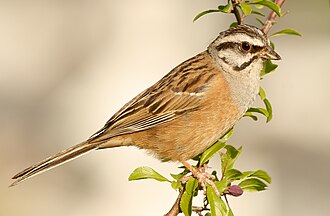
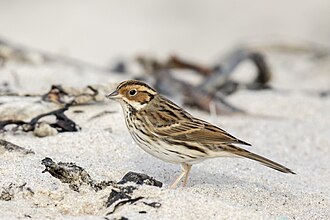
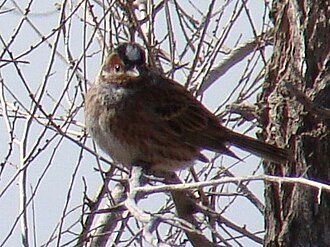
此鸟与 芦鹀 体型相似,腹部为白色,两侧有红褐色斑纹,双脚为粉红色,下喙为粉红色。夏天的雄鸟头部为黑色,喉咙和眉纹呈白色,胸部带有红褐色条纹。
雌鸟背部带有深色条纹,脸部为棕色,眉纹呈白色。她与雌性芦鹀相似,但两侧有红褐色条纹,颈背为栗色,下喙为粉红色,而非灰色。
其叫声为独特的 zit,歌声则是哀婉的 delee-deloo-delee。”
分布
分布于欧洲从挪威、芬兰至美国、向东经西伯利亚至勘察加半岛、南至日本、朝鲜半岛以及中国大陆的内蒙古、东北、宁夏、甘肃、河北、陕西、河南、山东、安徽、湖北、湖南、四川、江苏、浙江、福建、新疆等地,多生活于平原杂木林、人工林、灌木丛和沼泽草甸中以及也在长白山海拔800-1000m的低山区和山麓及开阔田野中。该物种的模式产地在Dauria。
于北部 古北界 繁殖。是 候鸟,冬季迁徙至东南亚、日本、韩国及中国东部。偶尔会在西欧出现。
它繁殖于潮湿的 针叶树 森林中,巢筑于灌木丛或地面,每次产下四到六枚蛋。它的天然食物主要是种子,哺育幼鸟时则以昆虫为食。
亚种
田鹀堪察加亚种(学名:Emberiza rustica latifascia)。分布于西伯利亚、勘察加以及中国大陆的东部等地。该物种的模式产地在勘察加的Rluchi。
田鹀指名亚种(学名:Emberiza rustica rustica)。分布于欧洲、西伯利亚、日本、朝鲜半岛以及中国大陆的内蒙古、东北各省、宁夏、甘肃、新疆、华北、长江流域各省等地。该物种的模式产地在Dauria。
以上内容摘自维基百科「田鹀」,按 CC BY-SA 4.0 使用,去掉了参考文献、外部链接等尾部小节,公式改写成了纯文本。全文、配图和出处见原文。
英文维基百科补充中文条目比较短,下面是英文条目「Rustic bunting」的原文
The rustic bunting (Schoeniclus rusticus) is a small passerine bird in the Old World bunting family Emberizidae, a group now separated by most modern authors from the finches in the family Fringillidae. It breeds in the northern Palearctic from Scandinavia eastwards to the Kamchatka Peninsula and winters to south-eastern China, southern Japan and the Korean Peninsula.
Taxonomy
The rustic bunting was first formally described in 1776 by the Prussian naturalist and explorer Peter Simon Pallas with Dauria in eastern Russia given as the type locality. The specific epithet rusticus is Latin for "rustic or simple".
This species was formerly placed in the genus Emberiza but in 2026 it was moved to the resurrected genus Schoeniclus based on the results of a 2021 molecular genetic study. Within the genus the rustic bunting is sister to the little bunting (S. pusillus).
Description
This bird is similar in size to a common reed bunting. It has white underparts with reddish flank, pink legs and a pink lower mandible. The summer male has a black head with a white throat and supercilium and a reddish breast band.
The female has a heavily streaked brown back and brown face with a whitish supercilium. She resembles a female reed bunting, but has the reddish flank streaks, a chestnut nape and a pink, not grey, lower mandible.
The call is a zit, similar to that of a song thrush (Turdus philomelos), and the song is a melancholic delee-deloo-delee.
Distribution
It breeds across the northern Palearctic. It is migratory, wintering in south-east Asia, Japan, Korea, and eastern China. It is a rare wanderer to western Europe.
Breeding
It breeds in wet coniferous woodland. Four to six eggs are laid in a nest in a bush or on the ground. Its natural food consists of seeds, and when feeding young, insects.
以上内容摘自英文维基百科「Rustic bunting」,按 CC BY-SA 4.0 使用,去掉了参考文献、外部链接等尾部小节,公式改写成了纯文本。全文、配图和出处见原文。