格物
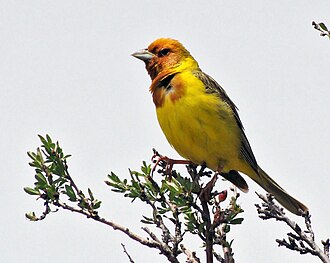
图:Ken and Nyetta · CC BY 2.0 · Wikimedia Commons
生命之树 › 真核生物 › 动物界 › 真后生动物亚界 › 两侧对称动物 › 后口动物总门 › 脊索动物门 › 脊椎动物亚门 › 有颌下门 › 肉鳍鱼总纲 › 四足形类 › 希望螈目 › 四足总纲 › 爬行动物 › 坚尾龙类 › 鸟纲 › 今鸟亚纲 › 今颚下纲 › 新鸟总目 › 雀形目 › 鹀科 › 鹀属
褐头鹀种
Emberiza bruniceps
褐头鹀 为雀科鹀属的鸟类,俗名红头雀、红头鹀。分布于俄罗斯、伊朗、哈萨克、吉尔吉斯、塔吉克、土库曼、乌兹别克、阿富汗、印度、孟加拉和中国。多见于开阔地区的草原、半荒漠的灌丛和草丛中、也在沙漠的小绿洲和山区荒地、常在多水的人造景观中和住宅附近的树上以及一般在海拔1000m左右高处。该物种的模式产地在土库曼。
摘自维基百科「褐头鹀」,CC BY-SA 4.0
- 学名
- Emberiza bruniceps
- 分类等级
- 种
- 英文名
- Red-headed Bunting
- 上级类群
- 鹀属
- 大类
- 鸟类
- 命名
- 约翰·弗里德里希·冯·勃兰特,1841 年
- 保护状况(IUCN)
- 无危物种
- 体重
- 2.77 克(出生体重);24 克(成年体重)
- 数据库
- NCBI 分类 · GBIF · IUCN 红色名录
百科正文
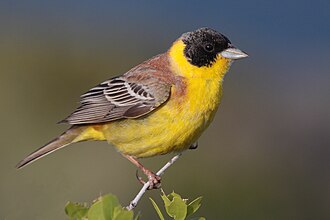
主要在中亚国家繁殖,繁殖期为5至7月,会迁徒至印度和孟加拉越冬。在西欧、台湾本种是迷鸟,但亦可能在此繁殖且容易和圈养逃出的个体混淆。容易混淆的原因是因为这个物种比其相关的黑头鹀(Emberiza melanocephala)更常见,尽管后者物种的繁殖范围更偏西。有英国的报告指出本种在英国的数量急遽下降,与受到鹀科物种自部分亚洲非法鸟类贸易进口之冲击相吻合。
褐头鹀会在开阔的灌木丛甚至农地中繁殖。每巢通常产三至五个蛋。食物主要以种子为食,在需要喂养幼鸟时会捕虫。
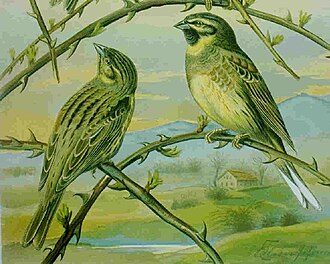
褐头鹀长17厘米,比芦鹀(Emberiza schoeniclus)大并且尾羽更长。繁殖期时雄性下半部呈亮黄色,上半部呈绿色,脸和胸部呈褐红色。
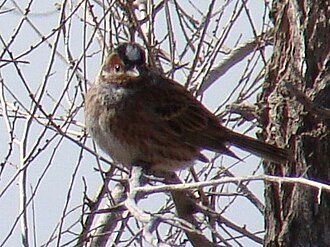
雌性是雄性的褪色版,下半部颜色较浅呈灰褐色,头部为灰色。幼鸟外表跟雌性成鸟很相似,这时羽色和黑头鹀(Emberiza melanocephala)高度相像也容易被混淆。
褐头鹀的叫声偏高音,为略沙哑的sweet-sweet-churri-churri-churri。
以上内容摘自维基百科「褐头鹀」,按 CC BY-SA 4.0 使用,去掉了参考文献、外部链接等尾部小节,公式改写成了纯文本。全文、配图和出处见原文。
英文维基百科补充中文条目比较短,下面是英文条目「Red-headed bunting」的原文
The red-headed bunting (Melophus bruniceps) is a small passerine bird in the Old World bunting family Emberizidae. It breeds in central Asia, including Afghanistan, Iran, Kazakhstan, Kyrgyzstan, Mongolia; Russia (European Russia, Central Asian Russia), Tajikistan, Turkmenistan, Uzbekistan and China. It is migratory, wintering in India and Bangladesh.
This species was formerly placed in the genus Emberiza but in 2026 it was moved to the resurrected genus Melophus based on the results of a 2021 molecular genetic study.
Its status in western Europe, where it is a vagrant, has been confused by escapes, especially as this species has been more commonly recorded than the closely related black-headed bunting, despite the latter having a more westerly breeding range. Reports in Britain have declined dramatically over recent years, coinciding with the decline in some Emberizidae species from the impact of illegal trade. An individual found on Shetland in 2010 was deemed to be wild in origin.
The red-headed bunting breeds in open scrubby areas including agricultural land. It lays three to five eggs in a nest in a tree or bush. Its natural food consists of seeds, or when feeding young, insects.
This bird is 17 cm long, larger than the common reed bunting, with a long tail. The breeding male has bright yellow underparts, green upperparts and a brownish-red face and breast.
The female is a washed-out version of the male, with paler underparts, a grey-brown back and a greyish head. The juvenile is similar, and both can be difficult to separate from the corresponding plumages of black-headed bunting bird.
The song, given from a high perch, is a jerky sweet-sweet-churri-churri-churri.
以上内容摘自英文维基百科「Red-headed bunting」,按 CC BY-SA 4.0 使用,去掉了参考文献、外部链接等尾部小节,公式改写成了纯文本。全文、配图和出处见原文。