格物
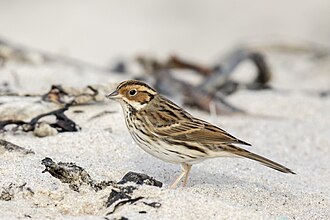
图:Andreas Trepte · CC BY-SA 4.0 · Wikimedia Commons
- 学名
- Emberiza pusilla
- 分类等级
- 种
- 英文名
- Little Bunting
- 上级类群
- 鹀属
- 大类
- 鸟类
- 命名
- 彼得·西蒙·帕拉斯,1776 年
- 保护状况(IUCN)
- 无危物种
- 特有于
- 鹰巢野生动植物保护区、Buxa Tiger Reserve、Neora Valley National Park、默哈嫩达野生动物保护区、辛加利拉国家公园、Senchal Wildlife Sanctuary
- 体重
- 1.89 克(出生体重);15.4 克(成年体重)
- 数据库
- NCBI 分类 · GBIF · IUCN 红色名录
百科正文
分类
小鹀于1776年由彼得·西蒙·帕拉斯首次描述,为一单型物种,在其广泛的古北界分布范围内没有地理变异。
属名Emberiza 来自古高地德语的Embritz,意指鹀。种小名pusilla在拉丁语中意为“非常小”。
描述
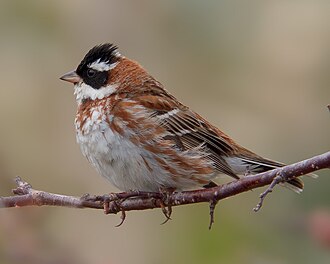
这是一种体型较小的鹀,身长仅12—14 cm(4.7—5.5英寸)。它有白色的腹部,胸部和两侧有深色的斑纹。它的脸部呈栗色,具有白色的颊纹,与小型的雌性芦鹀相似,但头顶有黑色条纹,眼圈为白色,栗色脸颊后方有一道细的深色边缘。雌雄鸟相似。
叫声是独特的zik,而歌声则是连续的siroo-sir-sir-siroo。
分布
分布于欧洲北部、俄罗斯、日本、朝鲜半岛、缅甸、印度以及中国大陆的内蒙古、东北、华北自河北、西至宁夏、甘肃、新疆、南至长江流域、长江以南的广大地区、四川、云南、贵州、海南等地,多栖息于平原、丘陵、山谷和高山以及栖息于灌木丛、小乔木、村边树林与草地、苗圃、麦地和稻田中。该物种的模式产地在西伯利亚达乌尔地区。
生态
小鹀分布于远东北的欧洲和北部欧亚西伯利亚的泰加林地区,直到俄罗斯远东地区。它是迁徙鸟类,冬季迁徙至北印度、南中国及东南亚北部的亚热带地区。这些鸟类在冬季栖地停留时间较长;在云南曾于3月底采集到样本。它是西欧的稀有迷鸟。该物种适应性强;例如在不丹的山区,少数个体在当地过冬,通常出现在农业栖地,大多位于海拔1,000和2,000米(3,300和6,600英尺)。
它在开阔的针叶林中繁殖,通常伴随一些桦树或柳树。每窝产四至六颗鸟蛋,巢筑于树上。它的自然食物是种子,或者在育幼期间为昆虫。
作为一种常见且分布广泛的物种,它在IUCN红色名录中未被视为受威胁。
以上内容摘自维基百科「小鹀」,按 CC BY-SA 4.0 使用,去掉了参考文献、外部链接等尾部小节,公式改写成了纯文本。全文、配图和出处见原文。
英文维基百科补充中文条目比较短,下面是英文条目「Little bunting」的原文
The little bunting (Schoeniclus pusillus) is a small passerine bird belonging to the Old World bunting family Emberizidae.
Taxonomy
First described by Peter Simon Pallas in 1776, the little bunting is a monotypic species, with no geographical variation across its extensive Palearctic range. The specific epithet pusillus is Latin for "very small".
This species was formerly placed in the genus Emberiza but in 2026 it was moved to the resurrected genus Schoeniclus based on the results of a 2021 molecular genetic study.
Description
This is a small bunting, measuring only 12–14 cm (4.7–5.5 in) in length. It has white underparts with dark streaking on the breast and sides. With its chestnut face and white malar stripe, it resembles a small female reed bunting, but has black crown stripes, a white eye-ring, and a fine dark border to the rear of its chestnut cheeks. The sexes are similar.
The call is a distinctive zik, and the song is a rolling siroo-sir-sir-siroo.
Breeding
The little bunting breeds across the taiga of the far north-east of Europe and northern Eurosiberia to the Russian Far East. It is migratory, wintering in the subtropics in northern India, southern China and the northern parts of south-east Asia. The birds remain in their winter quarters for quite long; specimens were taken in Yunnan in late March. It is a rare vagrant to western Europe. This species is adaptable; in the mountains of Bhutan for example, where small numbers winter, it is typically found in an agricultural habitat, mostly between 1,000 and 2,000 metres (3,280 and 6,560 ft) ASL.
It breeds in open coniferous woodland, often with some birch or willow. Four to six eggs are laid in a tree nest. Its natural food consists of seeds, or when feeding young, insects.
A common and widely-ranging species, it is not considered threatened on the IUCN Red List.
以上内容摘自英文维基百科「Little bunting」,按 CC BY-SA 4.0 使用,去掉了参考文献、外部链接等尾部小节,公式改写成了纯文本。全文、配图和出处见原文。