格物
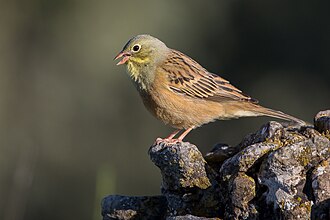
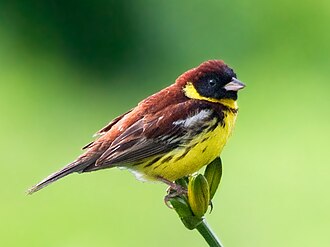
图:Pierre Dalous · CC BY-SA 3.0 · Wikimedia Commons
生命之树 › 真核生物 › 动物界 › 真后生动物亚界 › 两侧对称动物 › 后口动物总门 › 脊索动物门 › 脊椎动物亚门 › 有颌下门 › 肉鳍鱼总纲 › 四足形类 › 希望螈目 › 四足总纲 › 爬行动物 › 坚尾龙类 › 鸟纲 › 今鸟亚纲 › 今颚下纲 › 新鸟总目 › 雀形目 › 鹀科 › 鹀属
圃鹀种
Emberiza hortulana
圃鹀 为雀科鹀属的鸟类。分布地从欧洲、经伊朗、阿富汗、波斯湾至北非和克什米尔以及中国的新疆等地,一般生活于平原和山区、常出没于开阔地区的树上、耕地、公园、苗圃和葡萄园以及甚至沼泽地区。该物种的模式产地在瑞典。
摘自维基百科「圃鹀」,CC BY-SA 4.0
- 学名
- Emberiza hortulana
- 分类等级
- 种
- 英文名
- Ortolan Bunting
- 上级类群
- 鹀属
- 大类
- 鸟类
- 命名
- 卡尔·林奈,1758 年
- 保护状况(IUCN)
- 无危物种
- 体重
- 2.48 克(出生体重)
- 数据库
- NCBI 分类 · GBIF · IUCN 红色名录
百科正文
烤圃鹀在法国被视为珍馐,在朗德省的习俗中品尝烤圃鹀更是家家户户一年一度的传统。然而欧盟在1979年宣布此种鸟为保育类,而法国政府则在1999年跟进,从此食用圃鹀的传统在该国已几乎消逝殆尽,但仍有黑市交易存在,一只圃鹀的价格可高达150至200欧元。
以上内容摘自维基百科「圃鹀」,按 CC BY-SA 4.0 使用,去掉了参考文献、外部链接等尾部小节,公式改写成了纯文本。全文、配图和出处见原文。
英文维基百科补充中文条目比较短,下面是英文条目「Ortolan bunting」的原文
The ortolan (Emberiza hortulana), also called ortolan bunting, is a Eurasian bird in the bunting family Emberizidae, a passerine family now separated by most modern scholars from the finches, Fringillidae. The genus name Emberiza is from Alemannic German Embritz, a bunting. The specific name hortulana is from the Italian name for this bird, ortolana. The English ortolan is derived from Middle French hortolan, "gardener".
The ortolan is served in French cuisine, typically cooked and eaten whole. Traditionally, diners cover their heads with their napkin or a towel while eating the delicacy. The ortolan was so widely eaten that its French populations had dropped dangerously low by the 1990s. French laws protecting the bird, and an EU-wide prohibition against killing or capturing it, have had little effect on the ortolan's numbers.
Taxonomy
The ortolan bunting was described by the Swedish naturalist Carl Linnaeus in 1758 in the tenth edition of his Systema Naturae and retains its original binomial name of Emberiza hortulana. The species is monotypic. A molecular phylogenetic study of the buntings published in 2008 found that the ortolan bunting is most closely related to Cretzschmar's bunting (Emberiza caesia).
Description
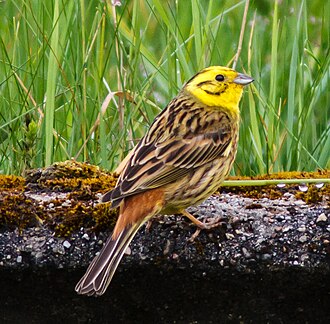
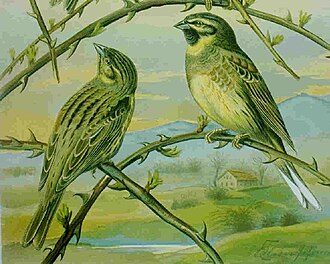
The ortolan bunting is 16–17 centimetres (6+1⁄4–6+3⁄4 inches) in length and has a wing-span of 23–29 cm (9–11+1⁄2 in). In appearance and habits it much resembles its relative the yellowhammer, but lacks the bright colouring of that species; the ortolan's head, for instance, is greenish-grey, instead of a bright yellow. The song of the male ortolan resembles that of the yellowhammer.
Distribution and habitat
A native of most European countries and West Asia, it reaches as far north as Scandinavia and beyond the Arctic Circle, frequenting cornfields and their neighbourhoods. It is an uncommon vagrant in spring, and particularly autumn, to the British Isles. Sightings in the UK are less common than they were, owing to the species' population decline due to overexploitation in France.
It was spotted at Kenjar Coastal Karnataka, India, in November 2018 and photographed by birdwatchers. Some birders commented that it is the first photographic record of an ortolan bunting in India.
Behaviour
Ortolan nests are placed on or near the ground.
The maximum age recorded is six years and ten months for a bird found dead in Switzerland.
Seeds are the natural diet, but beetles and other insects are taken when feeding their young.
Culinary use
The birds are caught with nets set during their autumn migratory flight to Africa. They are then kept in covered cages or boxes, where they are force-fed grain, usually millet seed. Once they have doubled in bulk, they are suspended upside down over a container of Armagnac, and by dipping, are drowned before being marinated in the brandy.
The birds are then plucked, salted and peppered and cooked in their own fat for seven minutes. Many consumers place the bird feet first into their mouth while holding onto the bird's head, eating the ortolan whole, with or without the head. Some spit out the larger bones, while others eat the whole bird head, bones and all. The traditional way French gourmands eat ortolans is to cover their heads and face with a large napkin or towel while consuming the bird. The purpose of the towel is debated.
Legal status
Ortolan hunting was banned in France in 1999, but the law was poorly enforced and it is thought that up to 50,000 ortolans were illegally killed each year during the autumn migration: mostly birds from breeding grounds in Finland and the Baltic area. According to France's League for the Protection of Birds, France's ortolan population fell 30% between 1997 and 2007. In 2007, the French government vowed to strictly enforce some existing rules about banning the practice, with the maximum fine set at €6,000. Killing and cooking ortolans is banned across the European Union. In 2007, the pressure from France's League for Protection of Birds and from the EU resulted in the French government promising to enforce the EU directive protecting the ortolan. After several years of active citizen watch revealing little if any change in the field situation, the local representative of the government repeated this statement in 2016.
- EU member states prohibit:
- deliberate killing or capture of these birds by any method;
以上节选摘自英文维基百科「Ortolan bunting」,按 CC BY-SA 4.0 使用,去掉了参考文献、外部链接等尾部小节,公式改写成了纯文本。篇幅所限,较长的小节只摘了开头一部分,有的小节没有收;全文、配图和出处见原文。