格物

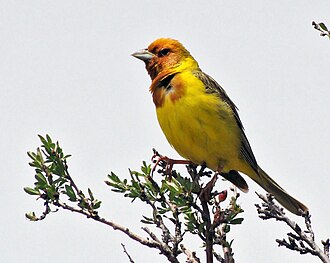
图:Imran Shah from Islamabad, Pakistan · CC BY-SA 2.0 · Wikimedia Commons
- 学名
- Emberiza buchanani
- 分类等级
- 种
- 英文名
- Grey-necked Bunting
- 上级类群
- 鹀属
- 大类
- 鸟类
- 命名
- 爱德华·布莱思,1844 年
- 保护状况(IUCN)
- 无危物种
- 数据库
- NCBI 分类 · GBIF · IUCN 红色名录
百科正文
常见于里海和新疆海拔1900m以下的山地、灌丛或山坡多石砾和石壁的荒野及耕地,本物种的繁殖地广泛,从里海到中亚的阿尔泰山脉都有,会迁徒至南亚部分地区过冬,常一小群出现。在台湾为罕见迷鸟。
本物种在香港只有两笔纪录,根据《香港及华南鸟类》2006年版第228页记载,灰颈鹀在1990年3月17日在米埔有曾出现;而22年后于2012年4月10日,一班行山人士于新界西贡,拍摄得该雀的照片,是灰颈鹀在香港的第二次实质记录。2017年在青海湖仙女湾湿地首次纪录该物种。
亚种
灰颈鹀新疆亚种(学名:Emberiza buchanani neobscura)。分布于俄罗斯、蒙古以及中国大陆的新疆等地。该物种的模式产地在哈萨克斯坦七河地区。
以上内容摘自维基百科「灰颈鹀」,按 CC BY-SA 4.0 使用,去掉了参考文献、外部链接等尾部小节,公式改写成了纯文本。全文、配图和出处见原文。
英文维基百科补充中文条目比较短,下面是英文条目「Grey-necked bunting」的原文
The grey-necked bunting (Emberiza buchanani), sometimes referred to as grey-hooded bunting (a name also in use for chestnut-eared bunting) is a species of bird in the family Emberizidae. It breeds along a wide distribution range from the Caspian Sea to the Altai Mountains in Central Asia and winters in parts of Southern Asia. Like other buntings it is found in small flocks.
Description
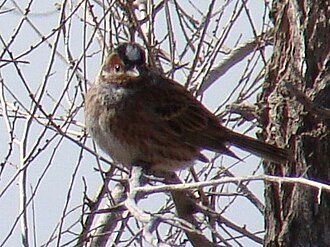
This bunting has a long pink bill and is greyish above. The male has a distinctive white eye-ring that stands out in contrast to the grey hood. The chin and throat are whitish pink and are bordered by grey malar stripes. The underparts are pinkish brown. The female is duller but the moustachial stripe can appear more noticeable. The outer tail feathers are whitish.
The species was described by Edward Blyth based on a drawing by Francis Buchanan-Hamilton after whom the species is named. It has been suggested that the actual date of the description was 1845 due to delays in the publication of the journal of The Asiatic Society. A supposed type specimen in the Indian Museum was never located.
In winter it makes a short subdued click note but the song is a metalling jingle made of swee-swee notes ending with a dzwe-ee-dul.
Three subspecies are noted nominate buchanani, neobscura, and ceruttii.
Habitat and distribution
This bunting is found mainly in dry and open habitats, often stony, scrubby hillsides covered with low thorn scrub. Birds that breed in the Baluchistan region winter in India moving through Gujarat in September and returning in March to their breeding grounds. It is found in Afghanistan, Armenia, Azerbaijan, Bhutan, Nepal, China, Hong Kong, India, Iran, Israel, Kazakhstan, Mongolia, Oman, Pakistan, Russia, Syria, Tajikistan, Turkey, Turkmenistan, and Uzbekistan.
It is an extremely rare vagrant north of its breeding range, with recent records from Finland and the Netherlands, though wanderers may be overlooked due to its similarity, in non-breeding plumage, to the closely related and far commoner ortolan bunting.
They winter in parts of Africa, West Asia, and parts of South Asia as far south as Sri Lanka.
Its natural habitat is temperate grassland mainly below 7000 ft. In winter it is found in weedy or stubbly fields. It nests on the ground under some overhanging vegetation. The nest is lined with grass and hair. The song given from a perch is a series of short and shrill notes that increase in volume.
A tick Hyalomma turanicum has been recorded on birds from Kazakhstan.
Claud Ticehurst noted that males and females migrated separately.
以上内容摘自英文维基百科「Grey-necked bunting」,按 CC BY-SA 4.0 使用,去掉了参考文献、外部链接等尾部小节,公式改写成了纯文本。全文、配图和出处见原文。