格物
- 类型
- 定理
- 命名来源
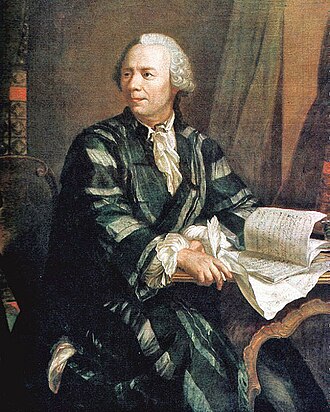
- 莱昂哈德·欧拉
- 属于
- 数学定理列表
- 学科
- 物理学
- 是……的一个方面
- 几何学
相关科学家
百科正文
其中 R 为外接圆半径, r 为内切圆半径。
从欧拉定理可推出欧拉不等式 (当三角形等边时,等号成立): R ≥ 2r.
证明
(1)当 d=0 时,表示外心 O 与内心 I 重合,此时易证三角形 ABC 为正三角形,且 R=2r,因此 d²=R(R-2r)。
(a)设三角形 ABC 的外心为 O,内心为 I,延长 AI 交外接圆于 L,则 L 为弧 BC 的中点。连 LO 延长交外接圆于 M,过 I 作 ID 垂直于 AB, D 为垂足,则 ID=r。易证三角形 ADI 与三角形 MBL 相似,故 ID/BL=AI/ML,即 ID× ML=AI× BL。所以 2Rr=AI× BL。
(b)连接 BI,因 ∠ BIL=∠ BAI+∠ ABI=(∠ BAC)/2+(∠ ABC)/2, ∠ IBL=∠ IBC+∠ CBL=(∠ ABC)/2+(∠ BAC)/2,
所以 ∠ BIL=∠ IBL,有 BL=IL,由(a)的结论知 AI· IL=2Rr。
(c)设 OI 延长线交外接圆于 P, Q 两点,则 PI· QI=AI· IL=2Rr,所以 (R+d)(R-d)=2Rr,即 d²=R(R-2r)。
以上内容摘自维基百科「欧拉定理 (几何)」,按 CC BY-SA 4.0 使用,去掉了参考文献、外部链接等尾部小节,公式改写成了纯文本。全文、配图和出处见原文。
英文维基百科补充中文条目比较短,下面是英文条目「Euler's theorem in geometry」的原文
In geometry, Euler's theorem states that the distance d between the circumcenter and incenter of a triangle is given by d²=R(R-2r)
or equivalently 1/(R-d)+1/(R+d)=1/r,
where R and r denote the circumradius and inradius respectively (the radii of the circumscribed circle and inscribed circle respectively). The theorem is named for Leonhard Euler, who published it in 1765. However, the same result was published earlier by William Chapple in 1746.
From the theorem follows the Euler inequality: R≥ 2r,
which holds with equality only in the equilateral case.
Proof
Let O be the center of the circumcircle of triangle ABC, and let I be the center of its incircle.
If the ray AI intersects the circumcircle at the point L, then L is the midpoint of arc BC. Draw the ray LO and denote its intersection with the circumcircle by M.
Then LM is a diameter of the circumcircle. Drop the perpendicular ID from the point I AB. Then ID=r. Rewrite Euler's formula in the following form: d²-R²=-2rR
Notice that the left-hand side is the power of the point I with respect to the circumcircle.
Therefore, it suffices to prove the equality LI· IA=2Rr.
By the trident lemma, LI=LB, so it suffices to prove that LB· IA=2Rr.
Now observe that 2R=LM and r=ID, that is, the required equality can be rewritten as LB· IA=LM· ID. Rewriting it once more, we obtain LB/LM=ID/IA.
This equality follows from the similarity of triangles (公式略) and (公式略).
Indeed, the angles at B and D in these triangles are right angles, while the angles at A and M are equal because they both subtend the arc BL (moreover, the ratio LB/LM=ID/IA is equal to the sine of the angle ∠ BAL).
Stronger version of the inequality
A stronger version is (公式略)
where a, b, and c are the side lengths of the triangle.
Euler's theorem for the escribed circle
If rₐ and dₐ denote respectively the radius of the escribed circle opposite to the vertex A and the distance between its center and the center of
the circumscribed circle, then dₐ²=R(R+2rₐ).
Euler's inequality in absolute geometry
Euler's inequality, in the form stating that, for all triangles inscribed in a given circle, the maximum of the radius of the inscribed circle is reached for the equilateral triangle and only for it, is valid in absolute geometry.
以上内容摘自英文维基百科「Euler's theorem in geometry」,按 CC BY-SA 4.0 使用,去掉了参考文献、外部链接等尾部小节,公式改写成了纯文本。全文、配图和出处见原文。