格物
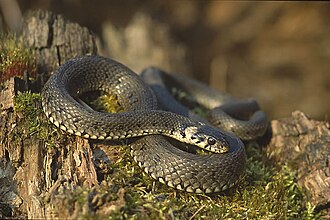
- 学名
- Colubridae
- 分类等级
- 科
- 上级类群
- 有鳞目
- 大类
- 爬行动物
- 命名
- Nicolaus Michael Oppel,1811 年
- 数据库
- NCBI 分类 · GBIF
下级类群(11)
- 黄颔蛇亚科 Colubrinae 亚科
- 白环蛇属 Lycodon 属
- 颌腔蛇属 Coelognathus 属
- Pseudoxenodontinae 亚科
- 渔蛇属 Helicops 属
- 美洲钝头蛇亚科 Dipsadinae 亚科
- 游蛇亚科 Natricinae 亚科
- Calamariinae 亚科
- Gongylosoma 属
- 剑蛇亚科 Sibynophiinae 亚科
- 瘦蛇亚科 Ahaetuliinae 亚科
百科正文
大部分游蛇科下的蛇种都是无毒的(又或者含有轻量而且对人体不构成伤害的毒素),因此对人类的威胁普遍不大。不过游蛇科当中仍然有一些蛇种带有强烈毒素(如非洲树蛇等),它们用以注射毒素的毒牙位处于口腔的较后位置。
分类
其实生物分类学上所谓的“游蛇科”并不是一个自然的分类,比起同科下的其它蛇种,有些蛇反而跟其它蛇科下的蛇(如眼镜蛇)更为亲近。之所以会设立“游蛇科”,最主要是要将一些未能立即作出仔细分类的蛇种集中收容,再留待详细的生物观察及DNA测试研究为这个科下的蛇找出一个更实际的科属。
- 游蛇科下原分为8个亚科:
- 剑蛇亚科 Sibynophiinae
- 游蛇亚科 Natricinae
- 斜鳞蛇亚科 Pseudoxenodontinae
- 食蜗蛇亚科 Dipsadinae
- 葛雷蛇亚科 Grayiinae
- 铁线蛇亚科 Calamariinae
- 瘦蛇亚科 Ahaetuliinae
- 黄颔蛇亚科 Colubrinae
2019年的研究将铁线蛇亚科 (Calamariinae)提升为两头蛇科(Calamariidae)、食蜗蛇亚科 (Dipsadinae)提升为食螺蛇科(Dipsadidae)、游蛇亚科(Natricinae)提升为水游蛇科(Natricidae)、斜鳞蛇亚科(Pseudoxenodontinae)提升为斜鳞蛇科(Pseudoxenodontidae)、剑蛇亚科(Sibynophiinae)提升为剑蛇科(Sibynophiidae)。
以上内容摘自维基百科「游蛇科」,按 CC BY-SA 4.0 使用,去掉了参考文献、外部链接等尾部小节,公式改写成了纯文本。全文、配图和出处见原文。
英文维基百科补充中文条目比较短,下面是英文条目「Colubridae」的原文
Colubridae (, commonly known as colubrids, from Latin: coluber, 'snake') is a family of snakes. With 249 genera, it is the largest snake family. The earliest fossil species of the family date back to the Late Eocene epoch, with earlier origins suspected. Colubrid snakes are found on every continent except Antarctica.
Description
Colubrids are a very diverse group of snakes. They can exhibit many different body styles, body sizes, colours, and patterns. They can also live in many different types of habitats including aquatic, terrestrial, semi-arboreal, arboreal, desert, mountainous forests, semi-fossorial, and brackish waters.
A primarily shy and harmless group of snakes, the vast majority of colubrids are not venomous, nor do most colubrids produce venom that is medically impactful to mammals. However, the bites of some can escalate quickly to emergency situations. Furthermore, within the Colubridae, the South African boomslang and twig snakes, as well as the Asian keelback snakes (Rhabdophis sp.) have long been notorious for inflicting the worst bites on humans, with the most confirmed fatalities.
Some colubrids are described as opisthoglyphous (often simply called "rear-fanged"), meaning they possess shortened, grooved "fangs" located at the back of the upper jaw. It is thought that opisthoglyphy evolved many times throughout the natural history of squamates and is an evolutionary precursor to the larger, frontal fangs of vipers and elapids. These grooved fangs tend to be sharpest on the anterior and posterior edges. While feeding, colubrids move their jaws backward to create a cutting motion between the posterior edge and the prey's tissue. In order to inject venom, colubridae must chew on their prey. Colubrids can also be proteroglyphous (fangs at the front of the upper jaw, followed by small solid teeth)
Reproduction
Most Colubridae are oviparous (mode of reproduction where an egg is produced that will later hatch) with clutch size varying by size and species of snake. However, certain species of snakes from the subfamilies of Natricinae and Colubrinae are viviparous (mode of reproduction where young are live birthed). These viviparous species can birth various amounts of offspring at a time, but the exact number of offspring depends on the size and species of snake.
Classification
In the past, the Colubridae was not a natural group, as many species assigned to it were more closely related to other groups, such as elapids, than to each other. This family was historically used as a "wastebasket taxon" for snakes that did not fit elsewhere. That is, until recently, colubrids were basically all the colubroids that were not elapids, viperids, or Atractaspis.
However, recent research in molecular phylogenetics has stabilized the classification of historically "colubrid" snakes and the family as currently defined is a monophyletic clade, although additional research will be necessary to sort out all the relationships within this group. As of May 2018, eight subfamilies are recognized.
Current subfamilies
- Sibynophiinae – three genera
- Natricinae – 36 genera (sometimes given as family Natricidae)
- Pseudoxenodontinae – two genera
- Dipsadinae – over 100 genera (sometimes given as family Dipsadidae)
- Grayiinae – one genus
- Grayia
- Calamariinae – seven genera
- Ahaetuliinae – five genera
- Colubrinae – 93 genera
- Sub-family currently undetermined
Former subfamilies
These taxa have been at one time or another classified as part of the Colubridae, but are now either classified as parts of other families, or are no longer accepted because all the species within them have been moved to other (sub)families.
Subfamily Aparallactinae (now a subfamily of Lamprophiidae, sometimes combined with Atractaspidinae)
Subfamily Boiginae (now part of Colubrinae)
Fossil record
The oldest colubrid fossils are indeterminate vertebrae from Thailand and specimens of the genus Nebraskophis from the U.S. state of Georgia, both from the Late Eocene. The presence of derived colubrids in North America so early on, despite their presumed Old World origins, suggests that they originated even earlier. The Pliocene (Blancan) fossil record in the Ringold Formation of Adams County, Washington has yielded fossils from a number of colubrids including Elaphe pliocenica, Elaphe vulpina, Lampropeltis getulus, Pituophis catenifer, a Thamnophis species, and the extinct genus Tauntonophis.
以上节选摘自英文维基百科「Colubridae」,按 CC BY-SA 4.0 使用,去掉了参考文献、外部链接等尾部小节,公式改写成了纯文本。篇幅所限,较长的小节只摘了开头一部分,有的小节没有收;全文、配图和出处见原文。