格物
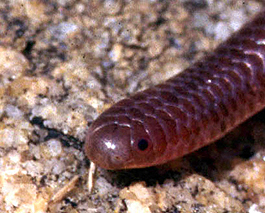
图:Public domain · Wikimedia Commons
- 学名
- Leptotyphlopidae
- 分类等级
- 科
- 上级类群
- 有鳞目
- 大类
- 爬行动物
- 命名
- 莱昂哈德·赫斯·史丹奈格,1892 年
- 数据库
- NCBI 分类 · GBIF
下级类群(3)
百科正文
特征
细盲蛇属于小型蛇,身长甚少超过30公分。它们的头盖骨及上颚是固定的,而且上颚位置没有牙齿。下颚的骨块呈方状,是骨型偏大的复合骨,下颚的牙齿亦较大。位于小安的列斯群岛的双线细盲蛇相信是世界上体型最小的蛇。
细盲蛇主要生活于热带森林中,并以蚂蚁、白蚁与及它们的幼虫及蛹为食。所有细盲蛇都是卵生的。
地理分布
细盲蛇主要分布于非洲、亚洲西部(包括土耳其、印度西北部)、美国西南部(包括墨西哥、中美洲及南美洲)。南美洲内的细盲蛇分布南至秘鲁南部海岸,甚至远至乌拉圭及阿根廷的大西洋海岸。在加勒比地区的巴哈马、伊斯帕尼奥拉岛及小安的列斯群岛一带,亦能找到细盲蛇的踪迹。
以上内容摘自维基百科「細盲蛇科」,按 CC BY-SA 4.0 使用,去掉了参考文献、外部链接等尾部小节,公式改写成了纯文本。全文、配图和出处见原文。
英文维基百科补充中文条目比较短,下面是英文条目「Leptotyphlopidae」的原文
The Leptotyphlopidae (commonly called slender blind snakes or thread snakes) are a family of small snakes found in North America, South America, Africa and Asia. All are fossorial and adapted to burrowing, feeding on ants and termites. Two subfamilies are recognized.
Description
Relatively small snakes, leptotyphlopids rarely exceed 30 cm (12 in) in length; only Trilepida macrolepis and Leptotyphlops occidentalis grow larger. The cranium and upper jaws are immobile and no teeth are in the upper jaw. The lower jaw consists of a much elongated quadrate bone, a tiny compound bone, and a relatively larger dentary bone. The body is cylindrical with a blunt head and a short tail. The scales are highly polished. The pheromones they produce protect them from attack by termites. Among these snakes is what is believed to be the world's smallest: L. carlae (Hedges, 2008).
Geographic range
Leptotyphlopids are found in Africa, western Asia from Turkey to eastern India, on Socotra Island, and from the southwestern United States south through Mexico and Central America to South America, though not in the high Andes. In Pacific South America, they occur as far south as southern coastal Peru, and on the Atlantic side as far as Uruguay and Argentina. In the Caribbean, they are found on the Bahamas, Hispaniola, Jamaica and the Lesser Antilles.
Habitat
Leptotyphlopids occur in a wide variety of habitats from arid areas to rainforest, and are known to occur near ant and termite nests.
Feeding
The diets of leptotyphlopids consist mostly of termite or ant larvae, pupae, and adults. Most species suck out the contents of insect bodies and discard the exoskeleton.
Reproduction
Snakes in the family Leptotyphlopidae are oviparous.
Taxonomy
- Subfamily Leptotyphlopinae
- Genus Epacrophis Hedges, Adalsteinsson & Branch, 2009 (3 species)
- Genus Leptotyphlops Fitzinger, 1843 (21 species)
- Genus Myriopholis Hedges, Adalsteinsson & Branch, 2009 (23 species)
- Genus Namibiana Hedges, Adalsteinsson & Branch, 2009 (5 species)
- Subfamily Epictinae
- Tribe Epictini, New World snakes
- Subtribe Epictina
- Genus Epictia Gray, 1845 (44 species)
Genus Habrophallos Martins, Koch, Pinto, Folly, Fouquet & Passos, 2020 (monotypic, collared blind snake)
- Genus Siagonodon W. Peters, 1881 (4 species)
- Subtribe Renina
- Genus Rena Baird & Girard, 1853 (10 species)
- Genus Trilepida Hedges, 2011 (14 species)
- Subtribe Tetracheilostomina
- Genus Mitophis Hedges, Adalsteinsson & Branch, 2009 (4 species)
- Genus Tetracheilostoma Jan, 1861 (3 species)
- Tribe Rhinoleptini, African snakes
- Genus Tricheilostoma Jan, 1860 (5 species)
Genus Rhinoleptus Orejas-Miranda, Roux-Estève & Guibé, 1970 (monotypic, Villiers's blind snake)
Genus Rhinoguinea J.-F. Trape, 2014 (monotypic, Rhinoguinea magna)
以上内容摘自英文维基百科「Leptotyphlopidae」,按 CC BY-SA 4.0 使用,去掉了参考文献、外部链接等尾部小节,公式改写成了纯文本。全文、配图和出处见原文。