格物
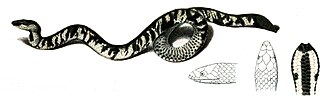
图:Public domain · Wikimedia Commons
生命之树 › 真核生物 › 动物界 › 真后生动物亚界 › 两侧对称动物 › 后口动物总门 › 脊索动物门 › 脊椎动物亚门 › 有颌下门 › 肉鳍鱼总纲 › 四足形类 › 希望螈目 › 四足总纲 › 爬行动物 › 鳞龙形下纲 › 鳞龙超目 › 有鳞目
盾尾蛇科科
Uropeltidae
盾尾蛇科,又名针尾蛇科,是蛇亚目下的一个科,这个科内的蛇类都具备洞栖性,主要分布于印度南部及斯里兰卡。盾尾蛇的学名“Urapeltidae”语源来自希腊语的“ura”及“pelte”,意思分别是“尾巴”与“盾牌”,表示盾尾蛇的尾部尖端的大型角质盾状物。目前,盾尾蛇科内有8个属共47个品种已被确认。
摘自维基百科「盾尾蛇科」,CC BY-SA 4.0
- 学名
- Uropeltidae
- 分类等级
- 科
- 上级类群
- 有鳞目
- 大类
- 爬行动物
- 命名
- 约翰内斯·彼得·米勒
- 数据库
- NCBI 分类 · GBIF
下级类群(5)
百科正文
特征
盾尾蛇属于小型蛇,成年的盾尾蛇大约有20至75公分长。盾尾蛇栖身于地下,它们的骨骼构造比较原始,弹性亦不足,颚骨僵硬,骨块呈四方形,下颚仍然保留喙状骨,但却眼窝骨却已经消失。同时,盾尾蛇头顶上侧的骨骼组织亦呈退化迹象,双眼细小,而且开始变质(蛇类眼睛上应有一片薄膜,但盾尾蛇的眼睛却有一块多边形的甲块),盆骨亦已消失。另外,针尾蛇的尾部是最具特色的地方。
地理分布
盾尾蛇主要分布于印度南部及斯里兰卡。在印度里,盾尾蛇主要是沿西高止山脉分布;在斯里兰卡,盾尾蛇只聚集于气候与西高止山脉接近的地区,例如斯里兰卡的西南部。
饮食及繁殖
盾尾蛇主要进食无脊椎动物,例如蚯蚓。不过相关研究仍相当贫乏,因此盾尾蛇的饮食习惯也许尚有商榷之处。另外,所有盾尾蛇都是卵胎生动物。
以上内容摘自维基百科「盾尾蛇科」,按 CC BY-SA 4.0 使用,去掉了参考文献、外部链接等尾部小节,公式改写成了纯文本。全文、配图和出处见原文。
英文维基百科补充中文条目比较短,下面是英文条目「Uropeltidae」的原文
The Uropeltidae, also commonly known as shield-tail snakes, shield-tailed snakes or earth snakes, are a family of primitive, nonvenomous, burrowing snakes native to Peninsular India and Sri Lanka. The name is derived from the Greek words ura (tail) and pelte (shield), indicating the presence of the large, keratinous shield at the tip of the tail. Seven or eight genera are recognized, depending on whether Teretrurus rhodogaster is treated in its own genus or as part of Brachyophidium. The family comprises over 50 species, but they are not well known in terms of their diversity, biology, and natural history.
Description
Snakes in the family Uropeltidae are small snakes, with adults growing to a total length (including tail) of 20–75 cm (7.9–29.5 in). They are adapted to a fossorial way of life, which is apparent in their anatomy. The skull is primitive and inflexible, with a short, vertical quadrate bone and rigid jaws; the coronoid bone is still present in the lower jaw. The orbital bones are absent, the supratemporal is vestigial, and the eyes are small and degenerated, not covered by a brille, but by large, polygonal shields. However, the pelvis and hind limbs, the presence of which is also considered a primitive trait, have disappeared in this family.
The tail is characteristic, ending in either an enlarged, rigid scale with two points, or more often an upper surface with a subcircular area covered with thickened, spiny scales, or a much enlarged, spiny plate. The ventral scales are much reduced in size. The body is cylindrical and covered with smooth scales.
Behaviour and natural history
Many species of shield-tail snakes are rather poorly known in terms of natural history. Field studies indicate that most species are obligate burrowers and may often come out on to soil surface during rainy nights. Even roadkills of these snakes have been recorded by field biologists during peak monsoon rains. They seem to prefer the humus-rich topsoil layers and rarely burrow deeper inside (like during very hot or dry weather).
When approached by predators, these snakes do not bite like most snakes, but coil their bodies into a ball and hide their heads tucked underneath. Some may poke with their harmless tail tip, like a worm snake. Many have a drab and dull-coloured back, but a very bright, contrastingly coloured underside (such as bright yellow, red, etc.) to startle predators by turning upside down and twitching. This aposematic colouration wards off would-be predators.
Geographic range
Shield-tail snakes are found in Peninsular India and Sri Lanka. In India, their distribution is mainly along the hills of the Western Ghats, and a few species occur in other areas such as the Eastern Ghats and the hills of Central India. In Sri Lanka, they occur in many biotopes, including dry zones and the plains.
Evolutionary significance
Because of their peculiar geographic distribution, with many hill ranges in South India and Sri Lanka each having an endemic shield-tail snake, they are thought to be analogous to Darwin's finches, in a broader sense – an evolutionary radiation. This is the only family of snakes endemic to South Asia. Genetic studies on this group have brought forth largely similar results as regards common ancestry and phenotypic diversification patterns.
Molecular dating analysis has suggested that uropeltids originated around the Paleocene-Eocene boundary, splitting from its sister clade Cylindrophiidae + Anomochilidae around 56 MYA.
Feeding
The diets of shield-tail snakes consist mostly of invertebrates, particularly earthworms, and many species have actually been observed in the wild by researchers to eat earthworms. Frank Wall, who dissected many species for analysing gut contents to study their diet, confirmed the presence of worms and mud.
Reproduction
All members of the family Uropeltidae retain eggs that hatch within the body of the female (ovoviviparity).
Genera
T Type genus.
以上内容摘自英文维基百科「Uropeltidae」,按 CC BY-SA 4.0 使用,去掉了参考文献、外部链接等尾部小节,公式改写成了纯文本。全文、配图和出处见原文。