格物
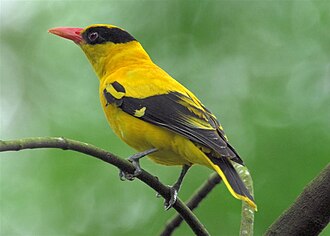
图:Natureatyourbackyard, Flickr User · CC BY 2.0 · Wikimedia Commons
- 学名
- Oriolidae
- 分类等级
- 科
- 上级类群
- 雀形目
- 大类
- 鸟类
- 命名
- 尼古拉斯·艾尔沃德·维戈斯,1825 年
- 数据库
- GBIF
下级类群(3)
百科正文
下属分类
- 本科包括以下属:
- Amimeta Mathews, 1913
- Galbula Scopoli, 1777
- Leptopteryx Horsfield, 1821
- Longmornis Boles, 1999
- Mimetes Vigors, 1826
- 黄鹂属 Oriolus Linnaeus, 1766
- 林鵙鹟属 Pitohui Lesson, 1831
- 裸眼鹂属 Sphecotheres Vieillot, 1816
以上内容摘自维基百科「黄鹂科」,按 CC BY-SA 4.0 使用,去掉了参考文献、外部链接等尾部小节,公式改写成了纯文本。全文、配图和出处见原文。
英文维基百科补充中文条目比较短,下面是英文条目「Old World oriole」的原文
The Old World orioles (Oriolidae) are an Old World family of passerine birds. The family contains 41 species which are divided in 4 genera. The family includes two extinct species from New Zealand that are placed in the genus Turnagra.
Taxonomy and systematics
The family Oriolidae comprises the piopios, figbirds, pitohuis and the Old World orioles. The piopios were added in 2011, having been formerly placed in the family Turnagridae. Several other genera have been proposed to split up the genus Oriolus. For example, the African black-headed species are sometimes placed in a separate genus, Baruffius. The family Oriolidae is not closely related to the New World orioles, despite their similar size, diet, behaviour and contrasting plumage patterns. Rather, these similarities are an example of convergent evolution.
Extinct genera
- There are at least two extinct genera in the family Oriolidae:
- Genus Turnagra – piopios (2 extinct species)
- Genus Longmornis – Longmornis robustirostrata
Description
The orioles and figbirds are medium-sized passerines, around 20–30 cm in length, with the females only slightly smaller than the males. The beak is slightly curved and hooked, and, except in the figbirds, as long again as the head. The plumage of most species is bright and showy, although the females often have duller plumage than the males do. The plumage of many Australasian orioles mimics that of friarbirds (a genus of large honeyeaters), probably to reduce aggression against the smaller orioles.
Distribution and habitat
The family is distributed across Europe, Africa, Asia, and Australia. The few temperate nesting species are migratory, and some tropical species also show seasonal movements.
Behaviour and ecology
Breeding
Orioles are monogamous, breeding in territorial pairs (although the Australasian figbird, and possibly also the other figbirds, breed in loose colonies). Nesting sites may be chosen near aggressive species such as shrikes, drongos or friarbirds, which confer a degree of protection. The nest is a deep woven cup suspended like a hammock from a branch. They usually lay two or three eggs, but as many as six have been recorded.
Food and feeding
Orioles are arboreal and tend to feed in the canopy. Many species are able to survive in open forests and woodlands, although a few are restricted to closed forest. They are opportunistic omnivores, with the main components of their diet being fruit, berries, arthropods, and nectar.
以上内容摘自英文维基百科「Old World oriole」,按 CC BY-SA 4.0 使用,去掉了参考文献、外部链接等尾部小节,公式改写成了纯文本。全文、配图和出处见原文。