格物
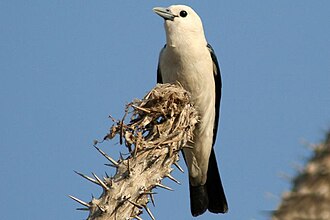
图:Fred.leviez · CC BY-SA 3.0 · Wikimedia Commons
生命之树 › 真核生物 › 动物界 › 真后生动物亚界 › 两侧对称动物 › 后口动物总门 › 脊索动物门 › 脊椎动物亚门 › 有颌下门 › 肉鳍鱼总纲 › 四足形类 › 希望螈目 › 四足总纲 › 爬行动物 › 坚尾龙类 › 鸟纲 › 今鸟亚纲 › 今颚下纲 › 新鸟总目 › 雀形目
钩嘴鵙科科
Vangidae
钩嘴鵙科 是雀形目的一个科,包含39个物种,分类为以下21属:
Calicalicus
钩嘴鵙属 Vanga
黑头莺嘴鵙属 Oriolia
厚嘴鵙属 Xenopirostris
弯嘴鵙属 Falculea
白头钩嘴鵙属 Artamella
黑钩嘴鵙属 Leptopterus
蓝钩嘴鵙属 Cyanolanius
棕钩嘴鵙属 Schetba
盔鵙属 Euryceros
泰拉钩嘴鵙属 Tylas
红嘴钩嘴鵙属 Hypositta
牛顿莺属 Newtonia
瓦氏鹟属 Pseudobias
克氏须鹛属 Mystacornis
盔鵙属 Prionops
鹟鵙属 Hemipus
钩嘴林鵙属 Tephrodornis
王鵙属 Philentoma
非洲鵙鹟属 Megabyas
黑白鵙鹟属 Bias
摘自维基百科「钩嘴鵙科」,CC BY-SA 4.0
- 学名
- Vangidae
- 分类等级
- 科
- 上级类群
- 雀形目
- 大类
- 鸟类
- 命名
- 威廉·约翰·斯温森,1831 年
- 异名
- 林鵙科
- 数据库
- NCBI 分类 · GBIF
下级类群(6)
- 红尾钩嘴鵙属 Calicalicus 属
- 鹟鵙 Hemipus 属
- Philentoma 属
- 林鵙属 Tephrodornis 属
- Prionops 属
- Xenopirostris 属
百科正文
- Calicalicus
- 钩嘴鵙属 Vanga
- 黑头莺嘴鵙属 Oriolia
- 厚嘴鵙属 Xenopirostris
- 弯嘴鵙属 Falculea
- 白头钩嘴鵙属 Artamella
- 黑钩嘴鵙属 Leptopterus
- 蓝钩嘴鵙属 Cyanolanius
- 棕钩嘴鵙属 Schetba
- 盔鵙属 Euryceros
- 泰拉钩嘴鵙属 Tylas
- 红嘴钩嘴鵙属 Hypositta
- 牛顿莺属 Newtonia
- 瓦氏鹟属 Pseudobias
- 克氏须鹛属 Mystacornis
- 盔鵙属 Prionops
- 鹟鵙属 Hemipus
- 钩嘴林鵙属 Tephrodornis
- 王鵙属 Philentoma
- 非洲鵙鹟属 Megabyas
- 黑白鵙鹟属 Bias
以上内容摘自维基百科「钩嘴鵙科」,按 CC BY-SA 4.0 使用,去掉了参考文献、外部链接等尾部小节,公式改写成了纯文本。全文、配图和出处见原文。
英文维基百科补充中文条目比较短,下面是英文条目「Vanga」的原文
The family Vangidae (from vanga, Malagasy for the hook-billed vanga, Vanga curvirostris) comprises a group of often shrike-like medium-sized birds distributed from Asia to Africa, including the vangas of Madagascar to which the family owes its name. Many species in this family were previously classified elsewhere in other families. Recent molecular techniques made it possible to assign these species to Vangidae, thereby solving several taxonomic enigmas. The family contains 40 species divided into 21 genera.
Taxonomy
In addition to the small set of Malagasy species traditionally called the vangas, Vangidae includes some Asian groups: the woodshrikes (Tephrodornis), flycatcher-shrikes (Hemipus) and philentomas.
Vangidae belongs to a clade of corvid birds that also includes bushshrikes (Malaconotidae), ioras (Aegithinidae) and the Australian butcherbirds, magpies and currawongs (Cracticidae) and woodswallows (Artamidae), which has been defined as the superfamily Malaconotoidea. They seem closely related to some enigmatic African groups: the helmetshrikes (Prionops) and the shrike-flycatchers (Bias and Megabyas).
Description
The vangas are an example of adaptive radiation, having evolved from a single founding population into a variety of forms adapted to various niches occupied by other bird families in other parts of the world. They differ in size, colour and bill shape but are similar in skull shape and bony palate structure. They are small to medium-sized birds, varying from 12 to 32 cm in length. Many have strong, hooked bills similar to those of shrikes. The helmet vanga has a particularly large bill with a casque on top. Other species, such as the newtonias, have a small, thin bill. The sickle-billed vanga is notable for its long, curved bill used to probe into holes and cracks.
Distribution and habitat
They are native to Sub-Saharan Africa and the Indomalayan realm, although most are endemic to Madagascar in a variety of forest and scrub habitats. Several species including Van Dam's vanga and sickle-billed vanga can be found in the dry deciduous forests in the west of the island. Some such as Crossley's vanga, helmet vanga and Bernier's vanga are restricted to rainforest in the east of the island. Lafresnaye's vanga and the recently discovered red-shouldered vanga occur in subarid thorn scrub in the south-west.
Behaviour
Their diet can include insects, earthworms, millipedes, lizards and amphibians. The blue vanga and chabert vanga occasionally eat fruit. Many species feed in small groups, often in mixed-species foraging flocks. The hook-billed vanga and Lafresnaye's vanga tend to forage alone. Vangas have a variety of different foraging strategies. Many species glean food as they move through the branches. The nuthatch vanga climbs up trunks and branches like a nuthatch but does not climb downwards as nuthatches do. Crossley's vanga forages by walking along the forest floor amongst the leaf litter. The chabert vanga and the tylas vanga often fly into the air to catch prey.
Status and conservation
Some species of vanga are common such as the chabert vanga which can survive in secondary woodland and plantations of introduced trees. Several other species are threatened by loss of their forest habitat. Pollen's vanga is classed as near-threatened by BirdLife International and the red-shouldered vanga, Bernier's vanga, helmet vanga and red-tailed newtonia are regarded as vulnerable. Van Dam's vanga is classed as endangered because it is restricted to a small area of north-west Madagascar where the forest is rapidly disappearing due to clearance for agriculture and uncontrolled bushfires.
Species list
The family contains 21 genera and 40 species.
- FAMILY: VANGIDAE
- Genus: Calicalicus
- Red-tailed vanga, Calicalicus madagascariensis
- Red-shouldered vanga, Calicalicus rufocarpalis
- Genus: Schetba
- Rufous vanga, Schetba rufa
- Genus: Vanga
- Hook-billed vanga, Vanga curvirostris
- Genus: Xenopirostris
- Lafresnaye's vanga, Xenopirostris xenopirostris
- Van Dam's vanga, Xenopirostris damii
- Pollen's vanga, Xenopirostris polleni
- Genus: Falculea
- Sickle-billed vanga, Falculea palliata
- Genus: Artamella
- White-headed vanga, Artamella viridis
- Genus: Leptopterus
- Chabert vanga, Leptopterus chabert
- Genus: Cyanolanius
- Madagascar blue vanga, Cyanolanius madagascarinus
Comoros blue vanga, Cyanolanius comorensis.
- Genus: Oriolia
- Bernier's vanga, Oriolia bernieri
以上节选摘自英文维基百科「Vanga」,按 CC BY-SA 4.0 使用,去掉了参考文献、外部链接等尾部小节,公式改写成了纯文本。篇幅所限,较长的小节只摘了开头一部分,有的小节没有收;全文、配图和出处见原文。