格物
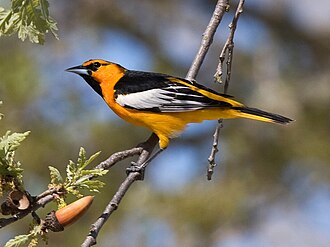
图:Kevin Cole from Pacific Coast, USA (en:User:Kevinlcole) · CC BY 2.0 · Wikimedia Commons
- 学名
- Icteridae
- 分类等级
- 科
- 上级类群
- 雀形目
- 大类
- 鸟类
- 命名
- 尼古拉斯·艾尔沃德·维戈斯,1825 年
- 数据库
- NCBI 分类 · GBIF
下级类群(14)
百科正文
大部分的拟黄鹂科鸟类都生活在热带地区,但也有一些种,例如长尾草地鹨等生活在温带地区。拥有最多的拟黄鹂的地区是哥伦比亚及墨西哥南部。有些拟黄鹂科的鸟类,例如红翅黑鹂因为喜食蔬菜及其他作物而成为了农业害鸟。
特征
拟黄鹂科的种类有明显的两性异形特征,雌雄的体态特征极为不同。其下最小的种为圃拟黄鹂,其雌性平均体长15厘米(5.9英寸),重18克(0.63盎司);最大的则是帕拉拟黄鹂,其雄性体长约52厘米(20英寸),重550克(19盎司)。
大多数拟黄鹂科的鸟类都是群居的,其中有些牛鹂有巢寄生的习性。
属
- 拟黄鹂科下的属包括:
- 刺歌雀属 Dolichonyx
- 黑鹂属 Agelaius
- 橙头黑鹂属 Xanthopsar
- 白眼黑鹂属 Agelasticus
- 栗顶黑鹂属 Chrysomus
- 牙买加黑鹂属 Nesopsar
- 草地鹨属 Sturnella
- 黄头黑鹂属 Xanthocephalus
- 艳拟鹂属 Dives
- 锈色黑鹂属 Euphagus
- 拟八哥属 Quiscalus
- 栗翅牛鹂属 Agelaioides
- 牛鹂属 Molothrus
- 拟黄鹂属 Icterus
- 黄嘴酋长鹂属 Amblycercus
- 酋长鹂属 Cacicus
- 拟椋鸟属 Psarocolius
- 黄头拟鹂属 Gymnomystax
- 沼泽雀属 Pseudoleistes
- 红头黑鹂属 Amblyramphus
- 红腹拟鹩哥属 Hypopyrrhus
- 南美黑鹂属 Curaeus
- 巴西拟鹂属 Gnorimopsar
- 绒额拟鹩哥属 Lampropsar
- 山鹩哥属 Macroagelaius
以上内容摘自维基百科「擬黃鸝科」,按 CC BY-SA 4.0 使用,去掉了参考文献、外部链接等尾部小节,公式改写成了纯文本。全文、配图和出处见原文。
英文维基百科补充中文条目比较短,下面是英文条目「Icterid」的原文
Icterids or New World blackbirds make up a family, the Icteridae , of small to medium-sized, often colorful, New World passerine birds. The family contains 108 species and is divided into 30 genera. Most species have black as a predominant plumage color, often enlivened by yellow, orange, or red. The species in the family vary widely in size, shape, behavior, and coloration.
Etymology
The name, meaning "jaundiced ones" (from the prominent yellow feathers of many species) comes from the Ancient Greek: ἴκτερος - íkteros via the Latin: ictericus.
Relationship to other species
This group includes the New World blackbirds, New World orioles, the bobolink, meadowlarks, grackles, cowbirds, oropendolas, and caciques.
Despite the similar names, the first groups are only distantly related to the Old World common blackbird (a thrush) or to the Old World orioles.
The Icteridae are not to be confused with the Icteriidae, a family created in 2017 and consisting of one species — the yellow-breasted chat (Icteria virens).
Characteristics
Most icterid species live in the tropics, although many species also occur in temperate regions, such as the red-winged blackbird and the long-tailed meadowlark. The highest densities of breeding species are found in Colombia and southern Mexico. They inhabit a range of habitats, including scrub, swamp, forest, and savanna. Temperate species are migratory, with many species that nest in the United States and Canada moving south into Mexico and Central America.
Icterids are variable in size, and often display considerable sexual dimorphism, with brighter coloration and greater size in males being typical. While such dimorphism is widely known in passerines, the sexual dimorphism by size is uniquely extreme in icterids. For example, the male great-tailed grackle is 60% heavier than the female. The smallest icterid species is the orchard oriole, in which the female averages 15 cm in length (6 in) and 18 g (0.040 lb) in weight, while the largest is the Amazonian oropendola, the male of which measures 52 cm (20 in) and weighs about 550 g (1.21 lb). This variation is greater than in any other passerine family (unless the kinglet calyptura belongs with the cotingas, which would then have greater variation). One unusual morphological adaptation shared by the icterids is gaping, where the skull is configured to allow them to open their bills strongly rather than passively, allowing them to force open gaps to obtain otherwise hidden food. Most icterids have rounded tails and lack rictal bristles. They have nine primary feathers and are placed among the nine-primaried oscines.
Icterids have adapted to taking a wide range of foods. Oropendolas and caciques use their gaping motion to open the skins of fruit to obtain the soft insides, and have long bills adapted to the process. Others such as cowbirds and the bobolink have shorter, stubbier bills for crushing seeds. The Jamaican blackbird uses its bill to pry amongst tree bark and epiphytes, and has adopted the evolutionary niche filled elsewhere in the Neotropics by woodcreepers. Orioles drink nectar.
Folklore
Cacique and oropendola species are called paucar or similar names in Peru. As paucares are considered very intelligent, Native Americans feed the brains to their children to make them fast learners. As the male plays no part in nesting and care of the young, a man who does not work may be called a "male paucar".
Taxonomy
The family group was introduced in 1825 as a subfamily Icterina by Irish zoologist Nicholas Vigors. He placed the subfamily in the starling family Sturnidae.
A phylogenetic analysis of the passerine families by Carl Oliveros and collaborators published in 2019 found that the family Icteridae was sister to the family Icteriidae (containing the yellow breasted chat) and together these two families formed a clade that was sister to the New World warbler family Parulidae.
The genus level cladogram shown below is based on a molecular phylogenetic study by Alexis Powell and collaborators that was published in 2014. The study compared mitochondrial gene sequences. The subfamilies are those that were proposed in 2016 by Van Remsen and collaborators. The numbers of species are taken from the list maintained by Frank Gill, Pamela Rasmussen and David Donsker on behalf of the International Ornithological Committee (IOC).
Genera
Prehistoric icterid genera that have been described from Pleistocene fossil remains are Pandanaris from Rancho La Brea and Pyelorhamphus from Shelter Cave.
以上节选摘自英文维基百科「Icterid」,按 CC BY-SA 4.0 使用,去掉了参考文献、外部链接等尾部小节,公式改写成了纯文本。篇幅所限,较长的小节只摘了开头一部分,有的小节没有收;全文、配图和出处见原文。