格物
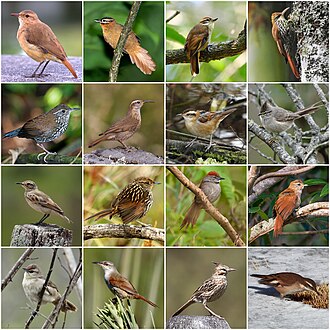
图:Hector Bottai · CC BY 4.0 · Wikimedia Commons
- 学名
- Furnariidae
- 分类等级
- 科
- 上级类群
- 雀形目
- 大类
- 鸟类
- 命名
- 乔治·罗伯特·格雷,1840 年
- 数据库
- NCBI 分类 · GBIF
下级类群(38)
- 掘穴雀属 Geositta 属
- 灶鸟属 Furnarius 属
- 抖尾地雀属 Cinclodes 属
- 卡纳灶鸟属 Asthenes 属
- 硬尾雀属 Sclerurus 属
- 棘雀属 Phacellodomus 属
- 典型针尾雀属 Cranioleuca 属
- Dendrocincla 属
- 纵纹䴕雀属 Xiphorhynchus 属
- 巨灶鸫属 Pseudoseisura 属
- 针尾雀属 Synallaxis 属
- 雷雀属 Aphrastura 属
- Xenops 属
- 软尾雀属 Thripophaga 属
- 鳞喉拾叶雀属 Anabacerthia 属
- Campylorhamphus 属
- Lepidocolaptes 属
- Xiphocolaptes 属
- Anabazenops 属
- 拾叶雀属 Philydor 属
- Certhiaxis 属
- Dendrocolaptes 属
- 爬地雀属 Upucerthia 属
- 山雀针尾雀属 Leptasthenura 属
- 爬树雀属 Margarornis 属
- Hylexetastes 属
- Pseudocolaptes 属
- 奥特拾叶雀属 Automolus 属
- Xenerpestes 属
- 树猎雀属 Thripadectes 属
- Premnoplex 属
- 合趾拾叶雀属 Syndactyla 属
- Dendroplex 属
- Hylocryptus 属
- 岩灶鸟属 Ochetorhynchus 属
- Deconychura 属
- Tarphonomus 属
- Clibanornis 属
百科正文
- 部分属:
- 矿雀属(Geositta)
- 爬地雀属(Upucerthia)
- 斑尾爬地雀属(Eremobius)
- 岩灶鸟属(Chilia)
- 抖尾地雀属(Cinclodes)
- 阿根廷线尾雀属(Sylviorthorhynchus)
- 灶鸟属(Furnarius)
- 雷雀属(Aphrastura)
- 弯嘴芦雀属(Limnornis)
- 乔托南美针尾雀属(Schoeniophylax)
- 尖尾溪䴓属(Lochmias)
- 拾叶雀属(Philydor)
- 卡乔雀属(Pseudoseisura)
- 尖嘴树猎雀属(Heliobletus)
- 树猎雀属(Thripadectes)
- 爬树雀属(Margarornis)
- 鹨丛跑雀属(Coryphistera)
- 棘雀属(Phacellodomus)
- 卡纳雀属(Asthenes)
- 集木雀属(Anumbius)
以上内容摘自维基百科「灶鸟科」,按 CC BY-SA 4.0 使用,去掉了参考文献、外部链接等尾部小节,公式改写成了纯文本。全文、配图和出处见原文。
英文维基百科补充中文条目比较短,下面是英文条目「Ovenbird (family)」的原文
Ovenbirds or furnariids are a large family of small suboscine passerine birds found from Mexico and Central to southern South America. They form the family Furnariidae. This is a large family containing around 321 species and 71 genera. The bird known as the ovenbird (Seiurus aurocapilla), which breeds in North America, is not a furnariid – rather it is a distantly related bird of the wood warbler family, Parulidae.
The ovenbirds are a diverse group of insectivores which get their name from the elaborate, vaguely "oven-like" clay nests built by the horneros, although most other ovenbirds build stick nests or nest in tunnels or clefts in rock. The Spanish word for "oven" (horno) gives the horneros their name. Furnariid nests are always constructed with a cover, and up to six pale blue, greenish or white eggs are laid. The eggs hatch after 15 to 22 days, and the young fledge after a further 13 to 20 days.
They are small to medium-sized birds, ranging from 9 to 35 cm in length. While individual species often are habitat specialists, species of this family can be found in virtually any Neotropical habitat, ranging from city parks inhabited by rufous horneros, to tropical Amazonian lowlands by many species of foliage-gleaners, to temperate barren Andean highlands inhabited by several species of miners. Two species, the seaside and the surf cinclodes, are associated with rocky coasts.
Taxonomy and systematics
The woodcreepers (formerly Dendrocolaptidae) were merged into this family, following analysis of sequences. While confirming the overall phylogenetic pattern, other scientists instead opted for maintaining the woodcreepers as a separate family, while splitting the ovenbirds (as traditionally defined) into two families, Furnariidae and Scleruridae.
The cladogram below showing the subfamilies of the ovenbirds is based on a molecular genetic studies that revealed that Sclerurinae was the first group to diverge The species numbers are from the list maintained by the International Ornithologists' Union (IOC).
The phylogeny of the Furnariidae is now well understood thanks to multiple analyses of nuclear and mitochondrial DNA. Among other discoveries, the classification of several genera had to be revised. The taxonomic arrangement presented below is based on molecular genetic studies of ovenbird relationships. However, because ovenbirds and woodcreepers are treated here as a single family some taxonomic ranks were modified. For more detail see "List of ovenbird species".
- Subfamily: Sclerurinae – miners and leaftossers
- Genus Geositta – miners (11 species)
- Genus Sclerurus – leaftossers (7 species)
- Subfamily: Dendrocolaptinae – woodcreepers
- Tribe: Sittasomini – "intermediate" woodcreepers
- Genus Dendrocincla – woodcreepers (6 species)
- Genus Deconychura – long-tailed woodcreepers (3 species)
- Genus Sittasomus – olivaceous woodcreeper
Genus Certhiasomus – spot-throated woodcreeper (genus introduced in 2010 for Deconychura stictolaema)
- Tribe: Dendrocolaptini – "strong-billed" woodcreepers
- Genus Glyphorynchus – wedge-billed woodcreeper
- Genus Nasica – long-billed woodcreeper
- Genus Dendrexetastes – cinnamon-throated woodcreeper
- Genus Dendrocolaptes – woodcreepers (5 species)
- Genus Hylexetastes – woodcreepers (3 species)
- Genus Xiphocolaptes – woodcreepers (4 species)
- Genus Dendroplex – straight-billed woodcreepers (2 species, formerly in Xiphorhynchus)
- Genus Xiphorhynchus – woodcreepers (13 species)
- Genus Lepidocolaptes – narrow-billed woodcreepers (11 species)
- Genus Drymornis – scimitar-billed woodcreeper
- Genus Drymotoxeres – greater scythebill
- Genus Campylorhamphus – scythebills (6 species)
- Subfamily: Furnariinae – Neotropical ovenbirds and allies
- Genus: Xenops – xenops (5 species)
Fossil record
Furnariids boast a notable fossil record for a passerine family. Numerous fossils comprising multiple skeletal elements, including cranial remains, have facilitated the identification and description of five distinct fossil species. Among these, two have been classified within the extant genera Cinclodes and Pseudoseisura, while the remaining three belong into the extinct genus Pseudoseisuropsis. All fossil are of Pleistocene age.
†Pseudoseisuropsis nehuen Noriega 1991, early Pleistocene of Argentina.
†Pseudoseisuropsis cuelloi Claramunt & Rinderknecht 2005, late Pleistocene of Uruguay.
†Pseudoseisuropsis wintu Stefanini et al. 2016, Early Pleistocene of Argentina.
†Cinclodes major Toni 1977, Pleistocene of Argentina.
†Pseudoseisura cursor Toni & Noriega, 2001, Pleistocene of Argentina.
以上节选摘自英文维基百科「Ovenbird (family)」,按 CC BY-SA 4.0 使用,去掉了参考文献、外部链接等尾部小节,公式改写成了纯文本。篇幅所限,较长的小节只摘了开头一部分,有的小节没有收;全文、配图和出处见原文。