格物
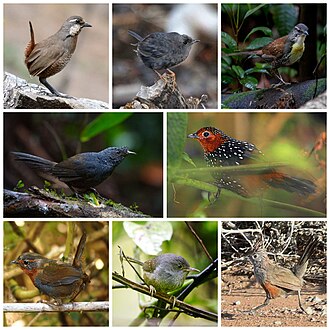
图:Hector Bottai · CC BY 4.0 · Wikimedia Commons
- 学名
- Rhinocryptidae
- 分类等级
- 科
- 上级类群
- 雀形目
- 大类
- 鸟类
- 命名
- Alexander Wetmore,1930 年
- 数据库
- NCBI 分类 · GBIF
下级类群(5)
- 塞特窜鸟属 Scytalopus 属
- Merulaxis 属
- Pteroptochos 属
- Scelorchilus 属
- Eleoscytalopus 属
百科正文
本科的鸟主要以节肢动物为食,尤其是昆虫和蜘蛛,但也吃水果和种子。鸟类学家对于它们的繁殖生态学知之甚少,推测它们是单配偶制的,部分物种的雄鸟参与育雏。它们极少飞行,主要在植物之间极速奔跑,因此难以发现。Scytalopus的最小型的几个物种被推测可能不具有飞行能力,但不能确证。
下属分类
- 本科包括以下属:
- 眼斑窜鸟属 Acropternis Cabanis & Heine, 1859
- Aulobia
Eleoscytalopus G.N.Mauricio, Mata, Bornschein, C.D.Cadena, H.Alvarenga & Bonatto, 2008
- 赭胁窜鸟属 Eugralla Lesson, 1842
- Leptorhynchus Ménétriés, 1835
- 锈纹窜鸟属 Liosceles P.L.Sclater, 1865
- Merulaxis Lesson, 1831
- 灰窜鸟属 Myornis Chapman, 1915
- Psiloramphus Gray, 1855
- 斑竹鹩属 Psilorhamphus P.L.Sclater, 1855
- Pteroptochos Kittlitz, 1830
- 冠窜鸟属 Rhinocrypta G.R.Gray, 1841
- Scelorchilus Oberholser, 1923
- 塞特窜鸟属 Scytalopus Gould, 1837
沙色窜鸟属 Teledromas Wetmore & J.L.Peters, 1922
以上内容摘自维基百科「窜鸟科」,按 CC BY-SA 4.0 使用,去掉了参考文献、外部链接等尾部小节,公式改写成了纯文本。全文、配图和出处见原文。
英文维基百科补充中文条目比较短,下面是英文条目「Tapaculo」的原文
The tapaculos or tapacolos are a family, Rhinocryptidae, of small suboscine passerine birds, found mainly in South America and with the highest diversity in the Andean regions. Three species (Chocó, Tacarcuna, and the silvery-fronted) are found in southern Central America.
Description
Tapaculos are small to medium-sized birds, with a total length ranging from 10–24 cm (4–9½ in). These are terrestrial species that fly only poorly on their short wings. They have strong legs, well-suited to their habitat of grassland or forest undergrowth. The tail is cocked and pointed towards the head, and the name tapaculo probably derives from Spanish for loincloth. Another possible explanation is that it originates from the Chilean name for the white-throated tapaculo, simply tapaculo, which is an onomatopoeic reference to its commonly heard song.
While the majority of the family are small blackish or brown birds there are some larger and more colourful species. All tapaculos are skulking birds that frequently stay low in dense vegetation, even the larger, colorful species, and this renders them difficult to see. They are best located and – in the case of Scytalopus spp. – identified by their vocalisations.
They feed on insects, seeds and other soft plant material with their pointed bills, and will scratch on the ground like a pheasant.
Most species lay two or three white eggs in a covered location, whether it be a burrow, a hole in a tree, or a domed nest.
Status and conservation
Some species have highly localized distributions and, being poor fliers, they easily become isolated in small populations. BirdLife International currently (2007) consider one species vulnerable (Scytalopus panamensis), three species endangered (S. iraiensis, S. rodriguezi and S. robbinsi), and two species critically endangered (Eleoscytalopus psychopompus and Merulaxis stresemanni). The two critically endangered species are restricted to Atlantic forest of eastern Brazil, and were only recently rediscovered after several years without any records.
Taxonomy
The tapaculos were traditionally placed in a distinct family Rhinocryptidae; more recent research indicates that according to analysis of mt and nDNA sequence data, the tapaculos might be better merged into the Formicariidae as tribe Rhinocryptini, as they are closer to the antthrushes than either is to the true antpittas.
An alternative family name Pteroptochidae, has been used historically.
The phylogenetic tree shown below is based on a large-scale genetic study of the suboscines by Michael Harvey and collaborators that was published in 2020. The species numbers are from the list maintained by the International Ornithologists' Union (IOC).
The species-limits within the genus Scytalopus have historically been difficult to determine. The birds are highly cryptic, and identification using visual features often is impossible. Vocal and biochemical data is typically needed to clarify the taxonomic status of the various populations. Several new species have been described in recent years (e.g. S. whitneyi and S. frankeae from Peru). The Brazilian taxa are similarly complex with several recently described species and considerable confusion surrounding the use of the scientific name Scytalopus speluncae.
Additionally, still undescribed species are known to exist, while some species as currently defined actually may include several species (e.g. the southern population of the large-footed tapaculo may represent a yet undescribed species). The confusing situation is perhaps best illustrated by the fact that only ten species were recognized in this genus in 1970, while the figure now is more than four times as high.
以上内容摘自英文维基百科「Tapaculo」,按 CC BY-SA 4.0 使用,去掉了参考文献、外部链接等尾部小节,公式改写成了纯文本。全文、配图和出处见原文。