格物
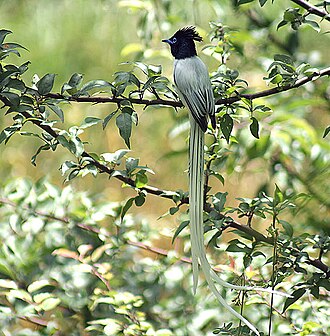
图:J.M.Garg · CC BY-SA 3.0 · Wikimedia Commons
生命之树 › 真核生物 › 动物界 › 真后生动物亚界 › 两侧对称动物 › 后口动物总门 › 脊索动物门 › 脊椎动物亚门 › 有颌下门 › 肉鳍鱼总纲 › 四足形类 › 希望螈目 › 四足总纲 › 爬行动物 › 坚尾龙类 › 鸟纲 › 今鸟亚纲 › 今颚下纲 › 新鸟总目 › 雀形目
王鹟科科
Monarchidae
王鹟科 是雀形目的一个科,包含106个物种,分类为以下15属:
王鹟属 Hypothymis
非洲凤头鹟属 Trochocercus
寿带属 Terpsiphone
蚋鹟属 Chasiempis
果鹟属 Pomarea
Mayrornis
棕腹鹟属 Neolalage
鵙嘴鹟属 Clytorhynchus
特鲁克鹟属 Metabolus
黑王鹟属 Symposiachrus
Monarcha
Carterornis
皱鹟属 Arses
鹊鹩属 Grallina
阔嘴鹟属 Myiagra
摘自维基百科「王鹟科」,CC BY-SA 4.0
- 学名
- Monarchidae
- 分类等级
- 科
- 上级类群
- 雀形目
- 大类
- 鸟类
- 命名
- 夏尔·吕西安·波拿巴,1854 年
- 数据库
- NCBI 分类 · GBIF
下级类群(14)
- 寿带属 Terpsiphone 属
- Grallina 属
- 阔嘴鹟属 Myiagra 属
- 果鹟属 Pomarea 属
- Clytorhynchus 属
- Arses 属
- 王鹟属 Hypothymis 属
- 灰鹟属 Mayrornis 属
- 非洲凤头鹟属 Trochocercus 属
- Monarcha 属
- 金王鹟属 Carterornis 属
- Symposiachrus 属
- Chasiempis 属
- 丝尾鹟属 Lamprolia 属
百科正文
- 王鹟属 Hypothymis
- 非洲凤头鹟属 Trochocercus
- 寿带属 Terpsiphone
- 蚋鹟属 Chasiempis
- 果鹟属 Pomarea
- Mayrornis
- 棕腹鹟属 Neolalage
- 鵙嘴鹟属 Clytorhynchus
- 特鲁克鹟属 Metabolus
- 黑王鹟属 Symposiachrus
- Monarcha
- Carterornis
- 皱鹟属 Arses
- 鹊鹩属 Grallina
- 阔嘴鹟属 Myiagra
以上内容摘自维基百科「王鹟科」,按 CC BY-SA 4.0 使用,去掉了参考文献、外部链接等尾部小节,公式改写成了纯文本。全文、配图和出处见原文。
英文维基百科补充中文条目比较短,下面是英文条目「Monarch flycatcher」的原文
The monarchs or monarch flycatchers (family Monarchidae) comprise a family of over 100 passerine birds which includes shrikebills, paradise flycatchers, and magpie-larks.
Monarchids are small insectivorous songbirds with long tails. They inhabit forest or woodland across sub-Saharan Africa, south-east Asia, Australasia, and a number of Pacific islands. Only a few species migrate. Many species decorate their cup-shaped nests with lichen.
Taxonomy
Some of the one hundred or more species making up the family were previously assigned to other groups, largely on the basis of general morphology or behaviour. The magpie-lark, for example, was assigned to the same family as the white-winged chough, since both build unusual nests from mud rather than vegetable matter. That family, Grallinidae, is now considered a synonym of Monarchidae. It was formerly considered to have four species. The magpie-lark and the torrent-lark were moved into Monarchidae, into the genus Grallina, on the basis of molecular evidence. The white-winged chough and the apostlebird were assigned to the family Corcoracidae.
With the new insights generated by the DNA–DNA hybridisation studies of Sibley and his co-workers toward the end of the 20th century, however, it became clear that these apparently unrelated birds were all descended from a common ancestor: the same crow-like ancestor that gave rise to the drongos. On that basis they were previously included as a subfamily of the Dicruridae, along with the fantails, although it is now treated at familial rank as Monarchidae.
Description
The monarchs are a diverse family of passerine birds that are generally arboreal (with the exception of the magpie-larks). They are mostly slim birds and possess broad bills. The bills of some species are quite large and the heavy-set bills of the shrikebills are used to probe dead wood and leaves. The plumage of the family ranges from sombre, such as the almost monochrome black monarch, to spectacular, as displayed by the golden monarch. The tails are generally long and spectacularly so in the paradise flycatchers in the genus Terpsiphone. Sexual dimorphism in plumage can be subtle, as in the paperbark flycatcher, where the female is identical to the male except for a slight buff on the throat; strikingly, in the Chuuk monarch, where the male is almost entirely white and the female entirely black; or non-existent, as in the Tahiti monarch. In some species, for example, the Malagasy paradise flycatcher, the males have two or more colour morphs.
Distribution and habitat
The monarchs have a mostly Old World distribution. In the western end of their range, they are distributed through sub-Saharan Africa, Madagascar, and the islands of the tropical Indian Ocean. They also occur in South and Southeastern Asia, north to Japan, down to New Guinea, and most of Australia. The family has managed to reach many Pacific islands, and several endemic genera occur across Micronesia, Melanesia, and Polynesia as far as Hawaii and the Marquesas.
The paradise flycatchers of the genus Terpsiphone have the widest distribution of any of the monarchs, ranging across almost all of sub-Saharan Africa, Madagascar, the Mascarenes and Seychelles, southern and eastern Asia as far as Korea, Afghanistan, the Philippines, and the Lesser Sundas. The other paradise flycatcher genus, Trochocercus, is restricted to Africa. The other exclusively Asian genus is the Hypothymis monarchs. The remaining genera are predominantly found in the Austro-Papuan and Oceania regions.
Breeding
The monarchs are generally monogamous, with the pair bonds ranging from just a single season (as in the African paradise flycatcher) to life (the Elepaio). Only three species are known to engage in cooperative breeding, but many species are as yet unstudied. They are generally territorial, defending territories that are around 2 ha in size, but a few species may cluster their nesting sites closely together. Nesting sites may also be chosen close to aggressive species. For example, leaden flycatchers' nests may be located near the nests of the aggressive noisy friarbird. The nests are in turn often aggressively defended by monarch species. In all species, the nest is an open cup on a branch, fork, or twig. In some species, the nests can be highly conspicuous.
以上节选摘自英文维基百科「Monarch flycatcher」,按 CC BY-SA 4.0 使用,去掉了参考文献、外部链接等尾部小节,公式改写成了纯文本。篇幅所限,较长的小节只摘了开头一部分,有的小节没有收;全文、配图和出处见原文。